




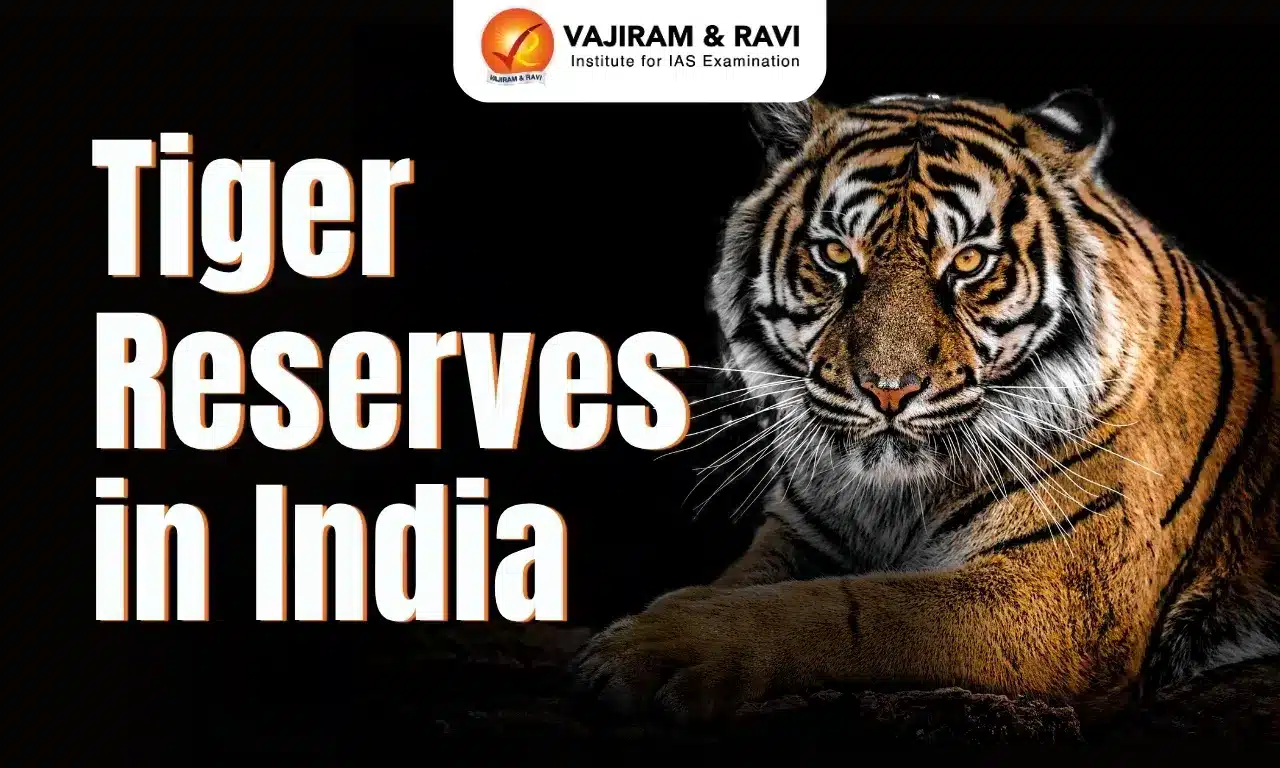
Tiger Reserves in India are protected areas created under Project Tiger in 1973 to conserve the Bengal tiger and its habitat. India hosts about 70% of the world’s tiger population and recorded 3,682 tigers in the 2022 census. Managed by the National Tiger Conservation Authority (NTCA), these reserves support wildlife conservation, biodiversity protection, and ecological balance across the country. The Bengal Tiger was officially declared the National Animal of India in 1972 and adopted in 1973 as part of the Project Tiger initiative. Before this the Lion held the status of National Animal of India. The decision was made as Bengal Tiger was listed as Endangered in the IUCN Red Data Book.
What are Tiger Reserves in India?
India is home to 70% of the world's tiger population. According to the Tiger Census Report 2022, conducted every 4 years, the tiger population in India increased from 2,967 in 2018 to 3,682 in 2022. In 2022, Madhya Pradesh had the highest number of tigers (785), followed by Karnataka (563), Uttarakhand (560), and Maharashtra (444). Among the Tiger Reserves in India, Corbett National Park (Uttarakhand) had the highest tiger population (260), followed by Bandipur (150) and Nagarhole (141) in Karnataka. Currently, India has 58 tiger reserves, governed under Project Tiger and administered by the National Tiger Conservation Authority (NTCA).
Also Read:- Buxa Tiger Reserve
List of Tiger Reserves in India 2026
India is home to 58 Tiger Reserves, established under Project Tiger. The latest addition is Madhav National Park in Madhya Pradesh, which was added in 2025. Here is the List of Tiger Reserves in India.
| Tiger Reserves in India List 2026 | ||||
| Sl No | Tiger Reserve (TR) | State | TR Notification Year | Total Area (sq km) |
|---|---|---|---|---|
| 1 | Bandipur | Karnataka | 2007 | 1456.3 |
| 2 | Corbett | Uttarakhand | 2010 | 1288.31 |
| - | Amanagarh buffer | Uttar Pradesh | 2012 | 80.60 |
| 3 | Kanha | Madhya Pradesh | 2007 | 2051.79 |
| 4 | Manas | Assam | 2008 | 2837.10 |
| 5 | Melghat | Maharashtra | 2007 | 2768.52 |
| 6 | Palamau | Jharkhand | 2012 | 1129.93 |
| 7 | Ranthambore | Rajasthan | 2007 | 1411.29 |
| 8 | Simlipal | Odisha | 2007 | 2750.00 |
| 9 | Sunderban | West Bengal | 2007 | 2584.89 |
| 10 | Periyar | Kerala | 2007 | 925.00 |
| 11 | Sariska | Rajasthan | 2007 | 1213.34 |
| 12 | Buxa | West Bengal | 2009 | 757.90 |
| 13 | Indravati | Chhattisgarh | 2009 | 2799.07 |
| 14 | Namdapha | Arunachal Pradesh | 1987 | 2052.82 |
| 15 | Nagarjunsagar-Srisailam | Andhra Pradesh | 2007 | 3296.31 |
| 16 | Dudhwa | Uttar Pradesh | 2010 | 2201.77 |
| 17 | Kalakad Mundanthurai | Tamil Nadu | 2007 | 1601.54 |
| 18 | Valmiki | Bihar | 2012 | 899.38 |
| 19 | Pench | Madhya Pradesh | 2007 | 1179.63 |
| 20 | Tadobha Andhari | Maharashtra | 2007 | 1727.59 |
| 21 | Bandhavgarh | Madhya Pradesh | 2007 | 1536.93 |
| 22 | Panna | Madhya Pradesh | 2007 | 1598.10 |
| 23 | Dampa | Mizoram | 2007 | 988.00 |
| 24 | Bhadra | Karnataka | 2007 | 1064.29 |
| 25 | Pench – MH | Maharashtra | 2007 | 741.22 |
| 26 | Pakke | Arunachal Pradesh | 2012 | 1198.45 |
| 27 | Nameri | Assam | 2000 | 464.00 |
| 28 | Satpura | Madhya Pradesh | 2007 | 2133.31 |
| 29 | Anamalai | Tamil Nadu | 2007 | 1479.87 |
| 30 | Udanti Sitanadi | Chhattisgarh | 2009 | 1842.54 |
| 31 | Satkoshia | Odisha | 2007 | 963.87 |
| 32 | Kaziranga | Assam | 2007 | 1173.58 |
| 33 | Achanakmar | Chhattisgarh | 2009 | 914.02 |
| 34 | Kali | Karnataka | 2007 | 1097.51 |
| 35 | Sanjay Dhubri | Madhya Pradesh | 2011 | 1674.50 |
| 36 | Mudumalai | Tamil Nadu | 2007 | 688.59 |
| 37 | Nagarhole | Karnataka | 2007 | 1205.76 |
| 38 | Parambikulam | Kerala | 2009 | 643.66 |
| 39 | Sahyadri | Maharashtra | 2012 | 1165.57 |
| 40 | Biligiri Ranganatha Temple | Karnataka | 2007 | 574.82 |
| 41 | Kawal | Telangana | 2012 | 2015.44 |
| 42 | Sathyamangalam | Tamil Nadu | 2013 | 1408.40 |
| 43 | Mukundara | Rajasthan | 2013 | 759.99 |
| 44 | Nawegaon Nagzira | Maharashtra | 2013 | 1894.94 |
| 45 | Amrabad | Telangana | 2015 | 2611.39 |
| 46 | Pilibhit | Uttar Pradesh | 2014 | 730.25 |
| 47 | Bor | Maharashtra | 2014 | 816.27 |
| 48 | Rajaji | Uttarakhand | 2015 | 1075.17 |
| 49 | Orang | Assam | 2016 | 492.46 |
| 50 | Kamlang | Arunachal Pradesh | 2017 | 783.00 |
| 51 | Srivilliputhur Megamalai | Tamil Nadu | 2021 | 1016.57 |
| 52 | Ramgarh Vishdhari | Rajasthan | 2022 | 1501.89 |
| 53 | Ranipur | Uttar Pradesh | 2022 | 529.36 |
| 54 | Veerangana Durgavati | Madhya Pradesh | 2023 | 2339.12 |
| 55 | Dholpur – Karauli | Rajasthan | 2023 | 1,057.88 |
| 56 | Guru Ghasidas – Tamor Pingla | Chhattisgarh | 2024 | 2829.39 |
| 57 | Ratapani | Madhya Pradesh | 2024 | 1271.47 |
| 58 | Madhav | Madhya Pradesh | 2025 | 1651.39 |
| Total | – | – | – | 84487.83 |


Tiger Reserves in India State Wise List
India is home to 58 Tiger Reserves spread across 18 states, dedicated to protect the endangered Bengal tiger and its natural habitat. These reserves operate under Project Tiger, launched in 1973 to ensure the recovery of tiger populations and the preservation of their ecosystems.
| State Wise List of Tiger Reserves in India | ||
|---|---|---|
| State | Number of Tiger Reserves | Tiger Reserves (TR) |
| Andhra Pradesh | 1 | Nagarjunsagar-Srisailam |
| Arunachal Pradesh | 3 | Namdapha, Pakke, Kamlang |
| Assam | 4 | Manas, Nameri, Kaziranga, Orang |
| Bihar | 1 | Valmiki |
| Chhattisgarh | 4 | Indravati, Udanti Sitanadi, Achanakmar, Guru Ghasidas – Tamor Pingla |
| Jharkhand | 1 | Palamau |
| Karnataka | 5 | Bandipur, Bhadra, Kali, Nagarhole, Biligiri Ranganatha Temple |
| Kerala | 2 | Periyar, Parambikulam |
| Madhya Pradesh | 9 | Kanha, Pench, Bandhavgarh, Panna, Satpura, Sanjay Dhubri, Veerangana Durgavati, Ratapani, Madhav |
| Maharashtra | 6 | Melghat, Tadobha Andhari, Pench – MH, Sahyadri, Nawegaon Nagzira, Bor |
| Rajasthan | 5 | Ranthambore, Sariska, Mukundara, Ramgarh Vishdhari, Dholpur – Karauli |
| Tamil Nadu | 5 | Kalakad Mundanthurai, Anamalai, Mudumalai, Sathyamangalam, Srivilliputhur Megamalai |
| Telangana | 2 | Kawal, Amrabad |
| Uttar Pradesh | 3 | Dudhwa, Amanagarh buffer (not counted as tiger reserve separately), Pilibhit, Ranipur |
| Uttarakhand | 2 | Corbett, Rajaji |
| West Bengal | 2 | Sunderban, Buxa |
| Mizoram | 1 | Dampa |
| Odisha | 2 | Simlipal, Satkoshia |
Top 10 Largest Tiger Reserves in India 2026
According to the National Tiger Conservation Authority (NTCA), the following are the Top 10 Largest Tiger Reserves in India 2026, ranked by area.
1. Nagarjunsagar-Srisailam Tiger Reserve (3,296.31 sq. km)
- Location: Located in the Nallamala Hill Ranges, an extension of the Eastern Ghats, in Andhra Pradesh.
- Constituents: Comprises Rajiv Gandhi Wildlife Sanctuary and Gundla Brahmeswaram Wildlife Sanctuary (GBM).
- River System: The Krishna River is its major water source, along with tributaries such as Dindi and Peddavagu.
- Vegetation: Predominantly consists of tropical dry deciduous forests with bamboo and grass undergrowth.
- Biodiversity: Supports endemic plants such as Andrographis nallamalayana and wildlife including tigers, leopards, wolves, wild dogs, sambar and chital.
Also Read:- Nagarjunsagar-Srisailam Tiger Reserve
2. Manas Tiger Reserve (2,837.10 sq. km)
- Location: Situated in Assam.
- International Boundaries: The River Manas and its tributaries, Beki and Hakua, separate it from Royal Manas National Park in Bhutan.
- Western Boundary: The River Sankosh separates it from Buxa Tiger Reserve in West Bengal.
- Conservation Status: Recognised as a Natural World Heritage Site, Elephant Reserve, Biosphere Reserve and Important Bird Area.
- Vegetation: Includes scrub, semi-evergreen and mixed deciduous forests, grasslands and riparian vegetation.
- Biodiversity: Provides habitat for tigers, greater one-horned rhinoceroses, swamp deer, pygmy hogs and Bengal floricans. Sal, alluvial savannah woodlands and Khair-Sisoo forests are important vegetation types.
Also Read:- Manas Tiger Reserv
3. Guru Ghasidas-Tamor Pingla Tiger Reserve (2,829.387 sq. km)
- Location: Situated in Chhattisgarh, across the Chota Nagpur and Baghelkhand plateaus.
- Establishment: Notified as India's 56th tiger reserve in 2024.
- Core and Buffer Areas: Comprises a core area of 2,049.2 sq. km and a buffer area of 780.15 sq. km.
- Constituents: The core area includes Guru Ghasidas National Park and Tamor Pingla Wildlife Sanctuary.
- Biodiversity: The Zoological Survey of India has documented 753 species, including 365 invertebrates and 388 vertebrates.
- Landscape Connectivity: Maintains ecological connectivity with Sanjay Dubri and Bandhavgarh Tiger Reserves in Madhya Pradesh and Palamau Tiger Reserve in Jharkhand.
4. Indravati Tiger Reserve (2,799.07 sq. km)
- Location: Situated in Chhattisgarh.
- Constituents: The Indravati landscape includes the tiger reserve and Bhairamgarh and Pamed Wildlife Sanctuaries.
- Connectivity: Connected with Kawal Tiger Reserve in Telangana, Tadoba in Maharashtra and Kanha in Madhya Pradesh.
- River System: The Indravati River forms its northern and western boundaries and also marks the interstate boundary between Chhattisgarh and Maharashtra.
- Vegetation: Contains Southern Moist Mixed Deciduous Forests with and without teak and Southern Dry Mixed Deciduous Forests.
- Biodiversity: Protects one of the last populations of rare wild buffalo, the state animal of Chhattisgarh. Other species include tigers, leopards, gaur, nilgai, blackbuck and sloth bears.
Also Read:- Indravati Tiger Reserve
5. Melghat Tiger Reserve (2,768.52 sq. km)
- Location: Situated in Maharashtra on Gavilgarh Hill, a southern extension of the Satpura Hill Range.
- Historical Significance: It was the first tiger reserve established in Maharashtra.
- Vegetation: Mainly consists of tropical dry deciduous forests dominated by teak.
- River System: Acts as a catchment area for five rivers: Khandu, Khapra, Sipna, Gadga and Dolar, which are tributaries of the Tapti River.
- Biodiversity: Supports teak, bamboo and other vegetation, along with sloth bears, Indian gaur, sambar, leopards and dholes. It is also a stronghold of the critically endangered forest owlet.
Also Read:- Melghat Tiger Reserve
6. Simlipal Tiger Reserve (2,750.00 sq. km)
- Location: Situated in Mayurbhanj district of Odisha.
- Vegetation: Predominantly consists of moist mixed deciduous forests, tropical semi-evergreen forests, dry deciduous patches and grasslands. Sal is the dominant tree species.
- Biodiversity: Houses 7% of India's flowering plants and 8% of its orchids. Important fauna includes tigers, elephants, leopards, sambar and hill mynahs.
Also Read:- Simlipal Tiger Reserve
7. Amrabad Tiger Reserve (2,611.39 sq. km)
- Location: Located in the Nallamala Hills of the Eastern Ghats in Telangana.
- Historical Background: Originally formed part of the larger Nagarjunsagar-Srisailam Tiger Reserve before the bifurcation of Andhra Pradesh and Telangana in 2014.
- River System: The Krishna River and its perennial streams contribute to the water supply of major reservoirs, including Srisailam and Nagarjunasagar.
- Tribal Community: The Chenchu tribe is one of the major tribal communities residing in the reserve.
- Biodiversity: Dry deciduous forests contain sal, teak, bamboo and acacia. Wildlife includes leopards, wild cats, sambar, chital, nilgai, wild boar and Indian bison. Over 303 bird species have been identified.
Also Read:- Amrabad Tiger Reserve
8. Sundarbans Tiger Reserve (2,584.89 sq. km)
- Location: Situated in West Bengal and forms part of the world's largest mangrove ecosystem.
- Establishment: Declared a tiger reserve in 1973 under the first phase of Project Tiger.
- Conservation Status: Became a Biosphere Reserve in 1989, received UNESCO recognition in 2001 and was declared a Ramsar Wetland Site in 2019.
- Vegetation: Dominated by mangroves, particularly Sundari (Heritiera fomes), Gewa (Excoecaria agallocha) and Golpata (Nypa fruticans), adapted to saline and tidal conditions.
- Biodiversity: Provides habitat for Royal Bengal Tigers, estuarine crocodiles, fishing cats, water monitor lizards, olive ridley turtles and several bird species.
- Unique Features: It is the world's only mangrove habitat for tigers and shares its transboundary ecosystem with Bangladesh. Its mangroves also provide natural protection against cyclones along coastal West Bengal.
9. Veerangana Durgavati Tiger Reserve (2,339.12 sq. km)
- Location: Spread across Sagar, Damoh and Narsinghpur districts of Madhya Pradesh.
- Constituents: Encompasses areas within Nauradehi Wildlife Sanctuary and Durgavati Wildlife Sanctuary.
- Name: Named after Rani Durgavati, the queen of the Gondi people.
- River System: Covers parts of the Narmada and Yamuna river basins. Major rivers include Kopra, Bamner and Bearma, which are tributaries of the Ken River.
- Biodiversity: Mainly comprises dry deciduous forests with teak, saja, dhaora, ber and amla. Wildlife includes tigers, leopards, wolves, nilgai, chinkara and sambar. It also protects habitats of critically endangered white-rumped and Indian vultures.
Also Read:- Veerangana Durgavati Tiger Reserve
10. Dudhwa Tiger Reserve (2,201.77 sq. km)
- Location: Situated along the Indo-Nepal border in Lakhimpur-Kheri district of Uttar Pradesh.
- Constituents: Includes Dudhwa National Park and two nearby wildlife sanctuaries, Kishanpur and Katerniaghat.
- River System: The Sharda, Geruwa, Suheli and Mohana rivers and streams form its important water systems and are tributaries of the Ghaghara River.
- Vegetation: Characterised by North Indian moist deciduous forests, including some of India's finest Sal forests.
- Biodiversity: Supports tigers, leopards, swamp deer, rhinoceroses, chital, hog deer, sambar and wild boar. Around 400 bird species, including floricans and black-necked storks, are found here.
Also Read:- Dudhwa Tiger Reserve

 Last updated on Nov, 2026
→ UPSC 2027 Notification will be released on 13 January 2027 at upsconline.nic.in.
→ Check Nobel Prize 2026 Winners List here.
→ Check out the latest UPSC Syllabus here.
→ Download UPSC Calendar 2027 PDF Here.
Tiger Reserves in India FAQs
Q1. Which is India's 57th tiger reserve?+
Q2. What is the 54th tiger reserve of India?+
Q3. Which is the 53rd Tiger Reserve in India?+
Q4. Where are 52nd Tiger Reserve in India?+
Q5. Which is 55th tiger reserve in India?+
Q6. How many Tiger Reserves in India?+
Tags: 54th tiger reserve in india 58th tiger reserve in india how many tiger reserve in india how many tiger reserves are there in india how many tiger reserves in india largest tiger reserve in india latest tiger reserve in india new tiger reserve in india number of tiger reserves in india tiger population in india tiger reserve tiger reserve in india tiger reserves tiger reserves in india tiger reserves in india 2026 tiger reserves in india upsc total tiger reserve in india total tiger reserve in india 2026 total tiger reserves in india total tiger reserves in india 2026