



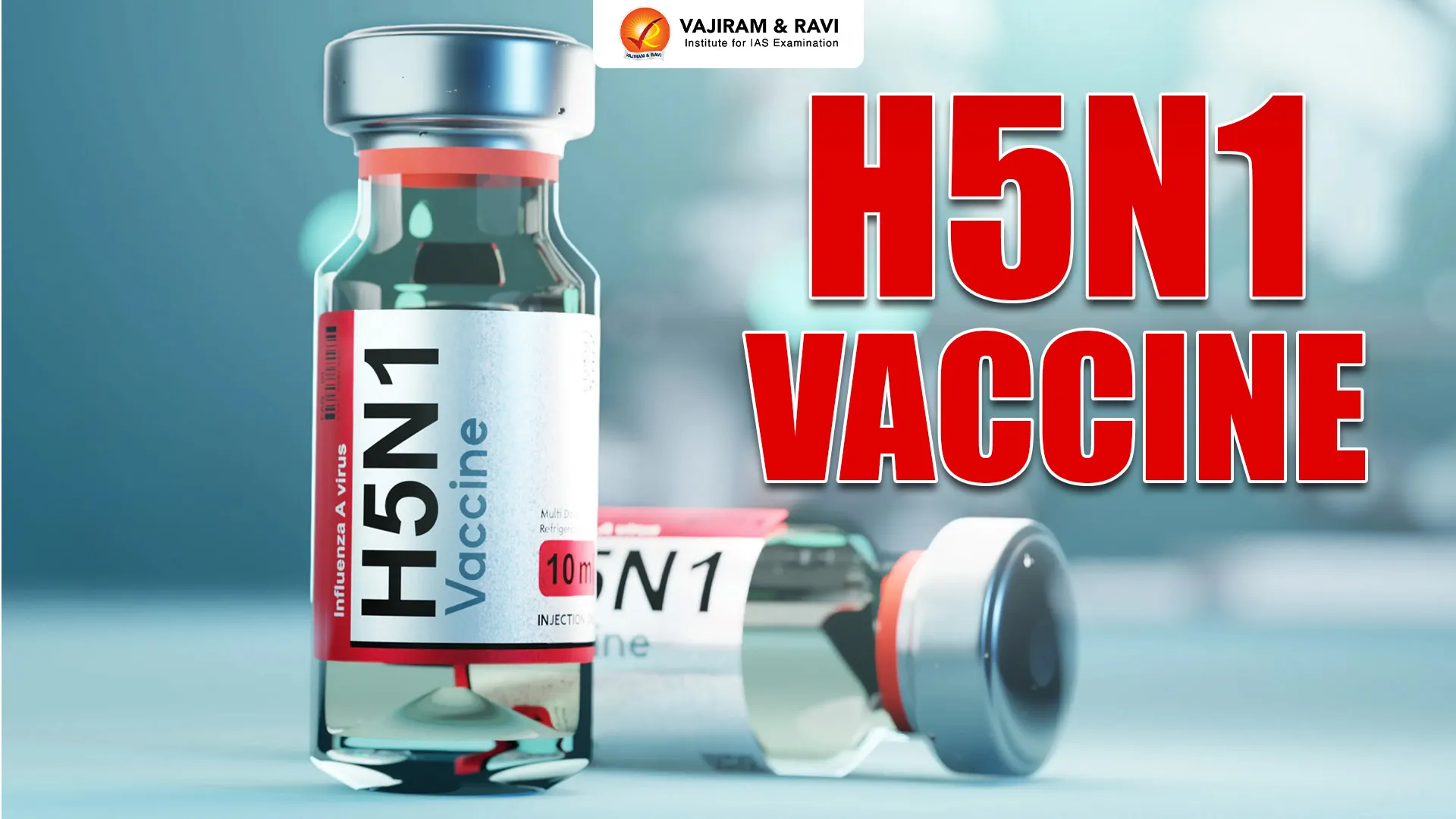
The H5N1 Vaccine is an important development in India's efforts to control Highly Pathogenic Avian Influenza (HPAI), commonly known as bird flu. India's first indigenous inactivated H5N1 (Clade 2.3.2.1a) vaccine for chickens has been developed by ICAR-National Institute of High Security Animal Diseases (ICAR-NIHSAD), Bhopal. The vaccine aims to protect poultry from serious infections, reduce economic losses for farmers and strengthen India's preparedness against bird flu outbreaks.
H5N1 Vaccine Latest News
The Government of India announced that Union Agriculture and Farmers Welfare Minister Shivraj Singh Chouhan would dedicate India's first indigenous H5N1 bird flu vaccine for chickens to the nation on November 20, 2026, at ICAR-NIHSAD in Bhopal, Madhya Pradesh.
- India's First Indigenous Vaccine: Developed specifically against the H5N1 Clade 2.3.2.1a virus, a strain associated with bird flu outbreaks in India.
- Developing Institution: Created by ICAR-National Institute of High Security Animal Diseases (ICAR-NIHSAD), Bhopal.
- Vaccine Type: An inactivated (killed-virus) vaccine designed to protect chickens against highly pathogenic avian influenza.
- Major Objective: Reduce bird mortality, mass culling, poultry farmers' financial losses and the spread of infection.
What is the H5N1 Vaccine & its Features
The H5N1 Vaccine is a veterinary vaccine designed to protect chickens against the H5N1 avian influenza virus, which causes a highly contagious and potentially fatal disease in poultry. The indigenous vaccine specifically targets Clade 2.3.2.1a, a genetic group of the H5N1 virus circulating in India.
About H5N1 Avian Influenza (Bird Flu)
- Disease: Highly Pathogenic Avian Influenza (HPAI) is a serious viral infection affecting chickens and other birds.
- High Mortality: Severe outbreaks can cause nearly 100% mortality in affected poultry flocks.
- First Detection in India: H5N1 bird flu was first reported in India in 2006.
- Outbreak History: India has recorded more than 500 combined outbreaks of H5N1 and H5N8 since 2006.
- Economic Impact: The 2006 bird flu outbreak caused estimated losses of ₹2,200-3,000 crore through poultry deaths, culling and trade restrictions.
- Public Health Concern: H5N1 is a zoonotic disease, meaning it can spread from infected animals to humans under certain circumstances.
Key Features of India's Indigenous H5N1 Vaccine
- Inactivated Vaccine: Uses chemically inactivated virus particles that cannot multiply or cause infection but can stimulate immunity in chickens.
- Targeted Protection: Developed specifically against H5N1 Clade 2.3.2.1a, addressing an important gap in poultry vaccination.
- Indigenous Development: Designed by Indian scientists at ICAR-NIHSAD, Bhopal, supporting domestic vaccine research and manufacturing capabilities.
- High-Security Research: Developed using specialised biosafety laboratories and veterinary research facilities.
- Poultry Protection: Intended to protect chickens from severe bird flu infections and reduce the need for large-scale culling.
- Preventive Disease Control: Can complement farm biosecurity, disease surveillance and veterinary monitoring to control outbreaks.


How Does the H5N1 Vaccine Work?
The H5N1 Vaccine works by preparing the chicken's immune system to recognise and respond to the H5N1 bird flu virus. Since it contains an inactivated virus, the vaccine is designed to produce immunity without causing the disease itself.
- Inactivated Virus: The vaccine contains killed H5N1 virus particles that cannot reproduce inside the chicken.
- Immune Recognition: After vaccination, the chicken's immune system identifies viral antigens as foreign substances.
- Antibody Production: The immune system produces protective antibodies against the H5N1 virus.
- Immune Memory: Vaccination helps the immune system respond more effectively if the chicken is later exposed to the virus.
- Disease Protection: The immune response is intended to reduce the risk of severe infection, mortality and disease spread.
- Additional Protection: Vaccination works alongside biosecurity measures, regular monitoring and early detection to strengthen poultry disease prevention.
Importance of H5N1 Vaccine
The development of India's first indigenous H5N1 Vaccine is a major step towards strengthening poultry health, disease prevention and farmers' economic security. It also supports efforts to reduce the risk of bird flu spreading from infected birds to other animals and humans.
- Protects Poultry Health: Helps prevent severe H5N1 infections, high mortality rates and mass culling among chickens, improving disease control.
- Reduces Economic Losses: Minimises financial losses, trade disruptions and livelihood risks for poultry farmers, particularly small-scale producers.
- Strengthens Disease Prevention: Supports preventive vaccination, disease surveillance and farm biosecurity, reducing the risk of transmission to animals and humans.
- Promotes Aatmanirbhar Bharat: Enhances India's self-reliance in veterinary biotechnology, indigenous vaccine development and animal disease management.
- Enhances Food Security and Pandemic Preparedness: Strengthens the poultry sector, food supply and agricultural economy while improving India's preparedness against emerging animal diseases and public health threats.
Challenges of H5N1 Vaccine Development
Despite its potential benefits, developing and introducing the H5N1 Vaccine in India involves several challenges, including virus mutations, safety testing, vaccine production and widespread immunisation.
- Virus Mutations and Surveillance: The H5N1 virus frequently evolves, requiring continuous monitoring of new variants and regular assessment of vaccine effectiveness.
- Complex Development and Safety: Developing vaccines against highly pathogenic viruses requires advanced biosafety laboratories, skilled researchers, rigorous testing and regulatory approval.
- Large-Scale Vaccination: Immunising chickens across commercial and backyard poultry farms presents major challenges in coverage and implementation.
- Production and Distribution: Ensuring sufficient vaccine manufacturing capacity, cold-chain facilities and veterinary infrastructure is essential for widespread vaccination.
- Farmer Awareness and Biosecurity: Farmers need proper training and awareness, along with strong farm hygiene, early detection, movement controls and disease surveillance to prevent outbreaks.

 Last updated on Nov, 2026
→ UPSC 2027 Notification will be released on 13 January 2027 at upsconline.nic.in.
→ Check Nobel Prize 2026 Winners List here.
→ Check out the latest UPSC Syllabus here.
→ Download UPSC Calendar 2027 PDF Here.
H5N1 Vaccine FAQs
Q1. What is the H5N1 Vaccine?+
Q2. Who developed India's first indigenous H5N1 Vaccine?+
Q3. When was India's first indigenous H5N1 Vaccine scheduled to be launched?+
Q4. How does the H5N1 Vaccine work?+
Q5. What are the key features of India's indigenous H5N1 Vaccine?+
Tags: H5N1 vaccine