



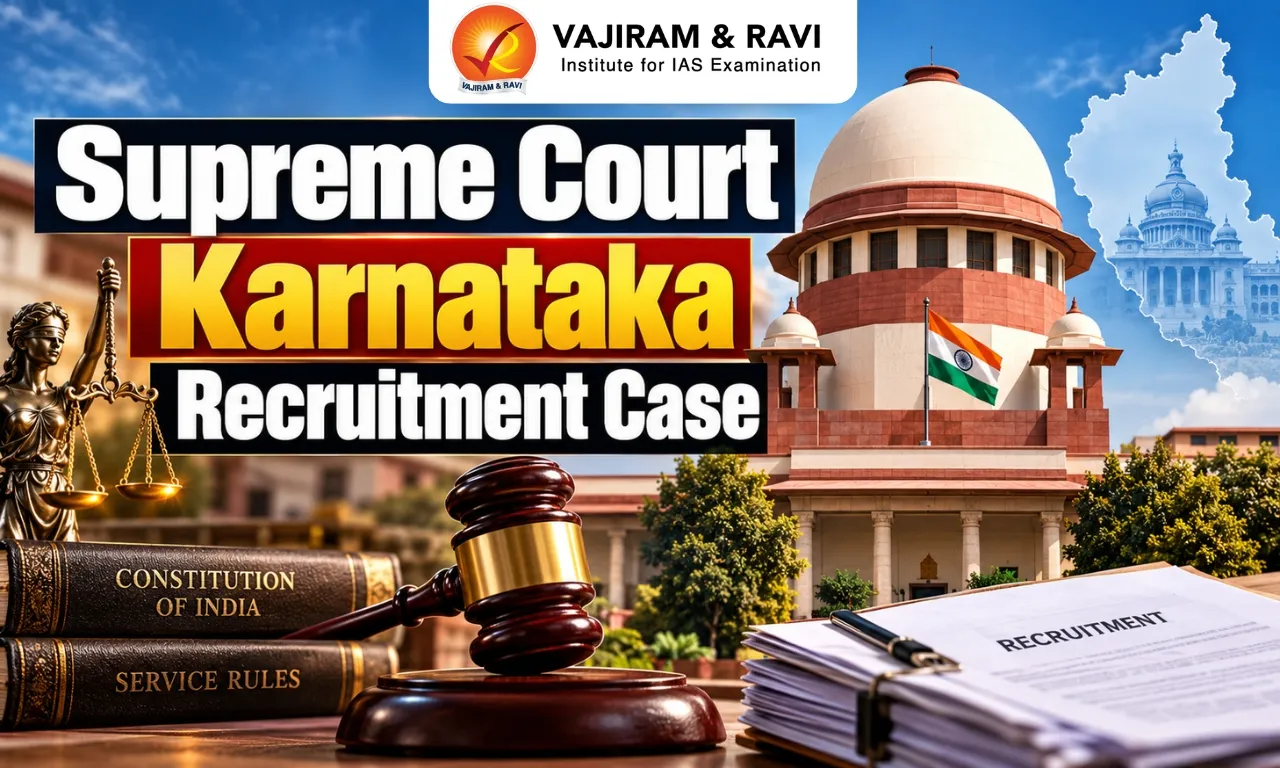
The Supreme Court Karnataka Recruitment Case is about the 2011 KPSC recruitment of 362 Gazetted Probationers, which was cancelled over corruption and nepotism. On 29 October 2026, the Supreme Court struck down Karnataka’s 2022 Validation Act, which tried to revive the selection and held that a legislature cannot overturn final court judgments. It also ordered fresh recruitment for the vacant posts.
What is the Supreme Court Karnataka Recruitment Case?
The Supreme Court Karnataka Recruitment Case 2026 refers to the judgment of 29 October 2026, in which the Supreme Court struck down a Karnataka law that tried to validate a corrupt recruitment process. The case, Srinivasa T. & Others v. State of Karnataka & Others (2026), concerned the 2011 selection of 362 Gazetted Probationers for Group A and B services through the Karnataka Public Service Commission (KPSC).
- Supreme Court Verdict: A Bench of Justice J.B. Pardiwala and Justice K. Vinod Chandran declared the Karnataka Civil Services (Validation of Selection and Appointment of 2011 Batch Gazetted Probationers) Act, 2022 unconstitutional. The Court held that a state legislature cannot use a new law to overturn court judgments that had upheld the cancellation.
- Origin of the Dispute: The 2011 KPSC exam faced serious allegations of corruption, favouritism, mark manipulation and interview irregularities.
- Cancellation of Recruitment: After a CID investigation, the government cancelled the recruitment in 2014. The High Court upheld this in 2018, and the Supreme Court declined to interfere.
- The 2022 Validation Act: The state passed this law to revive the cancelled selection and allow appointments from the old list. The Court found that it overrode binding judgments without removing their legal basis.
- Final Outcome: The 2022 law was struck down, appointments under the tainted process were brought to an end and fresh recruitment was ordered for the vacant posts, with a one-time age relaxation for eligible candidates.
Background of the Karnataka Public Service Commission Recruitment Controversy
The Karnataka Public Service Commission recruitment controversy began in 2011 and developed into a prolonged legal dispute involving allegations of examination malpractice, government decisions and the rights of candidates seeking public employment.
- Recruitment Notification (2011): On 3 November 2011, Karnataka announced recruitment for 362 Gazetted Probationer posts (Group A and B) under the Karnataka Recruitment of Gazetted Probationers (Appointment by Competitive Examinations) Rules, 1997.
- Cancellation (2014): On 14 August 2014, the government withdrew the requisition and cancelled the entire selection process.
- Tribunal Decision (2016): The Karnataka Administrative Tribunal (KAT) ruled for the selected candidates on 19 October 2016 and ordered appointments. 18 candidates received appointment orders in March 2017.
- High Court Intervention (2018): On 9 March 2018, the Karnataka High Court set aside the tribunal's order and upheld the cancellation, as the irregularities hurt the credibility of the whole process. It also rejected fresh interviews based on the earlier results.
- The 2022 Validation Act: The legislature passed the Karnataka Civil Services (Validation of Selection and Appointment of 2011 Batch Gazetted Probationers) Act, 2022, notified on 14 March 2022, to validate the selection despite the court findings.
- Supreme Court Verdict: The Act was challenged before the Tribunal and High Court, and the dispute reached the Supreme Court. On 29 October 2026, it struck down the law..


Supreme Court Judgment on Karnataka Recruitment Case 2026
On 29 October 2026, the Supreme Court delivered its judgment in Srinivasa T. & Others v. State of Karnataka & Others. The Court ruled that the Karnataka government's attempt to restore the cancelled 2011 recruitment through the 2022 Validation Act was unconstitutional.
- 2022 Validation Act Declared Unconstitutional: The Supreme Court struck down the Karnataka Civil Services (Validation of Selection and Appointment of 2011 Batch Gazetted Probationers) Act, 2022. It held that the law was meant to undo earlier High Court and Supreme Court decisions that upheld the cancellation.
- Legislature Cannot Directly Overturn Court Judgments: A legislature may pass retrospective laws to correct the legal basis of a judgment. It cannot declare a final judgment ineffective without changing the underlying legal circumstances.
- Cancellation Upheld: The 2011 process was badly affected by corruption, nepotism and manipulation. As this damaged the credibility of the entire exam, there was no justification for restoring it.
- Appointments Under the 2022 Act Invalidated: Appointments made under the unconstitutional law could not continue, even for candidates not personally involved in wrongdoing.
- Fresh Recruitment Ordered: The government must announce fresh recruitment for the vacant Group A and B posts under the current recruitment rules. The old process was not restarted, as nearly 15 years had passed.
- One-Time Age Relaxation: Relief was given to appointed candidates not found tainted, the six appellants and petitioners in pending KAT proceedings, so they can take part in the fresh recruitment.
- No Retrospective Seniority or Back Wages: Those selected will get seniority only from the date of fresh appointment, with no salary arrears and no earlier effective date.
- Protection of Pension Benefits: Candidates serving under the invalidated appointments who are selected again will have their earlier service counted for pension and retirement benefits.
- Criticism of the Government: The Court criticised the state’s repeated changes of stand, which caused unnecessary hardship and prolonged the dispute for almost 15 years.
Constitutional Provisions Involved in the Karnataka Recruitment Case
The following constitutional provisions and principles are relevant to the case. The main basis of the judgment was the constitutional limitation on legislation that attempts to nullify final court decisions.
- Article 14: It guarantees equality before the law and equal protection of the laws. In recruitment, it supports fair and non-arbitrary selection. A process hit by corruption or favouritism undermines equal treatment of candidates.
- Article 16: It ensures equal opportunity in public employment. The Karnataka case shows why transparent exams, impartial evaluation and merit-based selection matter.
- Article 309: It lets the appropriate legislature regulate recruitment and service conditions of public employees, subject to the Constitution. This power cannot be used to ignore constitutional limits or directly invalidate binding judgments.
- Article 320: It covers the functions of the Union and State Public Service Commissions, including exams for government appointments. The case stresses the need for commissions to keep selection procedures fair and credible.
- Article 141: The law declared by the Supreme Court is binding on all courts in India. The case reinforces that legislatures cannot set aside final judgments simply by passing a law.
- Article 144: All civil and judicial authorities must act in aid of the Supreme Court. It reflects the duty of public authorities to respect and implement the Court's decisions.
- Separation of Powers: The Constitution divides power among the legislature, executive and judiciary. The Court stressed that the legislature cannot exercise judicial power by overturning final judgments without removing their legal basis.
- Rule of Law and Judicial Review: Government actions and laws must follow the Constitution. Judicial review prevents misuse of legislative power and protects the integrity of public institutions.
Impact of the Supreme Court Ruling on Government Recruitment
The Supreme Court ruling on the Karnataka Recruitment Case has important implications for recruitment authorities, state governments, public service commissions and candidates preparing for government examinations.
- Greater Accountability of Recruitment Bodies: Public Service Commissions must ensure transparency in exams, interviews, evaluation and merit lists. The judgment shows the serious consequences when a selection process loses its integrity.
- Stronger Action Against Irregularities: It supports cancelling recruitment where widespread corruption makes the selection unreliable. It also shows that no individual wrongdoing by every selected candidate does not make an invalid process legally acceptable.
- Restrictions on Legislative Interference: States cannot pass new laws to restore recruitments already invalidated by final court decisions. Any validating law must stay within constitutional limits and address the legal basis of the earlier judgment.
- Fresh Opportunities for Eligible Candidates: Fresh recruitment lets eligible applicants compete under the existing rules. The one-time age relaxation gives affected candidates another chance to enter government service.
- Consequences for Existing Appointees: Candidates appointed under the 2022 Act cannot keep their posts on the strength of that law. They may compete in the fresh recruitment, and those already serving get limited protection for pension and retirement benefits if selected again.
- Importance of Timely Recruitment Decisions: Prolonged litigation and changing administrative decisions affected thousands of candidates. Recruitment authorities need effective complaint mechanisms, prompt investigations and timely decisions.
- Need for Better Examination Monitoring: Allegations of manipulated marks and records show the need for secure recordkeeping, transparent evaluation, monitored interviews and effective investigation of complaints.
- Wider Implications for Public Employment: The judgment guides future disputes over cancelled recruitments, retrospective validation laws and claims by selected candidates. Constitutional principles, fair competition and integrity of public recruitment must come before saving an invalid selection.

 Last updated on Oct, 2026
→ UPSC 2027 Notification will be released on 13 January 2027 at upsconline.nic.in.
→ Check Nobel Prize 2026 Winners List here.
→ Check out the latest UPSC Syllabus here.
→ Download UPSC Calendar 2027 PDF Here.
Supreme Court Karnataka Recruitment Case FAQs
Q1. What is the Supreme Court Karnataka Recruitment Case?+
Q2. Why did the Supreme Court strike down the 2022 Validation Act?+
Q3. What went wrong in the 2011 KPSC recruitment?+
Q4. What happens to candidates appointed under the 2022 Act?+
Q5. What relief did the Supreme Court give to affected candidates?+
Q6. Which constitutional provisions are linked to this case?+
Tags: supreme court karnataka recruitment case