



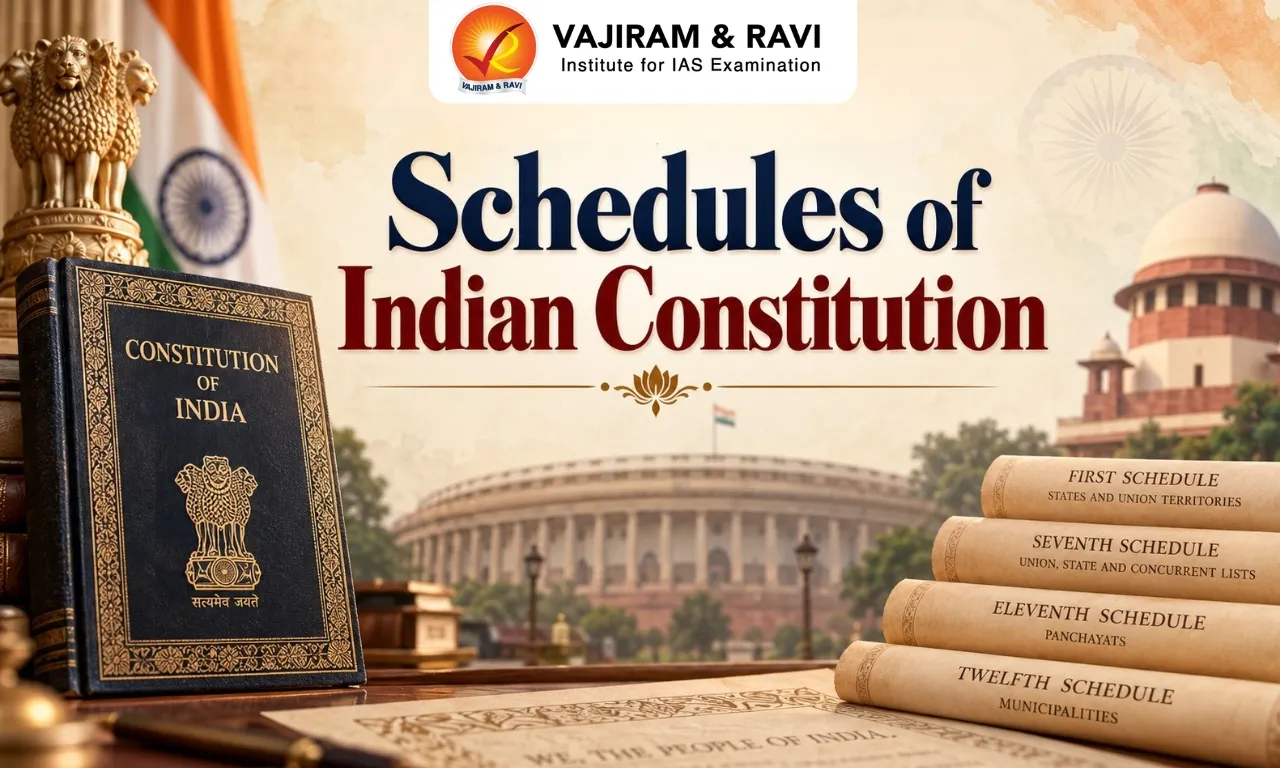
The Schedules of the Indian Constitution contain detailed lists, tables and supplementary provisions that help explain and implement different parts of the Constitution. They cover matters such as states and Union Territories, salaries of constitutional authorities, languages, administration of tribal areas, distribution of legislative powers and anti-defection rules.
The Constitution originally contained 8 Schedules when it came into force on 26 January 1950. Four additional Schedules were introduced through constitutional amendments, taking the total to 12 Schedules.
List of all 12 Schedules of the Indian Constitution
The following table summarises each Schedule, its main subject and the relevant constitutional Articles.
|
Schedule |
Main subject |
Related Articles |
|
First Schedule |
Names of States and Union Territories and their territories |
Articles 1 and 4 |
|
Second Schedule |
Salaries, allowances and other provisions relating to constitutional authorities |
Various Articles, including 59, 75, 125, 148 and 158 |
|
Third Schedule |
Forms of oaths and affirmations |
Various Articles, including 75, 99, 124, 164 and 188 |
|
Fourth Schedule |
Allocation of seats in the Rajya Sabha |
Articles 4 and 80 |
|
Fifth Schedule |
Administration and control of Scheduled Areas and Scheduled Tribes |
Article 244(1) |
|
Sixth Schedule |
Administration of tribal areas in Assam, Meghalaya, Tripura and Mizoram |
Articles 244(2) and 275(1) |
|
Seventh Schedule |
Distribution of legislative powers through the Union, State and Concurrent Lists |
Article 246 |
|
Eighth Schedule |
Recognised languages |
Articles 344(1) and 351 |
|
Ninth Schedule |
Certain laws and regulations placed under special constitutional protection |
Article 31B |
|
Tenth Schedule |
Disqualification of legislators on grounds of defection |
Articles 102(2) and 191(2) |
|
Eleventh Schedule |
Powers, authority and responsibilities of Panchayats; 29 subjects |
Article 243G |
|
Twelfth Schedule |
Powers, authority and responsibilities of Municipalities; 18 subjects |
Article 243W |
First Schedule — States and Union Territories
The First Schedule lists the States and Union Territories of India and specifies their territorial extent. It is linked to Articles 1 and 4, which deal with the Union of States and the formation or alteration of States.


Second Schedule — Salaries and Allowances
The Second Schedule contains provisions concerning the emoluments, allowances and related conditions of specified constitutional authorities, including the President, Governors, presiding officers of legislatures, judges of the Supreme Court and High Courts, and the Comptroller and Auditor General of India (CAG).
Third Schedule — Oaths and Affirmations
The Third Schedule prescribes the forms of oaths and affirmations for specified constitutional office-holders and elected representatives. These include Union and State Ministers, Members of Parliament, members of State Legislatures, and judges of the Supreme Court and High Courts.
Fourth Schedule — Rajya Sabha Seats
The Fourth Schedule provides for the allocation of seats in the Rajya Sabha, the Council of States, among the States and eligible Union Territories.
Fifth Schedule — Scheduled Areas and Scheduled Tribes
The Fifth Schedule deals with the administration and control of Scheduled Areas and Scheduled Tribes in States other than the tribal areas covered by the Sixth Schedule. It provides for mechanisms such as Tribes Advisory Councils and special responsibilities for Governors.
Sixth Schedule — Tribal Areas in Four Northeastern States
The Sixth Schedule provides special arrangements for the administration of tribal areas in Assam, Meghalaya, Tripura and Mizoram. It provides for Autonomous District Councils and, where applicable, Regional Councils, with specified legislative, judicial and administrative powers.
Seventh Schedule — Distribution of Legislative Powers
The Seventh Schedule divides legislative subjects between the Union and the States through three lists.
- Union List: Subjects on which Parliament generally has exclusive legislative power, such as defence and foreign affairs.
- State List: Subjects on which State Legislatures generally legislate, such as public order and police, subject to constitutional exceptions.
- Concurrent List: Subjects on which both Parliament and State Legislatures can legislate, such as education and forests. In cases of repugnancy, Article 254 provides the general rule, subject to its exceptions.
Eighth Schedule — Recognised Languages
The Eighth Schedule lists 22 languages recognised by the Constitution. It is relevant to Article 344, which concerns the Commission and Committee of Parliament on official language, and Article 351, which directs the Union to promote the spread and development of Hindi.
Ninth Schedule — Certain Laws and Regulations
The Ninth Schedule was added by the Constitution (First Amendment) Act, 1951. It initially sought to protect specified laws, particularly land reform laws, from challenges on the grounds of violating certain Fundamental Rights.
However, inclusion in the Ninth Schedule does not provide absolute immunity from judicial review. In I.R. Coelho v. State of Tamil Nadu (2007), the Supreme Court held that laws inserted into the Schedule after 24 April 1973 can be reviewed if they damage or destroy the Constitution's basic structure.
Tenth Schedule — Anti-Defection Law
The Tenth Schedule was added by the Constitution (Fifty-second Amendment) Act, 1985. It provides for disqualification of Members of Parliament and State Legislatures on specified grounds of defection, subject to the exceptions and procedures in the Schedule.
The Ninety-first Amendment Act, 2003 removed the protection previously available for a split by one-third of a legislature party. The merger exception generally requires support from at least two-thirds of the legislature party.
Eleventh Schedule — Panchayats
The Eleventh Schedule was added by the Constitution (Seventy-third Amendment) Act, 1992. It lists 29 subjects that may be devolved to Panchayats, including agriculture, minor irrigation, rural housing, drinking water, roads and poverty alleviation programmes.
Article 243G provides the constitutional framework for State Legislatures to endow Panchayats with powers and responsibilities, subject to the Constitution.
Twelfth Schedule — Municipalities
The Twelfth Schedule was added by the Constitution (Seventy-fourth Amendment) Act, 1992. It lists 18 subjects relating to urban local governance, including urban planning, regulation of land use, roads, water supply, sanitation, public health, fire services and urban poverty alleviation.
Article 243W provides the framework for State Legislatures to endow Municipalities with powers and responsibilities.
Constitutional Amendments
The Constitution originally had eight Schedules. The following amendments introduced the four additional Schedules.
|
Constitutional Amendment |
Year |
Schedule added |
Purpose |
|
First Amendment Act |
1951 |
Ninth Schedule |
Special protection for specified laws and regulations |
|
Fifty-second Amendment Act |
1985 |
Tenth Schedule |
Anti-defection provisions |
|
Seventy-third Amendment Act |
1992 |
Eleventh Schedule |
Subjects for Panchayats |
|
Seventy-fourth Amendment Act |
1992 |
Twelfth Schedule |
Subjects for Municipalities |
Significance of the Schedules of the Indian Constitution
The Schedules help organise constitutional provisions and provide detailed frameworks for governance.
- Administrative clarity: The First and Second Schedules specify territorial and institutional details.
- Federal division of powers: The Seventh Schedule helps define the legislative responsibilities of the Union and the States.
- Protection of tribal communities: The Fifth and Sixth Schedules provide special arrangements for the administration of Scheduled Areas and tribal areas.
- Language recognition: The Eighth Schedule recognises India's linguistic diversity.
- Political stability: The Tenth Schedule seeks to address political defections by legislators.
- Decentralisation: The Eleventh and Twelfth Schedules provide subject lists for rural and urban local governance.

 Last updated on Oct, 2026
→ UPSC 2027 Notification will be released on 13 January 2027 at upsconline.nic.in.
→ Check Nobel Prize 2026 Winners List here.
→ Check out the latest UPSC Syllabus here.
→ Download UPSC Calendar 2027 PDF Here.
Schedules of the Indian Constitution FAQs
Q1. How many Schedules are there in the Indian Constitution?+
Q2. How many Schedules were present in the original Constitution?+
Q3. Which Schedule deals with the division of legislative powers between the Union and States?+
Q4. Which Schedule contains the Anti-Defection Law?+
Q5. Which Schedules deal with Panchayats and Municipalities?+
Q6. Which Schedule contains the recognised languages of India?+
Q7. Does the Ninth Schedule completely exclude laws from judicial review?+
Tags: schedules of the indian schedules of the indian constitution