



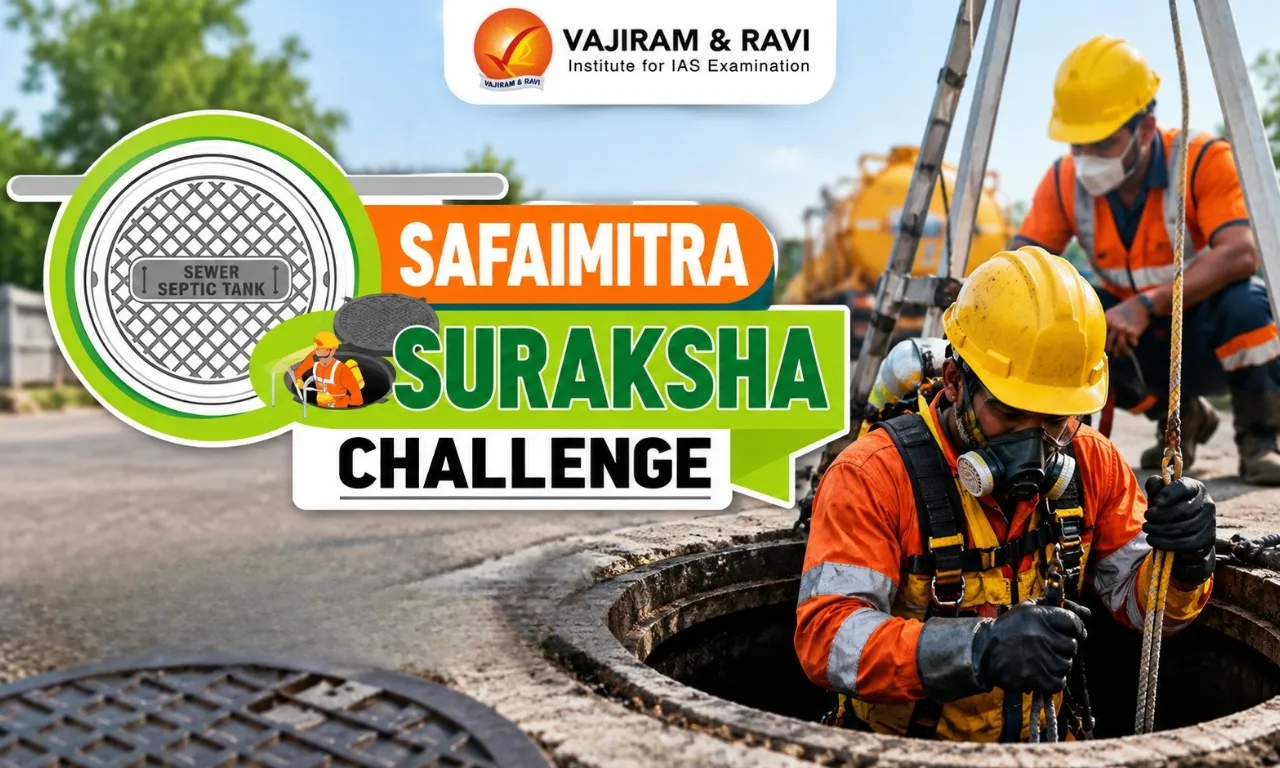
Safaimitra Suraksha Challenge (SSC) is a nationwide contest started by the Ministry of Housing and Urban Affairs (MoHUA) on 19 November 2020, timed with World Toilet Day. It runs under the Swachh Bharat Mission-Urban (SBM-U) and urges Indian cities to stop people from going into sewers and septic tanks by hand, and to use machines for cleaning instead. Its larger purpose is to keep sanitation workers safe from dangerous working conditions, to prevent deaths caused by hazardous sewer entry, and to protect their safety and dignity.
What is Safaimitra Suraksha Challenge?
The Safaimitra Suraksha Challenge (SSC) is a government initiative by the Ministry of Housing and Urban Affairs (MoHUA), launched on World Toilet Day in 2020. It aims to make sewer and septic tank cleaning safer by replacing risky manual work with machines in Indian cities.
- Launch and Participation: The challenge was started to make life safer for sanitation workers, also called SafaiMitras. 246 cities took part, including state capitals, Urban Local Bodies (ULBs) and Smart Cities.
- Focus on Mechanised Cleaning: Cities were urged to replace risky manual cleaning of sewers and septic tanks with machines and modern equipment. This was meant to lower workers’ exposure to toxic gases, infections and other life-threatening hazards.
- Commitment to Worker Safety: Participating cities pledged to mechanise sewer and septic tank cleaning by 30 April 2021. The initiative also aimed to prevent deaths caused by hazardous entry into sewers and septic tanks.
- Legal Framework: The challenge backs the Prohibition of Employment as Manual Scavengers and their Rehabilitation Act, 2013, which bans manual scavenging and hazardous cleaning. It also promotes compliance with Supreme Court directions on the safety and dignity of sanitation workers.
- Government Coordination: MoHUA led the effort, with help from state governments, municipal authorities, the Ministry of Social Justice and Empowerment and other organisations working in sanitation and worker welfare.
Objectives of Safaimitra Suraksha Challenge
The main objective of the Safaimitra Suraksha Challenge was to eliminate hazardous sewer and septic tank cleaning while ensuring safe working conditions and better livelihood opportunities for sanitation workers.
- Prevent hazardous cleaning: The first aim is to stop manual, unprotected entry into sewers and septic tanks, which has repeatedly cost workers their lives.
- Save lives: The government wants to make sure that no sewer or septic tank cleaner loses their life to hazardous entry again.
- Promote mechanised cleaning: Cities and towns are encouraged to make machine-based cleaning a regular practice instead of an exception.
- Follow the law: The Prohibition of Employment as Manual Scavengers and their Rehabilitation Act, 2013 and several Supreme Court judgements already ban manual entry without protective gear and proper procedures. The challenge pushes cities to follow these rules on the ground.
- Build awareness and capacity: It aims to educate citizens, create the infrastructure for mechanised cleaning, and train the workforce.
- Allow entry only in real emergencies: If a person must enter a sewer in an unavoidable emergency, they must be given proper safety gear and oxygen tanks.


Key Features of Safaimitra Suraksha Challenge
The Safaimitra Suraksha Challenge introduced several measures to encourage mechanised cleaning, improve worker safety and strengthen sanitation management in urban areas.
- Participation of 246 Cities: The challenge covered 246 cities across India. They were urged to build safer sanitation systems, upgrade cleaning infrastructure and follow standard operating procedures (SOPs).
- National Helpline Number 14420: A dedicated helpline was started to report hazardous cleaning practices and to register complaints about sewer overflow and septic tank desludging. It was meant to give citizens easy access to safe sanitation services and timely help.
- Mechanised Cleaning Equipment: Cities were encouraged to buy and use modern machines for sewer cleaning and septic tank maintenance. This supported the move from hazardous manual cleaning to safer mechanised operations.
- Loan Melas for Sanitation Workers: The National Safai Karamcharis Finance and Development Corporation (NSKFDC), backed by MoHUA, held Loan Melas. These helped SafaiMitras get financial assistance under the Swachhata Udyami Yojana (SUY) to buy sewer and septic tank cleaning equipment.
- Skill Development Programmes: Training was carried out with support from NSKFDC and the Ministry of Social Justice and Empowerment. Skill development activities ran in 115 cities to improve workers' knowledge of safe sanitation practices.
- Institutional Support: Responsible Sanitation Authorities (RSAs) were set up in 31 States and Union Territories. Sanitation Response Units (SRUs) were reported in 210 cities to strengthen coordination and emergency response.
- Training Guidelines and Advisories: MoHUA released technical documents prepared by the Central Public Health and Environmental Engineering Organisation (CPHEEO). These covered training modules for sanitary workers, equipment and workforce norms, and guidance on the land application of faecal sludge.
- Awards and Recognition: A total prize pool of ₹52 crore was set aside for winning cities. Cities competed in three population-based categories:
- More than 10 lakh
- 3 lakh to 10 lakh
- Up to 3 lakh
- Independent Assessment: An independent agency was to assess participating cities in May 2021. The results were originally planned for 15 August 2021.
Implementation of Safaimitra Suraksha Challenge
The implementation of the Safaimitra Suraksha Challenge involved coordination between central ministries, state governments, Urban Local Bodies, training institutions and sanitation organisations.
- Role of MoHUA: The Ministry of Housing and Urban Affairs was the nodal ministry for the challenge. It gave policy guidance, promoted mechanised cleaning, backed awareness campaigns and coordinated the work of participating cities.
- Role of National Institute of Urban Affairs (NIUA): MoHUA appointed NIUA to lead capacity-building. NIUA gave technical assistance, built a knowledge repository, ran training programmes and supported city officials in carrying out the challenge.
- Partnership with Training Organisations: NIUA identified training bodies across India and built a network of 30+ partner organisations ready to support participating cities. They helped with capacity building, technical implementation, GIS mapping, action research and awareness activities, based on local needs.
- Training and Workshops: Between December 2020 and March 2021, NIUA held five major workshops. These explained the challenge, resolved implementation difficulties and shared best sanitation practices.
- Capacity Building of Officials: Through these workshops, NIUA trained and supported 500+ participants across India. The sessions helped municipal officials and partner organisations understand mechanised cleaning technologies and sanitation safety requirements.
- Financial and Technical Assistance: NSKFDC supported sanitation workers with financial assistance, including Loan Melas under the Swachhata Udyami Yojana (SUY). This encouraged workers to buy equipment and take up mechanised cleaning services as a livelihood.
- Citizen Awareness Campaigns: MoHUA released posters and communication materials to spread awareness about the dangers of hazardous sewer cleaning. Citizens were encouraged to report unsafe practices and support responsible sanitation management.
- Monitoring and Evaluation: Participating cities had to improve their sanitation infrastructure and worker safety arrangements. The challenge included independent on-ground assessments and recognition of high-performing cities that adopted safe cleaning practices.
Significance of Safaimitra Suraksha Challenge
The Safaimitra Suraksha Challenge was an important initiative towards safer urban sanitation, protection of sanitation workers and the elimination of hazardous manual cleaning practices in India.
- Protection of Human Lives: The challenge sought to prevent deaths and injuries caused by hazardous sewer and septic tank cleaning. Promoting mechanised methods reduced the need for workers to enter dangerous confined spaces.
- Ending Hazardous Manual Cleaning: By pushing the shift from "manhole to machine hole", the initiative backed efforts to eliminate hazardous manual cleaning and promote safer, technology-based sanitation practices.
- Social Justice and Dignity: Sanitation work has long been tied to caste-based discrimination and social exclusion. The challenge aimed to improve the dignity, safety and working conditions of sanitation workers, especially those from marginalised communities.
- Strengthening Urban Sanitation: By promoting better equipment, trained workers and organised response systems, the initiative supported more efficient sewer maintenance and septic tank management in cities.
- Employment and Entrepreneurship: Financial support under the Swachhata Udyami Yojana (SUY) helped sanitation workers explore entrepreneurship by buying mechanised cleaning equipment and offering sanitation services.
- Better Governance and Accountability: Setting up sanitation authorities, response units and public complaint mechanisms made municipal bodies more responsible for sanitation worker safety.
- Supporting Swachh Bharat Mission-Urban: The challenge complemented SBM-U by looking beyond cleanliness and infrastructure to the health, safety and dignity of the workers who maintain these systems.
- Promoting Behavioural Change: Public awareness campaigns helped citizens see the dangers of hazardous cleaning and ask for safer sanitation services, building greater responsibility towards sanitation workers.
Challenges in Implementing Safaimitra Suraksha Challenge
Despite its objectives, the Safaimitra Suraksha Challenge faced several implementation challenges related to infrastructure, financing, awareness and the continued practice of hazardous sanitation work.
- Continued Hazardous Cleaning Practices: Manual entry into sewers and septic tanks stayed a concern despite legal restrictions. Inadequate equipment, unsafe working practices and weak enforcement could expose sanitation workers to serious health and safety risks.
- Limited Mechanised Infrastructure: Many Urban Local Bodies (ULBs) struggled to get modern sewer-cleaning machines and related equipment. The availability and maintenance of suitable machinery were key to achieving mechanised sanitation.
- Financial Constraints: Advanced cleaning machines and safety equipment can be costly, especially for smaller municipalities and sanitation workers. Access to affordable loans and financial support was therefore essential.
- Lack of Skilled Workers: Running mechanised equipment needs technical knowledge and practical training. Poor training could limit the effective use of machinery and the adoption of safe cleaning procedures.
- Weak Enforcement of Safety Laws: The 2013 Act prohibits hazardous sewer and septic tank cleaning, but real impact needs regular monitoring, institutional accountability and compliance with safety standards.
- Low Public Awareness: Citizens may not know the dangers of hazardous cleaning or that mechanised sanitation services exist. Low awareness can reduce the reporting of unsafe practices and the use of complaint mechanisms.
- Coordination Among Agencies: Success depends on cooperation between central ministries, state governments, municipal authorities, financial institutions and training organisations. Poor coordination may delay procurement, training and infrastructure development.
- Social and Economic Barriers: Sanitation workers from marginalised communities may face discrimination, financial insecurity and few alternative job options. Solving this needs technological improvements along with long-term social and economic support.

 Last updated on Oct, 2026
→ UPSC 2027 Notification will be released on 13 January 2027 at upsconline.nic.in.
→ Check Nobel Prize 2026 Winners List here.
→ Check out the latest UPSC Syllabus here.
→ Download UPSC Calendar 2027 PDF Here.
Safaimitra Suraksha Challenge FAQs
Q1. What is the Safaimitra Suraksha Challenge?+
Q2. When was the Safaimitra Suraksha Challenge launched?+
Q3. What is the main objective of the Safaimitra Suraksha Challenge?+
Q4. How many cities took part in the Safaimitra Suraksha Challenge?+
Q5. What is the prize money under the Safaimitra Suraksha Challenge?+
Q6. What is the helpline number for the Safaimitra Suraksha Challenge?+
Q7. Which role does NIUA play in the Safaimitra Suraksha Challenge?+
Tags: safaimitra suraksha challenge