



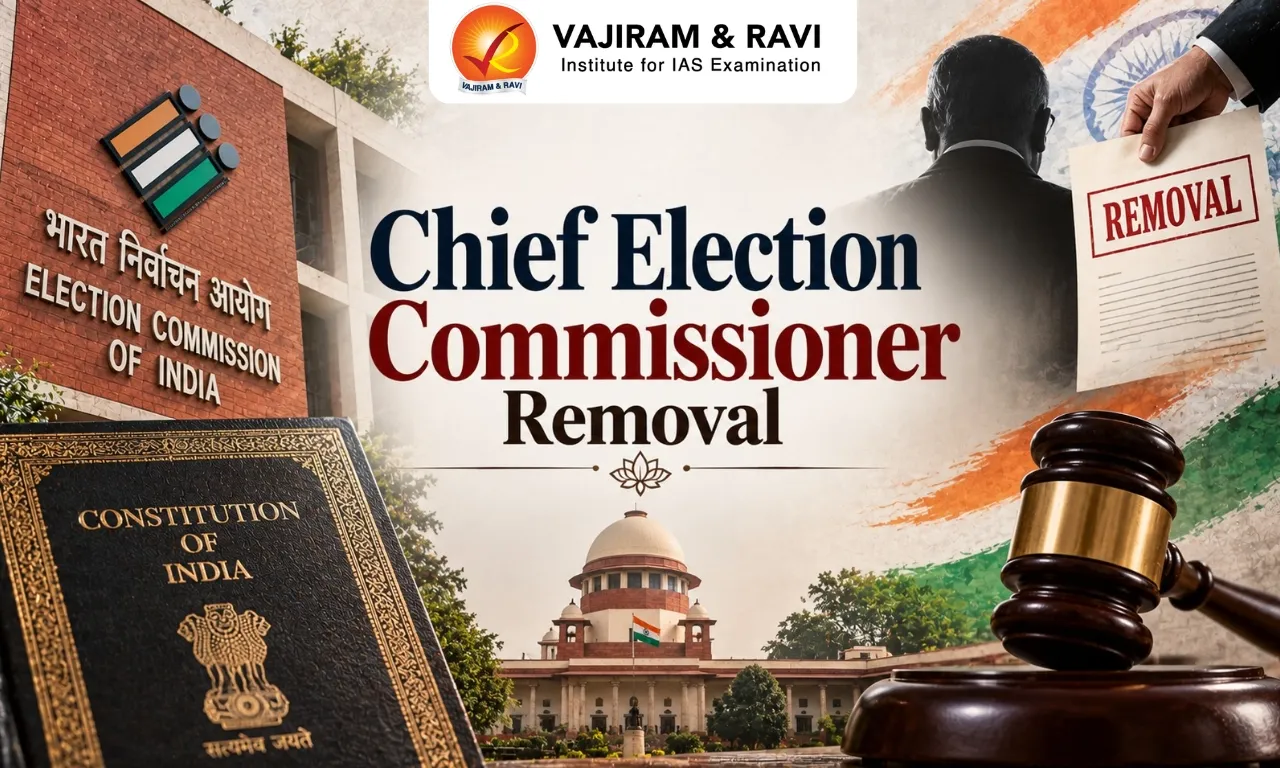
The Chief Election Commissioner Removal process in India is a special constitutional procedure designed to protect the independence of the Election Commission of India (ECI). The Chief Election Commissioner (CEC) cannot be removed by the Central Government or the President through an ordinary administrative order. The Constitution provides safeguards similar to those applicable to a Supreme Court judge.
Under Article 324(5) of the Indian Constitution, the Chief Election Commissioner can be removed only on the grounds of proved misbehaviour or incapacity and through a special parliamentary procedure. The removal motion must be approved by both Houses of Parliament through a special majority, followed by a formal order of the President of India.
This provision ensures that the Chief Election Commissioner can perform election-related responsibilities independently, without fear of arbitrary removal.
Constitutional Provisions Related to Chief Election Commissioner Removal
The Chief Election Commissioner Removal process is governed by the following constitutional provisions and laws:
- Article 324(5)
-
- The CEC can be removed only in the same manner and on the same grounds as a Supreme Court judge.
- Other Election Commissioners can be removed only on the CEC's recommendation.
- Article 124(4)
-
- Removal requires a special majority in both Houses of Parliament.
- Both Houses must pass the motion in the same session.
- The President issues the final removal order.
- Chief Election Commissioner and Other Election Commissioners Act, 2023
-
- The CEC can resign by writing to the President.
- Other Election Commissioners can be removed only on the CEC's recommendation.
- Judges (Inquiry) Act, 1968
-
- It lays down the procedure for investigating removal charges.
- A three-member inquiry committee examines the charges and submits its report.
Grounds for Chief Election Commissioner Removal
The Constitution permits the removal of the Chief Election Commissioner on only two grounds:
- Proved Misbehaviour
Proved misbehaviour refers to serious misconduct or improper conduct that is established through the prescribed inquiry procedure.
It must be supported by evidence and cannot be based merely on political disagreement, personal differences or unverified allegations.
- Incapacity
Incapacity refers to a situation in which the Chief Election Commissioner is unable to perform the responsibilities of the office because of physical or mental inability.
Such incapacity must be established through the prescribed legal procedure.


Step by Step Procedure for Chief Election Commissioner Removal
The removal of the Chief Election Commissioner follows a detailed parliamentary procedure similar to that of a Supreme Court judge. The process involves the following steps:
Step 1: Submission of Removal Motion
The process begins when Members of Parliament submit a formal notice of motion seeking the removal of the Chief Election Commissioner.
The notice must be signed by the minimum number of MPs prescribed under the Judges (Inquiry) Act, 1968.
|
House of Parliament |
Minimum Members Required |
|
Lok Sabha |
100 members |
|
Rajya Sabha |
50 members |
The notice can be submitted in either House of Parliament. It must contain the charges and grounds supporting the proposed removal.
Step 2: Admission or Rejection of the Motion
After receiving the notice, the presiding officer examines it.
- In the Lok Sabha, the Speaker examines the notice.
- In the Rajya Sabha, the Chairman examines the notice.
The Speaker or Chairman can either admit or reject the motion after considering the available material and relevant aspects.
The admission of the motion does not automatically mean that the CEC will be removed. It only allows the formal investigation process to begin.
Step 3: Formation of a Three-Member Inquiry Committee
If the motion is admitted, a three-member inquiry committee is constituted to investigate the charges against the Chief Election Commissioner.
Under the Judges (Inquiry) Act, 1968, the committee consists of:
- A Supreme Court Judge: One member selected from among the Chief Justice and other judges of the Supreme Court.
- A High Court Chief Justice: One member selected from among the Chief Justices of the High Courts.
- A Distinguished Jurist: One person considered a distinguished jurist by the Speaker or Chairman.
The committee examines the allegations and gives the concerned official a reasonable opportunity to present a defence.
Step 4: Investigation and Submission of Report
The inquiry committee investigates the charges and examines the available evidence.
Its responsibilities include:
- Framing specific charges against the CEC.
- Examining relevant documents and evidence.
- Giving the CEC an opportunity to present a defence.
- Assessing whether the charges of misbehaviour or incapacity have been established.
After completing the investigation, the committee submits its report to the Speaker or Chairman.
If the committee finds that the charges have not been proved, the removal motion cannot proceed on the basis of those charges.
If the committee establishes misbehaviour or incapacity, the motion can be considered further by Parliament.
Step 5: Special Majority in Both Houses of Parliament
If the inquiry committee establishes the charges, the removal motion is taken up for consideration in Parliament.
For the motion to be passed, both the Lok Sabha and Rajya Sabha must approve it by a special majority.
The special majority requires two conditions:
- Majority of the total membership: More than 50% of the total membership of that House must vote in favour of the motion.
- Two-thirds majority of members present and voting: At least two-thirds of the members present and voting must support the motion.
Both conditions must be fulfilled separately in each House of Parliament.
This requirement makes the removal process difficult and prevents the removal of the CEC through a simple majority.
Step 6: Presidential Order for Removal
After both Houses of Parliament pass the removal motion by the required special majority in the same session, an address is presented to the President of India.
The President of India then issues a formal order for the removal of the Chief Election Commissioner.
Thus, the final removal takes place through a Presidential order, following the approval of both Houses of Parliament.
Recent Example: Removal Motion Against CEC Gyanesh Kumar in 2026
In March 2026, Opposition MPs submitted notices seeking the removal of Chief Election Commissioner Gyanesh Kumar.
The important developments were:
- On 12 March 2026, 63 Rajya Sabha members submitted a notice seeking his removal.
- A separate notice was submitted in the Lok Sabha, signed by 130 MPs.
- The notices were submitted under Article 324(5) of the Constitution, read with Article 124(4), the 2023 Act and the Judges (Inquiry) Act, 1968.
- On 6 April 2026, the Rajya Sabha Chairman and Lok Sabha Speaker rejected the respective notices after considering the matter.
Since both notices were rejected at the admission stage, the inquiry committee was not constituted and the parliamentary removal process did not proceed further.
This example demonstrates that submitting a removal motion does not automatically lead to the removal of the Chief Election Commissioner. The motion must first satisfy the prescribed legal and procedural requirements.
Why Is the Removal Procedure of the Chief Election Commissioner Important?
The special removal procedure is important for maintaining the independence and credibility of India's electoral system.
- Protects Institutional Independence: It prevents the government from removing the CEC arbitrarily.
- Ensures Free and Fair Elections: It allows the CEC to perform election-related responsibilities without fear of political pressure.
- Prevents Misuse of Power: The requirement of a special majority prevents removal based only on political differences.
- Ensures Accountability: The inquiry committee investigates allegations and establishes whether the charges are genuine.
- Strengthens Democracy: An independent Election Commission is essential for maintaining public confidence in the electoral process.
Has Any Chief Election Commissioner Been Removed in India?
No Chief Election Commissioner has ever been successfully removed from office in India through the constitutional removal procedure.
The Constitution provides a strict process involving an inquiry committee, investigation of charges and approval by both Houses of Parliament through a special majority.
Although removal motions and notices may be submitted, they do not automatically result in removal. The prescribed constitutional requirements must be fulfilled.

 Last updated on Oct, 2026
→ UPSC 2027 Notification will be released on 13 January 2027 at upsconline.nic.in.
→ Check Nobel Prize 2026 Winners List here.
→ Check out the latest UPSC Syllabus here.
→ Download UPSC Calendar 2027 PDF Here.
Chief Election Commissioner Removal FAQs
Q1. Under which Article can the Chief Election Commissioner be removed?+
Q2. What are the grounds for Chief Election Commissioner Removal?+
Q3. Who can remove the Chief Election Commissioner of India?+
Q4. How many MPs are required to submit a removal motion against the CEC?+
Q5. What is the special majority required for removing the CEC?+
Q6. Which committee investigates charges against the Chief Election Commissioner?+
Q7. Which Act governs the investigation procedure for CEC removal?+
Q8. Can the President remove the CEC directly?+
Q9. Can other Election Commissioners be removed in the same manner as the CEC?+
Q10. Has any Chief Election Commissioner been removed in India?+
Tags: cec removal chief election commissioner removal