Why in the News?
- The Union Government reduced the Basic Customs Duty (BCD) on major imported edible oils from September 24, 2026, citing rising international prices and the need to moderate domestic food inflation.
What’s in Today’s Article?
- About Edible Oil BCD Changes (Background, Reasons, Impact on Consumers, Farmers’ Concerns, etc.)
Changes in Edible Oil BCD
- Ahead of the festival season, when demand for edible oils is expected to rise, the government rationalised import duties on several crude and refined edible oils.
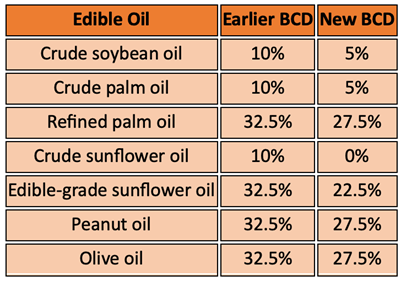
- The government has also maintained an import duty differential of 19.25% between crude and refined edible oils, intended to preserve an incentive for domestic refining.
Reasons for Reducing the Import Duty
- Rising International Edible Oil Prices
- International prices have been increasing. According to the FAO Food Price Index, the vegetable oil price index averaged 196.9 points in August 2026, increasing 0.6% over July and reaching its highest level since June 2022.
- The increase was driven particularly by higher global palm and soybean oil prices. International palm oil prices were also affected by strong global import demand and concerns over the potential impact of El Niño-related weather conditions on production in Southeast Asia.
- Moderating Domestic Prices
- Import duties form part of the landed cost of imported edible oils. When international prices rise, a high import duty can further increase the cost at which the commodity enters the domestic market.
- By reducing BCD, the government expects importers to face lower landed costs, with the benefit potentially transmitted through the domestic supply chain to consumers.
- The stated objective is therefore to provide consumer relief and contain food-price and broader inflationary pressures.
- Ensuring Adequate Supply During the Festival Season
- Demand for edible oils generally increases during the festival period. Apart from household consumption, demand also rises from the sweets, snacks, food-service and hospitality sectors.
- The Indian Vegetable Oil Producers’ Association (IVPA) stated that lower duties could improve the landed cost of imported oils and support availability during the period of higher demand.
Impact on Consumers
- Lower import duties can reduce the cost of imported edible oils by lowering the tax component of their landed price.
- Greater flexibility to import sunflower and soybean oil could also increase the availability of alternatives to palm oil.
- The industry expects this to be relevant because palm oil prices may remain relatively high due to changes in Indonesia's biofuel policy and constraints on acreage expansion in major producing countries.
- However, the extent to which lower import duties translate into lower retail prices depends on international prices, exchange rates, transportation costs, domestic margins and the transmission of savings through the supply chain.
Farmers’ Concerns
- Domestic oilseed farmers have raised concerns that cheaper imports could reduce the competitiveness of domestically produced oilseeds.
- Farmers growing soybean, sunflower, groundnut and oil palm have also pointed to the government's objective of achieving greater self-sufficiency in edible oil production. Their concern is that increased dependence on imported edible oils could weaken incentives for domestic production.
- The All India Kisan Sabha has criticised the move on the grounds that it could adversely affect oilseed farmers and potentially conflict with the objective of edible-oil self-sufficiency.
- These are the concerns expressed by the farmers' organisation and do not represent the government's stated rationale for the measure.
The Policy Trade-off
- The duty reduction illustrates a common policy trade-off between short-term consumer price management and long-term domestic production incentives.
- Lower import duties can help manage inflation and ensure adequate supplies when global prices are high. However, if imported oils become substantially more competitive, domestic oilseed producers may face greater price pressure.
- Thus, edible oil policy requires balancing:
- Consumer affordability
- Food inflation management
- Adequate market supply
- Farmer incomes
- Domestic oilseed production
- Long-term edible oil self-sufficiency
Conclusion
- The reduction in edible oil import duties is primarily aimed at reducing landed costs, improving availability and moderating domestic food-price pressures amid rising international edible oil prices.
- At the same time, concerns from oilseed farmers highlight the need to balance short-term consumer relief with incentives for domestic production.
- The effectiveness of the policy will therefore depend not only on lower import duties but also on how efficiently the resulting cost reduction reaches consumers and how domestic oilseed production is supported.

