Why in the News?
- The Government has amended the Foreign Direct Investment (FDI) policy to permit foreign investment in inventory-based e-commerce entities exclusively for exports of goods manufactured or produced in India.
What’s in Today’s Article?
- Background (Context, Models of E-commerce, Differences, etc.)
- New E-commerce Policy (Key Features, Expected Benefits, Concerns & Challenges, Significance)
Background
- India's FDI policy has traditionally distinguished between two models of e-commerce, marketplace-based and inventory-based.
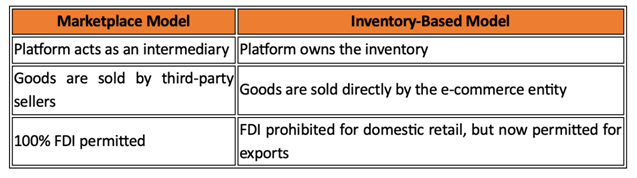
- Since 2016, the Government has permitted 100% FDI under the automatic route in the marketplace model of e-commerce, while prohibiting FDI in the inventory-based model for domestic retail trade.
- This restriction was intended to protect small retailers and ensure a level playing field by preventing foreign-funded e-commerce companies from directly owning and selling inventory in the Indian market.
- However, the Government has increasingly focused on promoting e-commerce exports as part of its broader objective of enhancing India's manufacturing competitiveness and increasing merchandise exports.
- Measures such as amendments to the Foreign Trade Policy, customs reforms for courier exports, and digital trade facilitation have been introduced to encourage Indian manufacturers and MSMEs to access global markets.
- In this context, the Department for Promotion of Industry and Internal Trade (DPIIT) issued Press Note 3 of 2026, allowing FDI in inventory-based e-commerce entities exclusively for exports while retaining restrictions on domestic retail operations.
What is the Inventory-Based E-commerce Model?
- An inventory-based model is an e-commerce model in which the platform owns the inventory of goods and sells them directly to consumers.
- In contrast, under the marketplace model, the e-commerce entity acts only as a digital intermediary that connects buyers with independent sellers without owning the goods.
Difference Between the Two Models
Key Features of the New Policy
- FDI Permitted Only for Export Operations
- The amended policy permits 100% FDI in inventory-based e-commerce entities only when they deal exclusively in exports of goods manufactured or produced in India.
- The liberalisation does not extend to domestic retail sales.
- No Change in Domestic E-commerce Rules
- The Government has retained the existing restrictions on Business-to-Consumer (B2C) inventory-based e-commerce within India.
- Foreign-funded e-commerce companies cannot own inventory for direct sale to Indian consumers.
- Support for Indian Manufacturers
- The policy is intended to provide Indian manufacturers, particularly MSMEs and businesses located in Tier-II and Tier-III cities, with easier access to international markets through large global e-commerce platforms.
- By allowing these platforms to maintain export-oriented inventories, the Government expects to improve logistics, reduce delivery timelines, and enhance the competitiveness of Indian products overseas.
- Removal of Regulatory Ambiguity
- The amendment also addresses an interpretational issue under the earlier FDI policy.
- While FDI was already permitted in Business-to-Business (B2B) e-commerce, uncertainty existed regarding whether inventory restrictions applicable to domestic retail also applied to export-oriented operations.
- The revised policy clarifies that the inventory restriction is limited to domestic retail trade and does not apply to export-only operations.
Expected Benefits of the Policy
- Boost to E-commerce Exports
- The policy is expected to strengthen India's e-commerce export ecosystem by enabling global platforms to procure, store, and ship Indian products more efficiently.
- The Government has set an ambitious target of achieving $200 billion in e-commerce exports by 2030.
- Greater Opportunities for MSMEs
- Small manufacturers often face challenges related to warehousing, logistics, and international market access.
- The new framework enables them to leverage the infrastructure and global customer networks of major e-commerce companies.
- Support for Manufacturing Growth
- The initiative aligns with the Government's objective of increasing the manufacturing sector's share in GDP to 25% by 2035 and expanding merchandise exports.
- Improved export opportunities may encourage higher domestic production and employment generation.
Concerns and Challenges
- Possibility of Policy Misuse
- Some experts have expressed concerns that maintaining separate inventories for export and domestic sales may be difficult to monitor.
- They argue that the export-only relaxation could eventually lead to demands for similar liberalisation in the domestic market.
- Impact on Domestic Retail
- Although the current amendment does not affect domestic retail, there are apprehensions that future policy changes could intensify competition for traditional retailers if inventory-based FDI is permitted beyond exports.
- Need for Effective Monitoring
- Successful implementation will require robust monitoring mechanisms to ensure that inventory created for export purposes is not diverted to the domestic market in violation of FDI regulations.
Significance of the Policy
- The amendment represents a calibrated liberalisation of India's FDI policy.
- It seeks to balance two important objectives:
- Promoting exports through global e-commerce platforms
- Preserving safeguards applicable to domestic retail trade
- The policy also complements India's broader initiatives under Make in India, Foreign Trade Policy, and Districts as Export Hubs, while supporting the country's ambition of becoming a major global manufacturing and export hub.

