Why in the News?
- India's trade deficit with China crossed $100 billion in 2026, prompting renewed concerns over restricted market access for Indian products, rising imports and structural imbalances in bilateral trade.
What’s in Today’s Article?
- India-China Trade (Trends, Trade Imbalance, Structural Causes, Strategic & Supply Chain Concerns, India’s Policy Approach, Way Forward)
Trends in India-China Trade
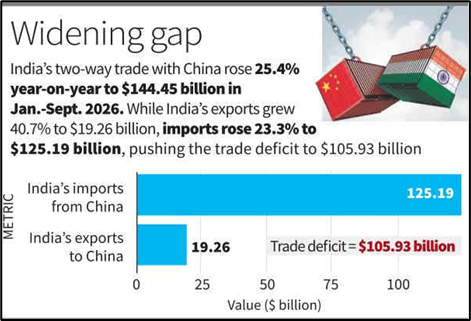
- India-China economic relations are characterised by substantial bilateral trade but an uneven balance between exports and imports.
- Bilateral trade: Trade between the two countries reached $144.45 billion during January-September 2026, registering 25.4% growth.
- India's exports: Indian exports to China rose by 40.7% to $19.26 billion during the first nine months of 2026.
- India's imports: Imports from China increased by 23.3% to $125.19 billion over the same period.
- Trade deficit: The deficit reached $105.93 billion and was on track to surpass the previous year's record of $116.12 billion.
- Although exports have grown significantly, they remain much smaller than imports.
- The resulting imbalance reflects differences in the scale and composition of trade, as well as concerns about market access and dependence on Chinese supplies.
Structural Causes of the Trade Imbalance
- Dependence on Chinese intermediate goods
- Indian manufacturers import substantial quantities of intermediate goods from China for domestic production. These inputs support industrial activity but also expose Indian supply chains to external disruptions.
- The continued import of finished products, particularly electronics and machinery, is another concern because it can limit opportunities for domestic manufacturing to capture greater value addition.
- Non-tariff barriers and restricted market access
- Finance Minister Nirmala Sitharaman has identified non-tariff barriers as a major obstacle to expanding Indian exports to China.
- These barriers include regulatory requirements, such as phytosanitary measures, that govern the import of agricultural and other products.
- While such measures can serve legitimate health and safety objectives, concerns arise when procedures are applied in ways that restrict market access without adequate transparency or timely resolution.
- India has highlighted export opportunities in generic medicines, bovine meat, vegetables and perishable products, but has raised concerns about limited access to the Chinese market.
- Unequal trade composition
- India imports large quantities of industrial inputs, electronics and machinery, while its exports to China are concentrated in a narrower range of products, including seafood, naphtha and printed circuit boards.
- This difference in trade composition contributes to the persistent imbalance and highlights the need to diversify India's export basket.
Strategic and Supply Chain Concerns
- The trade deficit is not merely a question of the value of imports and exports. It also has implications for India's industrial resilience and economic security.
- Export controls: Chinese restrictions on exports in sectors such as fertilisers and rare earths create uncertainty for Indian industries that depend on these supplies.
- Manufacturing vulnerability: Dependence on imported components and machinery can expose production to external price shocks and supply interruptions.
- Limited value addition: Continued reliance on finished goods can constrain the development of domestic manufacturing capabilities.
- External trade pressures: High import expenditure, including on crude oil and fertilisers, can increase the pressure on India's overall import bill.
- These concerns underline the importance of reducing excessive dependence without disrupting access to inputs required by Indian businesses.
India's Diplomatic and Trade Policy Approach
- India has continued to pursue dialogue with China to address market access concerns and structural trade imbalances.
- During their meeting on the side-lines of the BRICS summit in September 2026, Prime Minister Narendra Modi and Chinese President Xi Jinping acknowledged the need to address trade imbalances, supply chain issues and the facilitation of meaningful and predictable market access.
- India has also emphasised that dialogue, rather than the imposition of tariffs or countervailing duties, remains its preferred approach to addressing trade barriers.
- At the same time, India is accelerating negotiations for bilateral trade agreements with other countries. These agreements can expand export markets, strengthen commercial relationships and reduce overdependence on individual trading partners.
Way Forward
- Addressing the India-China trade deficit requires a combination of market access negotiations, domestic industrial development and export diversification.
- Improve market access: Pursue transparent and time-bound resolution of regulatory barriers affecting Indian products in China.
- Diversify exports: Expand opportunities in pharmaceuticals, agricultural products, processed foods, engineering goods and other competitive sectors.
- Strengthen domestic manufacturing: Improve infrastructure, technology adoption, productivity and component manufacturing to reduce excessive dependence on imported finished goods.
- Diversify supply chains: Develop alternative sources for critical inputs while maintaining reliable access to essential Chinese intermediates.
- Accelerate trade agreements: Use bilateral and multilateral trade arrangements to expand India's export opportunities across global markets.
- Promote value addition: Encourage domestic production of higher-value goods to improve export competitiveness and strengthen industrial capabilities.