Why in news?
Amid protests against the Special Intensive Revision (SIR) of electoral rolls, the Election Commission (EC) recently announced the schedule for the Special Summary Revision (SSR).
The annual exercise, aimed at updating electoral rolls, was skipped in 2026. It will now be conducted in 17 states and Union Territories, including the five states scheduled to hold Assembly elections in early 2027.
What’s in Today’s Article?
- What Is the Special Summary Revision?
- How SSR Normally Works
- The EC’s New SSR Announcement: Key Details
- How SSR Differs from SIR: The Core Distinction
What Is the Special Summary Revision?
- Article 324 of the Constitution gives the EC authority to prepare electoral rolls for Parliament and Assembly elections.
- The process is governed by the Representation of the People Act, 1950 and the Registration of Electors Rules, 1960.
- Electoral rolls are prepared constituency-wise, with the Electoral Registration Officer (ERO) as the statutory authority.
- Section 21(2) of the 1950 Act mandates roll revision: before every general election, and “in any year” if directed by the EC with reference to a “qualifying date.”
How SSR Normally Works?
- SSR is the routine annual update, adding newly eligible electors and removing those who have died or shifted residence.
- Conducted before each Lok Sabha/Assembly election, and annually with January 1 as the qualifying date — meaning everyone turning 18 by January 1 becomes eligible for enrolment.
- Why SSR 2026 Was Skipped: After announcing the decision to conduct the SIR in June 2025 (where rolls were prepared afresh, requiring all existing electors to re-establish eligibility), the EC did not conduct SSR 2026.
The EC’s New SSR Announcement: Key Details
- SSR will be held with a qualifying date of January 1, 2027 in:
- States/UTs where SIR has already been completed in 2025 and 2026.
- Assam, where the EC had decided not to conduct SIR at all.
- The 17 states/UTs covered: Andaman and Nicobar Islands, Assam, Bihar, Chhattisgarh, Goa, Gujarat, Kerala, Lakshadweep, Madhya Pradesh, Manipur, Puducherry, Punjab, Rajasthan, Tamil Nadu, Uttar Pradesh, Uttarakhand, and West Bengal.
- For remaining states (where SIR is still ongoing), the EC will announce the SSR schedule later.
- Timeline For the SSR Process:
- Rationalisation of polling stations: Completed by November 2, 2026.
- Publication of draft rolls: November 12, 2026.
- Claims and objections period: November 12 to December 11, 2026.
- Disposal of claims/objections: By December 28, 2026.
- Final electoral rolls published: January 4, 2027.
- For voters: Those turning 18 or seeking to shift enrolment can use Form 6 (new voters) or Form 8 (shifting/correction) during the revision.
How SSR Differs from SIR: The Core Distinction
- The EC broke from its annual SSR practice in 2025, opting instead for an intensive revision of rolls — the first of its kind in 20 years.
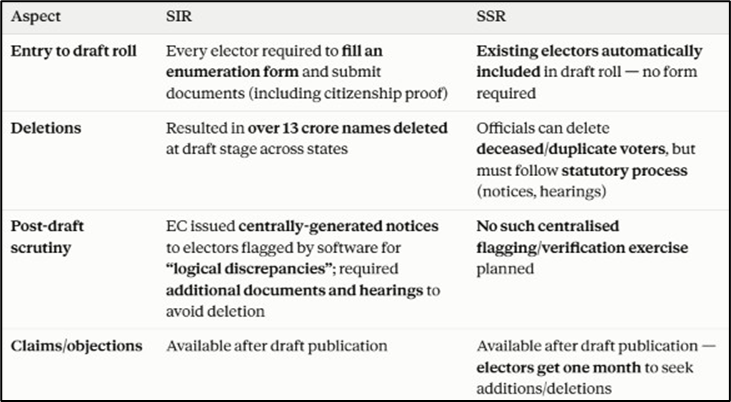
- The Essential Contrast: SIR placed the burden of proof on every elector to re-establish eligibility from scratch; SSR assumes continuity — existing electors stay on the roll unless specifically flagged through a due process-bound deletion mechanism.
Conclusion
The EC’s return to the Special Summary Revision, even as the Special Intensive Revision continues drawing criticism, highlights a deliberate procedural recalibration: SSR trusts the existing roll as its starting point, while SIR demanded electors prove their place on it all over again.
With Assembly elections approaching in several states by early 2027, the tight SSR timeline — draft to final rolls in under two months — will test whether this “lighter-touch” revision can balance administrative efficiency with the accuracy and fairness voters expect from India’s electoral machinery.