
India's Battery Recycling Push - Banning Export of Lithium-ion Battery Black Mass
Why in News?
- Recently, the Union Government prohibited the export of lithium-ion battery black mass to retain valuable secondary critical minerals within India.
- The Directorate General of Foreign Trade (DGFT) revised the export policy for the specified category of battery waste and scrap under ITC (HS) Code 85491400, changing its status from 'Free' to 'Prohibited'.
- The move aims to strengthen domestic battery recycling, reduce import dependence and develop an integrated battery manufacturing ecosystem.
What’s in Today’s Article?
- Understanding Black Mass
- Strategic Significance
- Other Policy Measures
- The Technology Gap
- Other Challenges
- Way Forward
- Conclusion
Understanding Black Mass:
- What is Black Mass?
- It is a powder obtained by shredding discarded lithium-ion batteries and battery manufacturing scrap.
- It contains recoverable metals such as lithium, cobalt, nickel and manganese, along with graphite and other residues.
- It is an intermediate raw material, not a finished battery component. Further processing is required to extract and purify individual metals.
- Why does its composition matter?
- The commercial value of black mass depends on battery chemistry, metal concentration, recovery efficiency and market prices.
- For example, NMC (Nickel-Manganese-Cobalt) batteries contain lithium, nickel and cobalt, generally offering greater recovery value.
- Domestic resource potential: India generates approximately 50,000 tonnes of end-of-life lithium-ion batteries annually, potentially yielding around 25,000 tonnes of black mass.
- Classification: MoEFCC's Technical Review Committee recognised black mass as hazardous waste unless processed on the same premises for critical mineral recovery.
- Regulatory framework: Import and export are governed by the Hazardous and Other Wastes (Management and Transboundary Movement) Rules, 2016, requiring MoEFCC permission and compliance with prescribed conditions.
Strategic Significance:
- Global trend: India's black-mass export ban aligns with a global shift towards retaining critical minerals within domestic supply chains. For example, the US and EU recently announced export restrictions.
- China's dominance: China controls approximately 90% of global critical mineral processing capacity, giving it significant leverage over international supply chains.
- Critical mineral security: India is almost entirely import-dependent for certain critical minerals, including lithium, cobalt, nickel, rare earth elements (REEs) and silicon.
- Circular economy: Converts discarded batteries into secondary resources, reducing waste and dependence on fresh mining.
- Industry-level impact: The export ban may adversely affect standalone battery shredders and dismantlers dependent on overseas buyers while benefiting domestic refiners and integrated recycling companies.
- Supply chain resilience: Reduces exposure to international mineral supply disruptions and geopolitical uncertainties.
- Value addition: Retains downstream processing opportunities, employment and technological capabilities within India.
Other Policy Measures:
- Incentive Scheme for Critical Mineral Recycling:
- Approved (in September 2025) under the National Critical Mineral Mission, with an outlay of ₹1,500 crore, and for an implementation period of 2025-26 to 2030-31.
- It seeks to develop domestic capacity for recovering critical minerals from secondary sources, including battery and electronic waste.
- Battery Waste Management Rules, 2022:
- Establish an Extended Producer Responsibility (EPR) framework, making battery producers responsible for collection, recycling and refurbishment obligations.
- Prescribe minimum material recovery targets for recyclers.
- For EV batteries, the minimum material recovery target reaches 90% from 2026-27 onwards.
- Require producers to incorporate domestically recycled materials into new batteries (5% from 2027-28, gradually increasing to 20% by 2030-31).
- Centre for Science and Environment (CSE) Recommendations:
- Its report highlighted black-mass exports as a loss of valuable domestic feedstock.
- It also flagged undervalued EPR certificates, which weaken incentives for investment in environmentally sound recycling and advanced recovery technologies.
The Technology Gap:
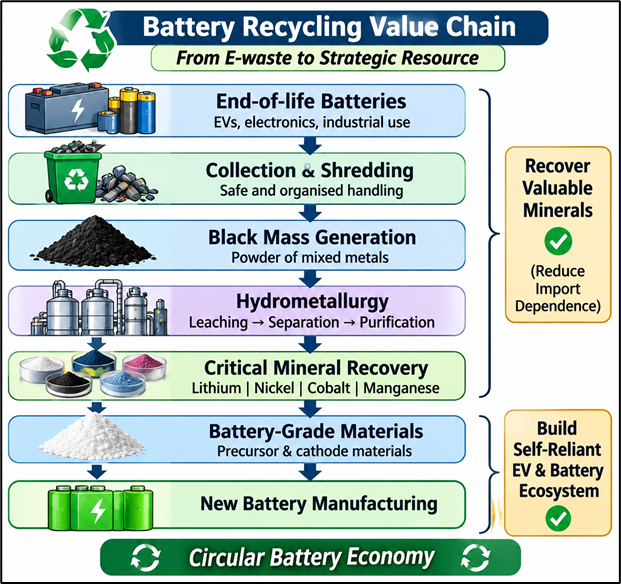
- Retaining black mass does not automatically make India self-reliant in battery manufacturing. The recovery process involves several stages.
- Recovering metals is not equivalent to producing battery-grade materials. Cell manufacturers require high purity, consistent chemical composition and stringent quality standards.
Other Challenges:
- Fragmented collection networks: Inadequate and unpredictable battery feedstock.
- Informal recycling: Material losses, unsafe handling and environmental pollution.
- High capital costs: Investment required in dismantling, chemical recovery and effluent treatment.
- Recycling economics: Lower recovery value can discourage commercial investment.
- Weak EPR enforcement: Risk of certificates reflecting reported waste rather than actual recovery.
- Limited downstream manufacturing: Recovered minerals may still lack domestic buyers.
- Quality and traceability gaps: Difficulty ensuring material purity and regulatory compliance.
Way Forward:
- Strengthen collection infrastructure: Develop organised battery take-back, aggregation and safe transportation networks.
- Improve EPR accountability: Ensure transparent, verifiable recycling certificates and strict monitoring of recovery targets.
- Promote advanced technologies: Invest in high-recovery hydrometallurgical processes, environmentally sound recycling and indigenous R&D.
- Develop domestic value chains: Link recyclers with mineral refiners, precursor manufacturers and battery-cell producers.
- Establish quality standards: Standardise black-mass composition, recovered materials and traceability mechanisms.
- Strengthen institutional coordination: Improve coordination among customs, environmental regulators and industry to ensure effective implementation of export restrictions.
Conclusion:
- India's battery black-mass export prohibition represents a shift from treating discarded batteries as waste towards recognising them as a strategic source of secondary critical minerals.
- However, its success will depend on building an integrated ecosystem that converts collected battery waste into high-purity, battery-grade materials.
- The ultimate objective should be to move from a 'Linear Battery Economy' (Extract–Manufacture–Discard) to a 'Circular Battery Economy' (Manufacture–Use–Recover–Reuse).