Why in the News?
- The Government is considering expanding the National Action for Mechanised Sanitation Ecosystem (NAMASTE) from urban areas to rural India, while recent government data highlight the progress as well as continuing challenges in ensuring the safety, dignity and rehabilitation of sanitation workers.
What’s in Today’s Article?
- About NAMASTE Scheme (Objectives, Key Components, Progress, Achievements, etc.)
- News Summary
NAMASTE Scheme
- The NAMASTE Scheme was launched in 2023 by the Ministry of Social Justice and Empowerment in collaboration with the Ministry of Housing and Urban Affairs.
- The scheme seeks to replace hazardous manual cleaning practices with mechanised sanitation solutions while improving the safety and socioeconomic conditions of sanitation workers.
- The initial focus was on sewer and septic tank workers (SSWs) and was subsequently expanded to include waste pickers.
- The broader approach of NAMASTE is based on three interconnected objectives:
- Eliminating hazardous manual cleaning practices.
- Improving occupational safety and dignity.
- Providing livelihood, skill development and social-security support.
Key Components of NAMASTE
- Mechanisation and Capital Assistance
- The scheme provides financial assistance to eligible sanitation workers for procuring mechanised cleaning equipment.
- This enables workers and sanitation enterprises to transition from hazardous manual cleaning towards safer mechanised operations.
- Personal Protective Equipment (PPE)
- The scheme provides PPE kits to sanitation workers and waste pickers.
- PPE is particularly important because workers may remain exposed to occupational hazards even when mechanised equipment is used.
- Training and Skill Development
- NAMASTE also provides occupational safety and skill development training.
- The objective is to equip workers with the technical and safety skills required to operate mechanised sanitation equipment and undertake sanitation-related activities safely.
- Health and Social Security
- The scheme also seeks to strengthen social protection for sanitation workers through access to health insurance and other welfare measures.
- This is important because sanitation workers face occupational risks as well as broader socioeconomic vulnerabilities.
- Rehabilitation of Manual Scavengers
- NAMASTE is complemented by measures for the rehabilitation of identified manual scavengers.
- The Government has undertaken surveys to identify persons engaged in manual scavenging and subsequently provide rehabilitation assistance.
Progress & Achievements Under NAMASTE
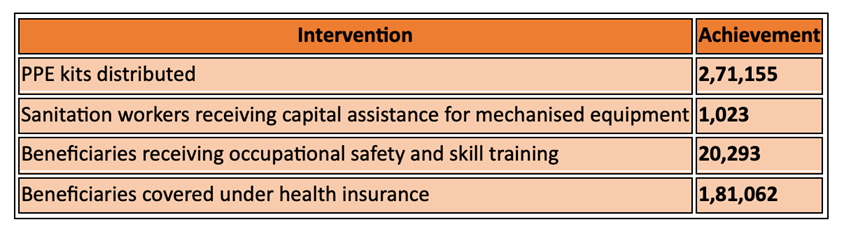
- These figures indicate that the scheme is combining mechanisation with occupational safety and social protection rather than treating mechanisation as a standalone intervention.
- Rehabilitation of Identified Manual Scavengers
- Surveys conducted in 2013 and 2018 identified 58,098 manual scavengers across the country. According to the Government:
- All identified beneficiaries have received one-time cash assistance.
- 27,926 beneficiaries have undergone skill development training.
- 2,803 beneficiaries have received capital subsidy for establishing general self-employment projects.
- These measures are intended to provide alternative livelihood opportunities and facilitate the socioeconomic rehabilitation of identified manual scavengers.
News Summary
- The Central government has proposed expanding NAMASTE from towns and cities to rural areas.
- The proposed expansion would broaden the categories of workers covered by the scheme to include:
- Drain cleaners
- Workers in sewage treatment plants (STPs)
- Workers in faecal sludge treatment plants
- The proposed expanded scheme would have an estimated outlay of approximately 498.73 crore, to be spent from the current financial year through 2030-31.
- The proposed expansion is significant because hazardous sanitation work is not confined to urban sewer and septic tank systems.
- Extending mechanisation and occupational-safety interventions to rural sanitation infrastructure could widen the reach of the programme.
Significance
- The expansion of NAMASTE reflects a shift towards a more comprehensive approach to sanitation-worker welfare.
- The central objective is not merely to prevent manual entry into sewers and septic tanks but to create an ecosystem in which sanitation workers have access to:
- Mechanised equipment
- Occupational safety training
- Protective equipment
- Health insurance
- Skill development
- Alternative livelihood opportunities
- The proposed rural expansion is particularly important because sanitation infrastructure is increasingly being developed beyond major urban centres.
- At the same time, the gaps identified in capital subsidy approvals and disbursements demonstrate that effective implementation and timely access to financial assistance remain critical challenges.

