Why in News?
- The National Organ and Tissue Transplant Organisation (NOTTO) has launched a dynamic real-time national portal and mobile application to digitise India's organ transplantation ecosystem.
- The platform aims to establish a unified nationwide waiting list, enable transparent organ allocation, facilitate national-level donor matching, and improve transplant outcome monitoring.
- This will help in strengthening equity, efficiency, and accountability in organ transplantation.
What’s in Today’s Article?
- Why the Portal is Significant?
- Key Features of the Portal
- How Organ Allocation will Work?
- Major Challenges
- Conclusion
Why the Portal is Significant?
- The portal represents a major reform in India's organ transplantation framework by -
- Reduce delays in transplantation by creating a real-time national waiting list for organ recipients.
- Enabling transparent and traceable organ allocation across hospitals and states.
- Increase utilisation of donated organs by facilitating nationwide matching of swap donors.
- Recording post-transplant health outcomes through follow-up data.
- Strengthening cooperative federalism through better Centre-State coordination.
- Improving coordination among hospitals, State Organ and Tissue Transplant Organisations (SOTTOs), Regional Organ and Tissue Transplant Organisations (ROTTOs), and NOTTO.
- Promoting organ donation through Aadhaar-linked organ donation pledges.
- Generating evidence-based data for future healthcare planning, and improving public trust in the transplantation system.
- The initiative aligns with the broader goals of Digital Health, Good Governance, and Universal Health Coverage.
Key Features of the Portal:
- Unified national waiting list:
- Hospitals directly upload patient details onto the portal.
- The system automatically generates hospital-level waiting lists, state-level waiting list, regional waiting list, and national waiting list.
- This replaces fragmented hospital-based record systems and enhances transparency.
- Real-time organ allocation:
- The portal digitally manages inter-hospital allocation, intra-state transfers, inter-state organ movement, and national-level allocation where required.
- Every transaction is digitally recorded, improving accountability and reducing delays.
- National swap donor matching:
- The portal expands the pool for paired kidney exchange (swap transplantation).
- Earlier, hospitals searched only within their own donor pool.
- Now, matching can occur across the country, significantly increasing the probability of compatible donor-recipient pairs among nearly one lakh patients awaiting transplantation.
- National transplant outcome registry: For the first time, hospitals will upload follow-up health data of transplant recipients, creating a national database on transplant outcomes, useful for -
- Policy formulation
- Clinical research
- Quality assessment
- Performance monitoring
- Digital alerts and Aadhaar-linked organ pledges: The portal enables -
- Automated alerts replacing manual coordination through calls and messages.
- Aadhaar-linked organ donation pledges, ensuring clarity regarding donor consent when required.
- Regulatory functions: The platform also supports registration and renewal of transplant centres, online processing by State Appropriate Authorities, and formation and monitoring of statutory committees.
How Organ Allocation will Work?
- The portal follows existing allocation principles:
- The donor hospital gets the first opportunity to allocate organs to its registered patients.
- If no suitable recipient is available - organ moves to the State Pool, then to the Regional Pool, and finally to the National Pool.
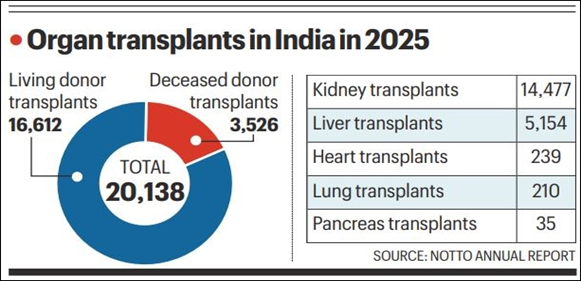
- Kidney allocation: Since kidneys constitute the largest share of transplants -
- One kidney generally remains with the donor hospital.
- The second is allocated to the nearest government hospital with a matching recipient.
- If unmatched, it progresses through the state, regional, and national pools.
- Current status of organ transplantation in India:
- Delhi recorded the highest overall transplants of 4,564.
- Tamil Nadu performed the highest number of deceased donor transplants (266).
Major Challenges:
- Diverse state allocation policies:
- Uniform allocation remains difficult because states follow different criteria.
- For example,
- Telangana, Maharashtra and Gujarat follow Score-based allocation.
- West Bengal, Karnataka, Rajasthan and Kerala follow priority based on earlier registration.
- Tamil Nadu follows a regional zonal allocation system.
- Madhya Pradesh and Chhattisgarh give preference to patients lacking suitable living donors.
- Consequently, although the portal generates a consolidated national waiting list, allocation priorities continue to follow existing state guidelines.
- Need for policy harmonisation: NOTTO is consulting states to evolve uniform allocation standards, but healthcare being primarily a State Subject, consensus remains essential.
- Phased rollout: While the portal has been launched, all operational modules are expected to become fully functional within the next two months, after testing system performance and traffic.
Conclusion:
- The NOTTO portal marks a transformative step towards creating a transparent, technology-driven and equitable organ transplantation ecosystem in India.
- Its long-term success, however, will depend on uniform national allocation guidelines, effective Centre-State coordination, robust data governance, and greater public awareness to boost organ donation rates.