Why in news?
The Calcutta High Court has held that casteist slurs on social media can attract provisions of the SC/ST (Prevention of Atrocities) Act, 1989, ruling that "public view" under the law is not confined to physical spaces.
A single bench of Justice Uday Kumar held that the requirement of "public view" under Sections 3(1)(r) and 3(1)(s) of the Act "transcends physical space into the digital domain."
This ruling comes weeks after the Supreme Court reiterated that not every caste-related remark amounts to an offence under the Act, and that courts must closely examine whether its statutory requirements are met — making this an important, evolving area of law.
What’s in Today’s Article?
- What the Law Says?
- How Courts Have Interpreted Public View So Far?
- What the Calcutta High Court Held?
- The Emerging Judicial Pattern
What the Law Says?
- Sections 3(1)(r) and 3(1)(s) of the SC/ST Act criminalise intentionally insulting, intimidating or abusing a member of a Scheduled Caste or Scheduled Tribe by caste name, "in any place within public view."
- To establish these offences, three elements must be satisfied:
- The accused must not be a member of an SC/ST community.
- The act must be intended to humiliate the victim on the basis of caste.
- The incident must occur in a place within public view.
- Digital cases typically hinge on this third requirement.
How Courts Have Interpreted Public View So Far
- Hitesh Verma v. State of Uttarakhand (2020) — Supreme Court. The SC held that public view means a place where members of the public can witness or hear the alleged utterance.
- It clarified: "If the alleged offence takes place within the four corners of the wall where members of the public are not present, then it cannot be said that it has taken place at a place within public view."
- Ramkrishna Chauhan v. State of Uttar Pradesh (2026) — Supreme Court. Apex Court quashed proceedings against a school manager under both clauses. The bench held the requirement depends on whether the alleged utterance was made in circumstances where members of the public could witness or hear it.
- Crucially, it added: "the mere fact that the occurrence took place within the premises of a school does not, by itself, satisfy this requirement."
- This shows the Supreme Court has been applying the test cautiously and narrowly in physical-space cases.
What the Calcutta High Court Held?
- The petitioner, a member of a Scheduled Caste, alleged that two men from general caste communities had "hurled foul, unparliamentary, and casteist expletives targeting his caste identity, religion, God, and family" on Facebook.
- Police approached Facebook through the Cyber Police Station, Kolkata, but did not receive user details.
- Police then filed a "Final Report True, No Clue" — effectively closing the case.
- The complainant challenged this closure, but the Special Court at Alipore rejected his petition.
- The HC's Intervention
- The High Court set aside the Special Court's order.
- The court held it "transcends physical space into the digital domain."
- It noted that police had seized screenshots and recorded statements during investigation, and therefore the investigating agency "cannot throw up its hands reporting 'no clue'" after a mere local cyber inquiry failed — without exhausting specialised State CID cyber-forensic or IP-log tracking protocols.
- This is a significant procedural direction: investigators must pursue advanced technical methods before declaring a dead end.
The Emerging Judicial Pattern
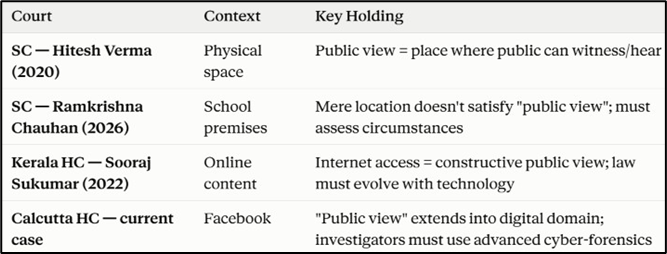
- The pattern shows courts applying a stricter, circumstance-based test for physical spaces, while extending the concept more liberally to digital spaces — recognising that online content, by its nature, has unlimited potential viewership.
Conclusion
The law was written for a world without screenshots and social media feeds, yet courts are now stretching "public view" to cover exactly that. The Calcutta High Court's ruling, read alongside Kerala's 2022 judgment, signals that caste-based abuse online cannot hide behind the excuse of a closed investigation.

