Why in news?
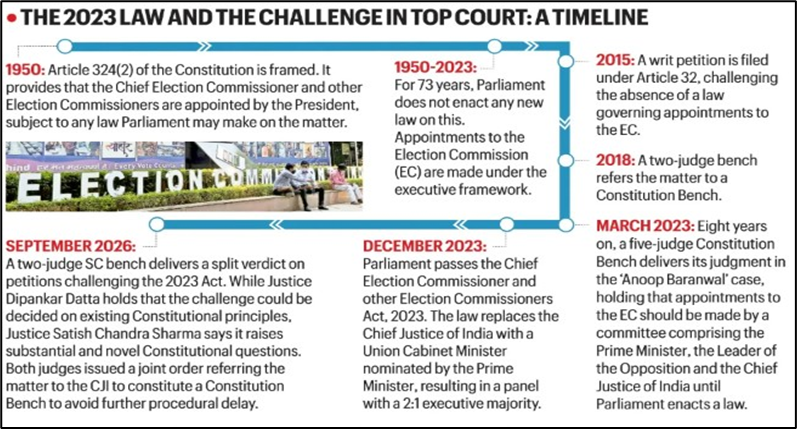
A two-judge Bench of the Supreme Court referred petitions challenging the 2023 law on appointment of the Chief Election Commissioner (CEC) and Election Commissioners (ECs) to the Chief Justice of India (CJI).
Justices Dipankar Datta and Satish Chandra Sharma disagreed on the merits of the case, but agreed the matter should go before the CJI to constitute an appropriately sized bench, so proceedings are not delayed further.
What’s in Today’s Article?
- Background: Where the 2023 Law Came From?
- What the 2023 Act Changed?
- Why the Bench Referred the Matter Further?
- Justice Datta's Key Observations
- A Shared Concern: Delays in Constitutional Adjudication
Background: Where the 2023 Law Came From?
- The challenge traces back to the Supreme Court's judgment in Anoop Baranwal v. Union of India in March 2023.
- The Court noted that Parliament had never enacted a law governing EC appointments, despite Article 324 of the Constitution contemplating one.
- It laid down an interim mechanism: appointments would be made by a committee comprising the Prime Minister, the Leader of Opposition (LoP) in Lok Sabha, and the CJI.
- The Bench stressed that those conducting elections must be insulated from executive influence, underlining the importance of an independent Election Commission.
- Parliament subsequently enacted the Chief Election Commissioner and Other Election Commissioners (Appointment, Conditions of Service and Term of Office) Act, 2023.
What the 2023 Act Changed?
- The law altered the composition laid down by the Court in a crucial way.
- It replaced the CJI on the selection committee with a Union Cabinet Minister nominated by the Prime Minister.
- As a result, the government effectively gained two representatives — the PM and the nominated minister — on the three-member panel, alongside the LoP.
- This shifted the committee's balance away from the judiciary-involved model the Court had temporarily designed.
Why the Bench Referred the Matter Further?
- A genuine split on the core question.
- The two judges disagreed on whether the present Bench could decide the case itself, or whether it needed a Constitution Bench.
- Justice Datta held that the relevant constitutional principles are already settled; the Court only needs to test the 2023 law against them.
- Justice Sharma held that the case raises an important constitutional question not previously decided.
- Avoiding further delay.
- Rather than referring their disagreement to a three-judge bench — which would trigger another round of litigation — both judges agreed to place the matter directly before the CJI, to consider constituting a five-judge Constitution Bench.
Justice Datta's Key Observations
- Though the case moves to a larger bench, Justice Datta's observations (part of the split reasoning) carry significant substantive weight.
- Independence Must Be Visible, Not Just Real - Using a cricket analogy, he noted that even correct decisions can be viewed with suspicion if the process of choosing the umpire appears unfair.
- The issue, he said, is as much about public confidence as about actual independence.
- The LoP's Role Risks Becoming Ornamental - Because a Cabinet Minister nominated by the PM is bound by collective responsibility, such a minister is unlikely to disagree with the PM within the committee.
- This effectively neutralises any check the LoP's presence might otherwise provide.
- Justice Datta observed that the petitioners' argument — that the law gives the executive overwhelming influence over EC appointments — does appear to have substance.
- On The Collegium Comparison - The government's defenders often argue that if judges can appoint judges via the collegium without outside checks, a similar executive-heavy model for EC appointments should also be acceptable.
- Justice Datta pushed back on this comparison, pointing out that judicial appointments already involve the executive at the confirmation stage, and flagging concerns over the executive selectively clearing collegium recommendations.
- He also questioned whether the presence of a "neutral member" would even be meaningful in the EC selection process, given that the collegium itself functions without an outsider.
A Shared Concern: Delays in Constitutional Adjudication
- Both judges, despite their disagreement on the merits, jointly flagged a systemic problem: the long time taken to decide Constitution Bench matters.
- They noted that several constitutional references have remained pending for years, and urged the CJI to consider setting up a Constitution Bench to resolve such matters more expeditiously.
Conclusion
The verdict resolves nothing yet — it only decides how the question will be decided. But its real weight lies in Justice Datta's diagnosis: an opposition seat that cannot dissent is a safeguard in name only. Whether India's election watchdog stays independent in appearance, not just in law, now awaits a Constitution Bench.

