




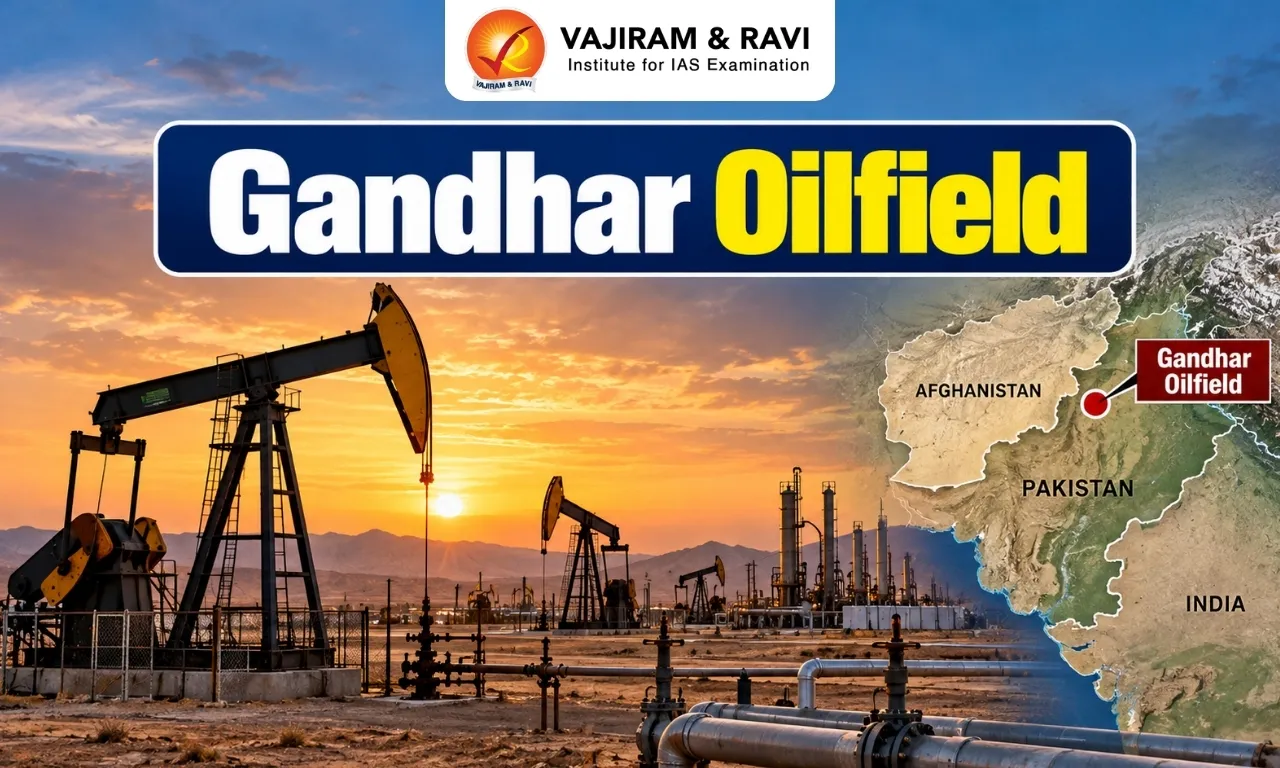
ONGC is developing a carbon capture and storage (CCS) pilot at the Gandhar Oilfield in Gujarat. The project aims to capture carbon dioxide (CO₂) from industrial sources and store it underground. It will also explore whether CO₂ injection can help extract additional oil from this mature field.
Gandhar Oilfield Location and Key Features
The Gandhar Oilfield is located in the Jambusar-Broach block of the Cambay Basin in Gujarat.
- It lies on the western flank of the Broach depression, between the Dadhar River in the north and the Narmada River in the south.
- The field is operated by the Oil and Natural Gas Corporation (ONGC) under its Ankleshwar Asset.
What is a brownfield oilfield?
A brownfield oilfield is an existing field that has already been explored and developed and has been producing oil or gas for some time. As production declines, techniques such as enhanced oil recovery may help extract additional hydrocarbons. Existing infrastructure and geological data may also make such fields potential sites for carbon dioxide storage, subject to safety assessments.
ONGC’s Carbon Capture and Storage Pilot
The project aims to capture CO₂ from industries in Dahej and ONGC’s Hazira plant and transport it to Gandhar for underground storage.
- The captured CO₂ is proposed to be injected through two abandoned onshore wells at a target rate of around 100 tonnes per day.
- The project will assess whether underground reservoirs can safely store CO₂ over the long term.
- It will also examine the potential for Enhanced Oil Recovery (EOR), in which injected CO₂ helps mobilise residual oil and increase production from mature reservoirs.


Significance of the Project
The Gandhar CCS project is significant for its potential to reduce industrial emissions, make use of existing oilfield infrastructure and support India’s transition towards a low-carbon economy.
- Industrial decarbonisation: CCS could help reduce emissions from industries that are difficult to decarbonise through direct electrification or other measures.
- Shared infrastructure: Transporting CO₂ from industrial centres such as Dahej and Hazira to a common storage site could help distribute infrastructure costs.
- Use of mature oilfields: Existing geological data and infrastructure may help assess whether depleted reservoirs are suitable for CO₂ storage.
- Climate commitments: CCS could complement renewable energy, energy efficiency and green hydrogen as India works towards its net-zero emissions target for 2070.
Challenges and the Way Forward
- High costs: Capturing, compressing and transporting CO₂ requires substantial investment and energy.
- Risk of leakage: Underground storage requires careful assessment of geological formations, well integrity and long-term monitoring.
- Climate trade-offs: Enhanced oil recovery may increase oil production, but the additional emissions from using that oil must be considered when assessing the project's overall climate benefit.
India needs clear regulations for CO₂ storage, long-term monitoring and liability, along with suitable financial incentives. Commercial expansion should depend on evidence that the technology is safe, effective and economically viable.

 Last updated on Oct, 2026
→ UPSC 2027 Notification will be released on 13 January 2027 at upsconline.nic.in.
→ Check Nobel Prize 2026 Winners List here.
→ Check out the latest UPSC Syllabus here.
→ Download UPSC Calendar 2027 PDF Here.
Gandhar Oilfield FAQs
Q1. Where is the Gandhar Oilfield located?+
Q2. Which organisation operates the Gandhar Oilfield?+
Q3. What is a brownfield oilfield?+
Q4. What is the objective of ONGC’s CCS pilot at Gandhar?+
Q5. What is Enhanced Oil Recovery (EOR)?+
Tags: gandhar gandhar oilfield