




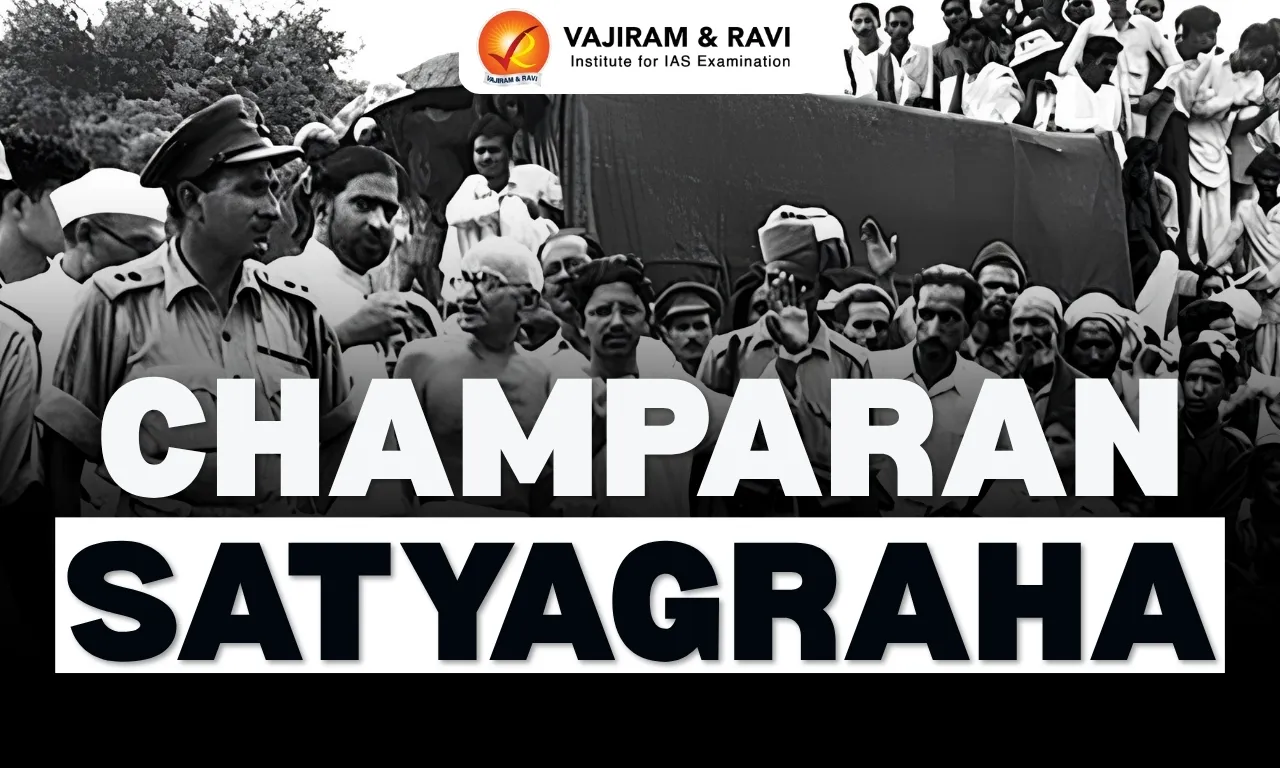
Champaran Satyagraha of 1917 was the first major civil disobedience movement led by Mahatma Gandhi in India. It was launched in Champaran, Bihar, against the exploitation of indigo farmers by European planters. Gandhi used Satyagraha, non-violent resistance and peaceful protest to demand justice for the farmers. The movement marked an important step in the development of Gandhi's methods of struggle against British rule.
What Was the Champaran Satyagraha?
The Champaran Satyagraha was a farmers' movement that began in April 1917 in the Champaran district of Bihar. It aimed to end the unfair practices followed by European indigo planters, who forced tenant farmers to grow indigo under oppressive conditions.
The farmers faced low payments, heavy rents and illegal charges. They had little freedom to decide which crops to grow on their land.
Mahatma Gandhi visited Champaran to investigate the farmers' problems and support their struggle. Instead of using violence, he collected evidence, organised peaceful resistance and challenged the authorities through civil disobedience.
Background and Causes of the Champaran Satyagraha
The Champaran Satyagraha was the result of long-standing exploitation of farmers by European indigo planters. The farmers had to follow unfair cultivation rules and pay additional charges, which caused serious economic difficulties.
- Forced indigo cultivation: European planters forced tenant farmers to grow indigo on a fixed portion of their land.
- Tinkathia system: Under this system, farmers had to cultivate indigo on 3 out of every 20 parts of their land, or 15% of their holdings.
- Low payment for indigo: Farmers received poor returns for their crops and had limited freedom to choose what they wanted to cultivate.
- Heavy rents and illegal charges: Planters imposed additional payments and charges on farmers, increasing their financial burden.
- Demand for compensation: When farmers wanted to stop growing indigo, some planters demanded additional payments, including tawan (compensation or a lump-sum payment) and sharahbeshi (an increase in rent).
- Decline in indigo cultivation: The growing use of synthetic dyes reduced the demand for natural indigo in some markets. Some planters sought payments from farmers in return for releasing them from indigo cultivation agreements.
- Lack of justice: Farmers had limited power to challenge the planters and obtain relief from unfair practices.


What Was the Tinkathia System?
The Tinkathia system was an oppressive arrangement under which tenant farmers in Champaran were required to grow indigo on 3/20 of their land for European planters. Under this system:
- Farmers had to reserve a fixed portion of their land for indigo cultivation.
- They received inadequate payment for the crop.
- Their freedom to grow food crops and other agricultural produce was restricted.
- Some planters imposed additional charges when farmers sought to end their obligation to grow indigo.
Role of Rajkumar Shukla in the Champaran Satyagraha
Rajkumar Shukla was an indigo cultivator from Champaran who played a key role in bringing Gandhi to the region. He met Gandhi at the Lucknow session of the Indian National Congress in December 1916 and requested him to visit Champaran to investigate the exploitation of farmers.
Shukla continued to persuade Gandhi to visit the district. His efforts eventually led Gandhi to travel to Bihar in April 1917 and investigate the farmers' grievances.
Course of the Champaran Satyagraha
The Champaran Satyagraha developed through Gandhi's visit, his refusal to obey an order to leave the district, a detailed investigation of farmers' complaints and negotiations with the colonial government.
- Gandhi's arrival in Bihar (April 1917): Gandhi arrived in Patna on 10 April 1917 with Rajkumar Shukla. He then travelled to Muzaffarpur, where he met local supporters and began gathering information about the farmers' condition.
- Visit to Champaran: Gandhi travelled to Champaran to investigate the problems caused by forced indigo cultivation and the Tinkathia system.
- Order to leave the district: The local authorities ordered Gandhi to leave Champaran. He refused because he believed that investigating the suffering of farmers was a moral responsibility.
- Civil disobedience: Gandhi was summoned to appear before a court. He accepted that he had disobeyed the order but explained that he had acted to serve the people. Large numbers of farmers gathered outside the court in support of him.
- Withdrawal of the case: The authorities eventually withdrew the case and allowed Gandhi to continue his investigation.
- Collection of farmers' statements: Gandhi and his associates visited villages and recorded farmers' complaints about forced cultivation, unfair payments and illegal charges.
- Formation of an inquiry committee: The government formed the Champaran Agrarian Inquiry Committee in June 1917 and included Gandhi as a member.
- Recommendations and legal reform: The committee examined the farmers' grievances and recommended changes to the indigo cultivation system. Its recommendations led to the abolition of the Tinkathia system and other reforms under the Champaran Agrarian Act of 1918.
Important Leaders Associated with the Champaran Satyagraha
Several Indian leaders and volunteers supported Gandhi during the movement and helped document farmers' complaints.
- Mahatma Gandhi: Led the Satyagraha, investigated the farmers' problems and used non-violent civil disobedience to challenge the authorities.
- Rajkumar Shukla: Brought the plight of indigo farmers to Gandhi's attention and persuaded him to visit Champaran.
- Dr. Rajendra Prasad: Supported the movement and later became the first President of independent India.
- J. B. Kripalani: Helped Gandhi during his visit to Bihar and supported the movement.
- Anugrah Narayan Sinha: Assisted in the efforts associated with the farmers' cause and later became an important political leader in Bihar.
- Mazhar-ul-Haq: Welcomed Gandhi during his visit to Bihar and supported the broader effort to address the farmers' grievances.
Role of Gandhi in the Champaran Satyagraha
The Champaran movement was an important early example of Gandhi's method of Satyagraha in India. He combined peaceful resistance with fact-finding and constructive social work.
- Investigation of grievances: Gandhi visited villages and collected evidence directly from affected farmers.
- Non-violent resistance: He peacefully refused to obey the order to leave Champaran and was prepared to face legal consequences.
- Organisation of farmers: His presence encouraged farmers to share their experiences and speak against unfair practices.
- Negotiation with authorities: He used documented evidence and public pressure to demand official action.
- Constructive work: Gandhi and his associates also worked to improve village education, sanitation and public awareness.
Also Read:- Champaran Satyagraha 1917
Outcome of the Champaran Satyagraha
The movement led to an official investigation and important changes in the system of indigo cultivation.
- Formation of the Champaran Agrarian Inquiry Committee: The government appointed an inquiry committee in June 1917, with Gandhi as one of its members.
- Abolition of the Tinkathia system: The committee recommended ending the compulsory indigo cultivation arrangement.
- Refund to farmers: The committee recommended refunding 25% of the tawan payments collected by planters in the cases covered by its findings. The government accepted this recommendation.
- Reduction of additional charges: The reforms also addressed certain rent increases and illegal charges imposed on cultivators.
- Champaran Agrarian Act, 1918: The Bihar and Orissa Legislative Council passed the legislation on 4 March 1918, providing a legal basis for important agrarian reforms.
- Greater confidence among farmers: The movement encouraged cultivators to raise their concerns collectively and challenge unfair treatment.
Significance of the Champaran Satyagraha
The Champaran Satyagraha holds an important place in India's freedom struggle because it demonstrated the practical use of Gandhi's methods in India.
- First major Satyagraha in India: It was Gandhi's first major Satyagraha after returning from South Africa in 1915.
- Rise of Gandhi as a mass leader: The movement brought Gandhi into wider public attention and strengthened his connection with ordinary people.
- Use of non-violent civil disobedience: It showed how peaceful resistance could challenge unjust orders and policies.
- Importance of peasant issues: It brought the problems of rural cultivators into the wider political discussion.
- Participation of local people: Farmers actively shared their grievances, making them important participants in the struggle for justice.
- Evidence-based protest: Gandhi relied on village visits, recorded statements and an official inquiry rather than violence.
- Development of constructive work: The movement also addressed education and sanitation in villages.
- Influence on later movements: The experience helped shape Gandhi's approach to subsequent struggles, including the Kheda Satyagraha of 1918 and later nationwide campaigns.
Champaran Satyagraha UPSC PYQs
Q1: Indigo cultivation in India declined by the beginning of the 20th century because of (UPSC Prelims 2020)
- peasant resistance to the oppressive conduct of planters
- its unprofitability in the world market because of new inventions
- national leaders’ opposition to the cultivation of indigo
- Government control over the planters
Ans: (b)
Q2: Which one of the following is a very significant aspect of the Champaran Satyagraha? (UPSC Prelims 2018)
- Active all-India participation of lawyers, students and women in the National Movement.
- Active involvement of Dalit and Tribal communities of India in the National Movement.
- Joining of peasant unrest to India’s National Movement.
- Drastic decrease in the cultivation of plantation crops and commercial crops.
Ans: (c)

 Last updated on Oct, 2026
→ UPSC 2027 Notification will be released on 13 January 2027 at upsconline.nic.in.
→ Check Nobel Prize 2026 Winners List here.
→ Check out the latest UPSC Syllabus here.
→ Download UPSC Calendar 2027 PDF Here.
Champaran Satyagraha FAQs
Q1. When did the Champaran Satyagraha take place?+
Q2. Who started the Champaran Satyagraha?+
Q3. What was the Tinkathia system?+
Q4. Why was the Champaran Satyagraha launched?+
Q5. What was the outcome of the Champaran Satyagraha?+
Q6. Why is the Champaran Satyagraha important?+
Q7. Who was Rajkumar Shukla?+
Q8. What was the role of the Champaran Agrarian Inquiry Committee?+
Tags: champaran satyagraha champaran satyagraha 1917