



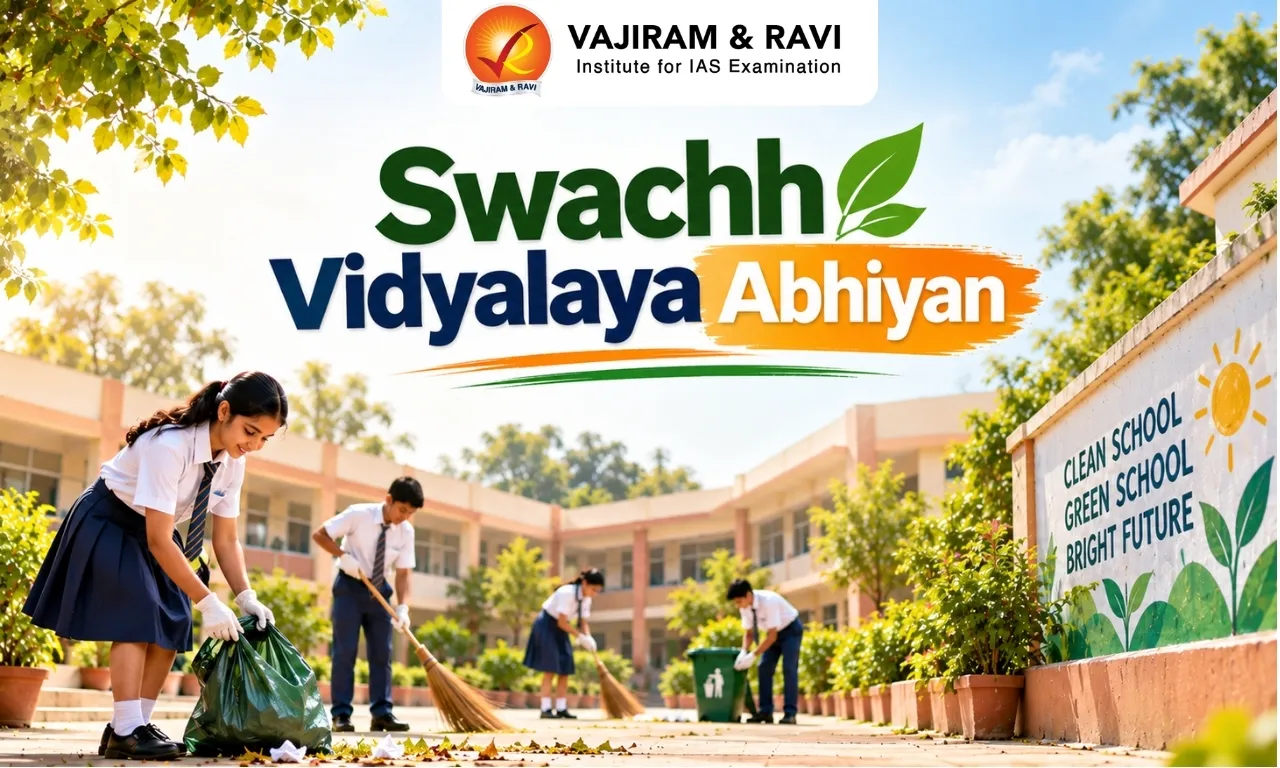
Swachh Vidyalaya Abhiyan is an initiative launched by the Government of India in August 2014,under the Swachh Bharat Mission. The initiative aims to provide a clean, safe, and hygienic learning environment in schools across India. It focuses on providing separate toilets for boys and girls, safe drinking water, and proper handwashing facilities. It also encourages students and teachers to maintain cleanliness and follow good hygiene practices to improve students' health and overall school sanitation.
Swachh Vidyalaya Abhiyan Objectives
The Swachh Vidyalaya Abhiyan aims to improve cleanliness, sanitation, and hygiene in schools to provide students with a safe and healthy learning environment. The key objectives of the initiative are discussed below.
- Announced on 15th August 2014: The Prime Minister called for all government schools to have toilets, with separate toilets for girls, within one year. He also invited the corporate sector to join this national effort.
- Launched by the Ministry of Human Resource Development (MHRD): The ministry is now known as the Ministry of Education. It launched the campaign as “Swachh Bharat: Swachh Vidyalaya” under the Swachh Bharat Mission.
- Supports the Right to Education (RTE) Act: The RTE Act requires every school to have separate toilets for boys and girls, and this campaign works to make that a reality.
- Focus on water, sanitation and hygiene (WASH): The aim is that every school has working and well-maintained facilities for drinking water, toilets and handwashing.
- Healthy school environment: Clean facilities protect children from illness and help them attend school regularly and learn better.
- A child’s right: Policymakers, government representatives, citizens and parents are all expected to make sure every child studies in a school with safe water and proper sanitation.
Swachh Vidyalaya Abhiyan Key Features and Initiatives
The campaign combines technical facilities (toilets, water, handwashing stations) with human development activities (hygiene habits and awareness). Here are its main features.
- Separate toilets for boys and girls: One unit usually means one toilet plus three urinals, and the preferred ratio is one unit for every 40 students.
- Menstrual hygiene management (MHM): Schools should provide soap, a private space for changing, enough water for washing, and disposal facilities such as incinerators and dust bins. Girls should be taught about menstrual hygiene by female teachers in a supportive way.
- Group handwashing with soap: Stations should let 10-12 students wash their hands at the same time. They should be simple, low-cost, use minimum water, and can be built from local materials.
- Handwashing before the mid-day meal: Teachers supervise these sessions, set aside about 10-12 minutes, and use them to teach that hands must be washed before eating and after using the toilet.
- Safe drinking water: Schools should provide child-friendly drinking water every day, plus enough water for handwashing, cleaning and cooking. Water should be stored and handled safely.
- Inclusive and accessible design: Facilities should suit small children, adolescent girls and children with disabilities. Building accessibility into the design from the start costs far less than fixing it later.
- Operation and maintenance: Schools can use Annual Maintenance Contracts (AMCs) for regular repairs and supplies such as soap, disinfectants, brooms and buckets. Alternatively, they can appoint local cleaners. The School Management Committee (SMC) appoints people to inspect facilities daily.
- Behaviour change activities: Hygiene messages can be part of textbooks, activity-based learning, supplementary reading or the morning assembly.
- Swachh Vidyalaya Puraskar (June 2016): This award recognises schools that perform well in water, sanitation, handwashing, maintenance and behaviour change and capacity building. At the national level, 200 schools (100 elementary and 100 secondary) receive Rs. 50,000 as an extra school grant along with a certificate. There are also 40 state-level and 48 district-level awards with certificates.


Swachh Vidyalaya Abhiyan Implementation and Government Initiatives
The Swachh Vidyalaya Abhiyan was implemented with support from the government, corporate partners, and local authorities to improve school sanitation. The key initiatives are discussed below.
- Joint funding: The Central Government funded the work through Sarva Shiksha Abhiyan (SSA), Rashtriya Madhyamik Shiksha Abhiyan (RMSA) and the Swachh Bharat Kosh, together with States and Union Territories.
- Corporate partnership: The work was done with 64 Public Sector Undertakings (PSUs) and 11 private corporations.
- Toilets sanctioned under SSA and RMSA: 88,728 toilets were sanctioned in 2014-15.
- Taken up by PSUs and corporates: About 1.58 lakh toilets, including dysfunctional ones, were taken up for construction or repair.
- Swachh Bharat Kosh allocation: Rs. 56.51 crore was set aside to rebuild and repair non-working toilets.
- Role of CPSEs: Central Public Sector Enterprises had to build toilets with running water and handwashing facilities. They also had to maintain them for three to five years, with costs charged to their Corporate Social Responsibility (CSR) budgets.
- Gap assessment first: At launch, the gap in working toilets was assessed and the work planned around it, so that every child could have a gender-separate toilet.
- Involving Panchayats: The MHRD worked with the Ministry of Panchayati Raj and the Ministry of Drinking Water and Sanitation to involve Panchayats in maintaining school toilets and disposing of waste. States were advised to add toilet construction, repair and drinking water in schools to the Gram Panchayat Development Plan.
- Swachhta Pakhwada : Schools held cleanliness drives, essay, painting and debate competitions, slogan writing, cultural programmes and a Swachhata Shapath (pledge). Teachers also held meetings with parents on cleanliness.
Swachh Vidyalaya Abhiyan Challenges
The Swachh Vidyalaya Abhiyan faces several challenges in maintaining sanitation facilities, ensuring clean water, and promoting hygiene practices in schools. The key challenges are discussed below.
- Maintenance and repair: Once 100% access was reached, the upkeep of toilets became the main concern, since facilities that are not maintained quickly stop working.
- Waste disposal: Schools need systems for the safe disposal of solid and liquid waste, which is why Panchayats were brought in.
- Dysfunctional toilets: A large number of existing toilets did not work and needed reconstruction or repair, not just new buildings.
- Reliable water supply: Handwashing and toilet use depend on enough water. Handwashing stations are meant to use minimum water, which shows how important this issue is.
- Menstrual hygiene support: Girls need private spaces, soap, water and disposal facilities. Without these, they may stay away from school.
- Changing habits: Handwashing and hygiene need to become a daily routine, which takes continuous teaching and supervision.
- Building capacity: Teachers, community members, NGOs and administrators need training in managing, monitoring and promoting school sanitation.
- Accessibility: Facilities must work for children with disabilities, and they should be involved in the design process.
Swachh Vidyalaya Abhiyan Impact
The Swachh Vidyalaya Abhiyan has helped improve school sanitation, student health, and hygiene awareness across India. The key impacts of the initiative are discussed below.
- Target achieved in one year: By 15th August 2015, 4,17,796 toilets had been built or made functional in 2,61,400 schools.
- 100% access: India reached its target of working toilets in all government schools.
- National recognition: Swachh Vidyalaya was named a priority programme for the Prime Minister’s Excellence Award 2016.
- Better health and hygiene: Better sanitation lowers the spread of water and sanitation-related diseases among children.
- Higher enrolment, attendance and retention: This is especially true for girls, who are more likely to drop out when toilets are missing, unsafe or not private.
- Support for school nutrition: Washing hands with soap before the mid-day meal helps children get the full benefit of their food instead of picking up germs.
- Dignity, privacy and equity: Gender-separate and accessible toilets protect dignity and give every child, including those with special needs, an equal chance to learn.
- Children as agents of change: Pupils carry good habits home to their families and communities. School water and sanitation clubs also share chores among boys and girls, breaking the idea that cleaning is only for women or certain groups.
- Stronger hygiene education: Health and hygiene are being built into the curriculum and teaching methods, which supports lasting behaviour change.

 Last updated on Oct, 2026
→ UPSC 2027 Notification will be released on 13 January 2027 at upsconline.nic.in.
→ Check Nobel Prize 2026 Winners List here.
→ Check out the latest UPSC Syllabus here.
→ Download UPSC Calendar 2027 PDF Here.
Swachh Vidyalaya Abhiyan FAQs
Q1. What is Swachh Vidyalaya Abhiyan?+
Q2. When was Swachh Vidyalaya Abhiyan launched?+
Q3. What is the main objective of Swachh Vidyalaya Abhiyan?+
Q4. Which ministry launched Swachh Vidyalaya Abhiyan?+
Q5. What are the key features of Swachh Vidyalaya Abhiyan?+
Q6. What are the major achievements of Swachh Vidyalaya Abhiyan?+
Tags: swachh vidyalaya abhiyan