



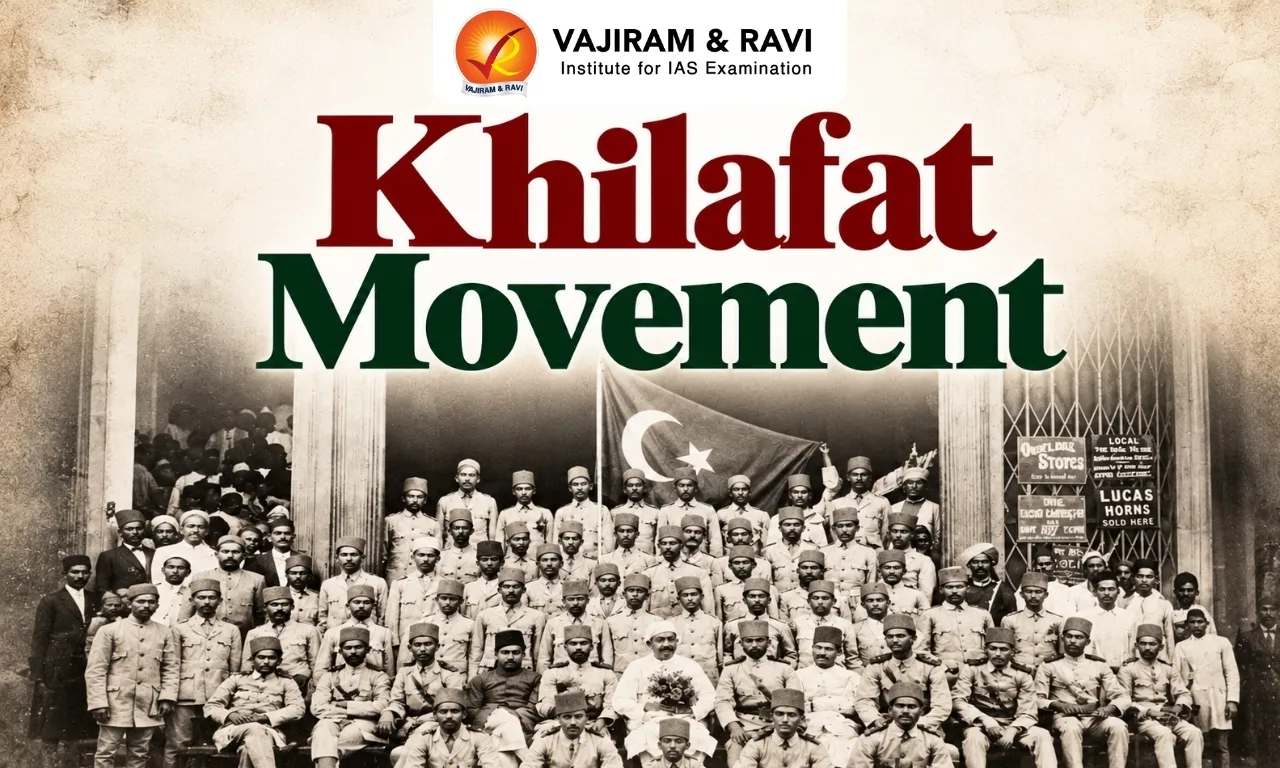
The Khilafat Movement was a political campaign launched by Indian Muslims in 1919 to protect the Ottoman Caliphate after the First World War. It developed into a broader anti British struggle when Mahatma Gandhi linked it with the Non Cooperation Movement. The movement strengthened mass participation in India's freedom struggle and encouraged Hindu-Muslim cooperation, but its influence declined following the withdrawal of non cooperation and the abolition of the Caliphate in 1924.
What is Khilafat Movement?
The Khilafat Movement emerged in British India to defend the Ottoman Caliph's authority and oppose the post war settlement imposed on Turkey.
- Origin: Indian Muslim leaders launched the agitation after the First World War, fearing that the victorious Allied powers would weaken the Caliphate.
- Khilafat Committee: Established in Bombay in March 1919, the committee organised meetings and coordinated efforts to defend the Caliph's position.
- Nationalist association: Mahatma Gandhi and the Indian National Congress supported the cause, connecting it with the struggle against British colonial rule.
- Non Cooperation Movement: From 1920, the two movements worked together through peaceful protests and the boycott of British institutions and foreign goods.
- Duration: The movement remained active from 1919 to 1924, ending after the Turkish government abolished the Caliphate.
Khilafat Movement Causes
The Khilafat Movement arose from religious concerns, post war political developments and growing dissatisfaction with British rule among Indians.
- Defeat of the Ottoman Empire: The Ottoman Empire's defeat in the First World War raised fears that the Allied powers would dismantle it and reduce the Caliph's authority.
- Threat to the Caliphate: Many Indian Muslims viewed the Ottoman Sultan as a symbol of unity for Muslims worldwide and opposed measures threatening his position.
- Treaty of Sèvres 1920: The treaty imposed severe conditions on Turkey, dividing its territories and intensifying opposition among Indian Muslims.
- Economic hardship: Wartime inflation, rising rents and taxes and declining industrial production increased public dissatisfaction with British administration.
- Repressive colonial policies: The Rowlatt Act, Jallianwala Bagh Massacre and dissatisfaction with the Government of India Act 1919, strengthened anti British sentiment.


Khilafat Movement Events and Timeline
The Khilafat Movement progressed through organised political action, cooperation with Congress and major developments in India and Turkey.
- March 1919: The Khilafat Committee was formed in Bombay to organise protests and build support for protecting the Ottoman Caliphate.
- November 1919: At the All India Khilafat Conference in Delhi, Gandhi supported non cooperation, while Hasrat Mohani advocated boycotting British goods.
- 1920: The Treaty of Sèvres intensified opposition and Khilafat leaders joined Gandhi's campaign against British rule through non cooperation.
- 1920-1921: The combined movement mobilised students, traders, peasants and other sections through boycotts and peaceful political participation.
- 1921: The Malabar rebellion and the migration of Muslim peasants to Afghanistan weakened the movement's wider appeal.
- 1922: Gandhi suspended the Non Cooperation Movement following the Chauri Chaura incident, reducing the Khilafat agitation's political strength.
- 1922: Mustafa Kemal Atatürk's government removed Sultan Mehmed VI, further weakening the original objective of the movement.
- 1924: Atatürk abolished the Caliphate, removing the movement's central demand and bringing its organised campaign to an end.
Khilafat Movement Impacts
Despite its eventual decline, the Khilafat Movement influenced Indian nationalism, political participation and relations between different religious communities.
- Mass political participation: The movement brought more Muslims into organised anti colonial politics and widened participation in India's freedom struggle.
- Hindu-Muslim cooperation: Joint participation with Congress created opportunities for cooperation between communities against British colonial rule.
- Growth of nationalism: Boycotts, demonstrations and non cooperation strengthened public involvement in political activities and resistance to colonial authority.
- Expansion of mobilisation: Students, traders, peasants, artisans, women and urban workers participated in the wider campaign, extending nationalism beyond established political circles.
Khilafat Movement Leaders
Several religious scholars and nationalist leaders organised the agitation, mobilised supporters and connected Khilafat Movement with India's broader freedom struggle.
- Maulana Mohammad Ali Jauhar: One of the principal Khilafat Movement Leaders, he helped organise the campaign and mobilise Indian Muslims against the post war treatment of Turkey.
- Maulana Shaukat Ali: Mohammad Ali's brother, he played a major role in organising the agitation and promoting cooperation with the national movement.
- Maulana Abul Kalam Azad: A scholar and nationalist, he supported the Khilafat cause and encouraged political mobilisation through his writings and public influence.
- Mahatma Gandhi: He connected the Khilafat issue with non cooperation, seeking to strengthen Hindu-Muslim unity and resistance to British rule.
- Hasrat Mohani: He supported the movement and advocated boycotting British goods as a means of opposing colonial authority.
- Hakim Ajmal Khan and Dr. Mukhtar Ahmed Ansari: Both contributed to organising the movement and supported nationalist cooperation, including efforts to bring Muslim participation into wider political activities.

 Last updated on Oct, 2026
→ UPSC 2027 Notification will be released on 13 January 2027 at upsconline.nic.in.
→ Check Nobel Prize 2026 Winners List here.
→ Check out the latest UPSC Syllabus here.
→ Download UPSC Calendar 2027 PDF Here.
Khilafat Movement FAQs
Q1. Who started the Khilafat Movement and why?+
Q2. Who was the president of the All India Khilafat Movement in 1919?+
Q3. What was the main objective of the Khilafat Movement?+
Q4. How was the Khilafat Movement related to the Non Cooperation Movement?+
Q5. What caused the Collapse and End of the Movement?+
Tags: khilafat andolan khilafat movement