



Quit India Movement (1942)
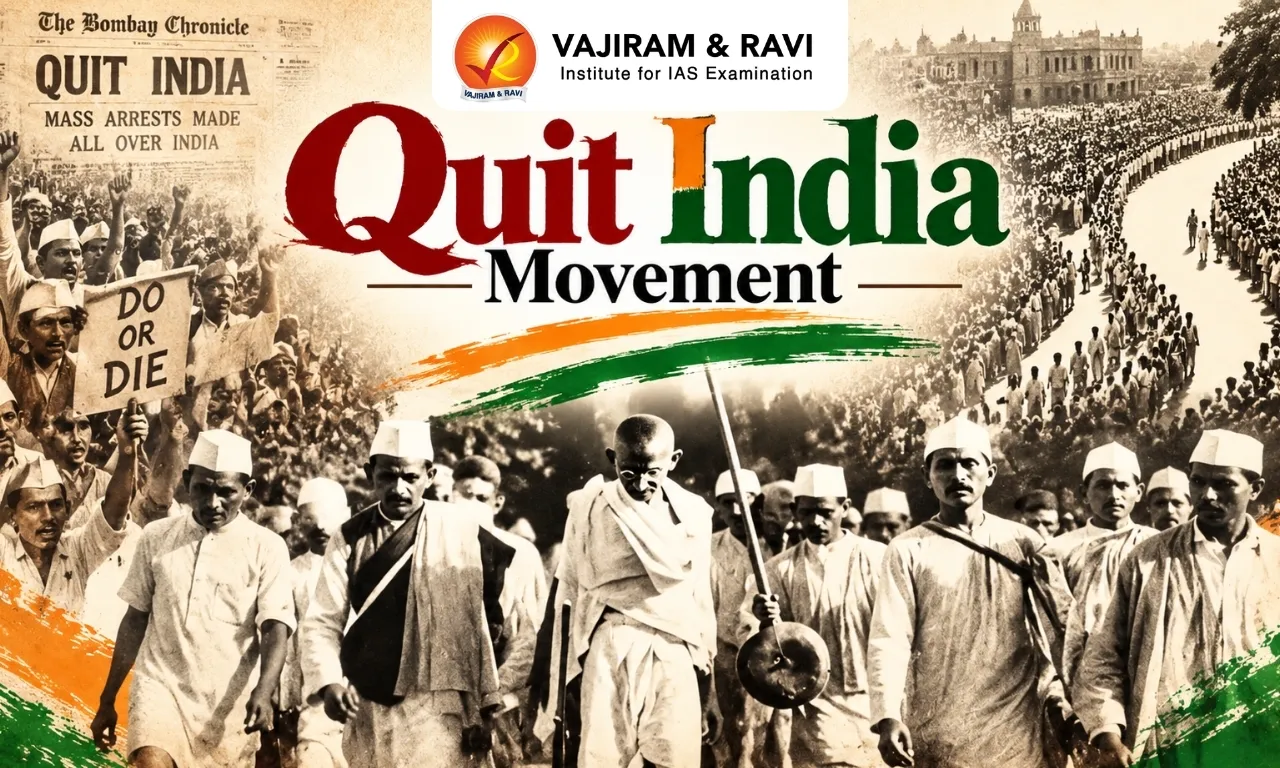
The Quit India Movement was a mass anti-colonial movement launched by the Indian National Congress under Mahatma Gandhi’s leadership to demand the immediate end of British rule in India. Also known as the August Movement or August Kranti, it marked a decisive phase in the freedom struggle during the Second World War.
On 8 August 1942, the All India Congress Committee (AICC) adopted the Quit India Resolution at Bombay, now Mumbai. Gandhi gave the call of “Do or Die”, urging Indians to struggle for freedom through non-violent resistance. Following the arrest of major Congress leaders on 9 August, protests spread across the country, often developing into spontaneous and decentralised resistance.
Why was the Quit India Movement launched?
The Quit India Movement emerged from the failure of constitutional negotiations, growing wartime hardship and the Congress's demand for immediate independence.
- India’s involvement in the Second World War: In September 1939, the British government declared India a participant in the war without consulting Indian political representatives. The Congress opposed this unilateral decision and demanded a clear commitment to Indian independence.
- Failure of the August Offer, 1940: The British offer did not meet the Congress demand for an immediate transfer of power, leaving the constitutional deadlock unresolved.
- Individual Satyagraha, 1940-1941: Gandhi launched Individual Satyagraha to assert the right to oppose the war without initiating a mass movement. Vinoba Bhave was the first individual Satyagrahi, followed by Jawaharlal Nehru.
- Failure of the Cripps Mission, 1942: Sir Stafford Cripps offered proposals for constitutional arrangements after the war, including Dominion Status and a constitution-making body. The Congress rejected the proposals because they did not provide for immediate transfer of power and allowed provinces to remain outside the proposed Union.
- Japanese advance in Southeast Asia: Japanese military successes and the fall of British positions in Southeast Asia brought the war closer to India's borders, increasing anxiety and distrust of British wartime policies.
- Wartime economic hardship: Rising prices, shortages of essential goods and economic disruption intensified public discontent.
- Demand for immediate independence: Gandhi and the Congress leadership concluded that British rule itself had to end and that Indians needed to take responsibility for their own political future.


Launch of the Quit India Movement
The Quit India Movement developed through a series of Congress decisions in July and August 1942.
- 14 July 1942: The Congress Working Committee adopted a resolution at Wardha calling for an end to British rule and preparing for mass struggle.
- 8 August 1942: The AICC approved the Quit India Resolution at Gowalia Tank Maidan in Bombay, now known as August Kranti Maidan.
- “Do or Die” slogan: Gandhi urged Indians to make a determined effort to achieve freedom. The slogan became the defining call of the movement.
- 9 August 1942: The British government arrested Gandhi and other leading Congress figures before they could direct the campaign. The arrests triggered widespread demonstrations, strikes and acts of resistance.
The early arrests removed much of the movement’s central leadership, contributing to its spontaneous and decentralised character.
Programme and Methods of the Movement
The Quit India Movement demanded an end to colonial rule and sought to mobilise Indians across social and regional boundaries.
- Mass civil disobedience: People were encouraged to defy colonial authority and participate in protests against British rule.
- Strikes and demonstrations: Students, workers and other groups organised strikes, processions and public meetings.
- Boycott of colonial institutions: Protesters challenged the functioning of government offices and other institutions associated with British authority.
- Disruption of communications: In several areas, protesters damaged railway lines, telegraph wires and other communication infrastructure to disrupt colonial administration. Such actions often involved violence and were not consistent with Gandhi’s prescribed method of non-violent resistance.
- Underground resistance: Activists used secret publications, clandestine networks and underground broadcasts to maintain communication and sustain the movement.
- Local self-government: In certain districts, activists established parallel administrations that challenged or temporarily displaced colonial authority.
Although Gandhi called for non-violent action, the movement developed in different ways after the leadership was arrested. Some local protests became violent, and the campaign was not centrally controlled throughout its course.
Spread and Mass Participation
The Quit India Movement drew support from a wide range of social groups, with local grievances shaping participation in different regions.
- Students and youth: Students left educational institutions, joined demonstrations and helped organise underground resistance.
- Women: Women participated in protests, provided organisational support and helped sustain underground networks. Aruna Asaf Ali became a prominent symbol of resistance after hoisting the Congress flag at Gowalia Tank Maidan on 9 August 1942.
- Peasants: Rural communities participated in protests against colonial officials, revenue demands and local forms of exploitation.
- Workers: Workers in several industrial centres joined strikes and demonstrations, although participation varied across industries and regions.
- Socialist leaders: Jayaprakash Narayan, Ram Manohar Lohia and Achyut Patwardhan were among the leaders associated with underground activities.
- Local activists: Many lesser known activists and ordinary citizens sustained the movement after the arrest of senior Congress leaders.
The participation of diverse groups made the Quit India Movement a major expression of popular opposition to British rule, even though its reach and intensity differed across regions.
Underground Activities During the Quit India Movement
Underground networks became important after the British government arrested the principal Congress leadership in August 1942.
- Usha Mehta: She helped operate the clandestine Congress Radio in Bombay, which broadcast nationalist messages and information about the movement.
- Aruna Asaf Ali: She remained active in the resistance and became associated with underground political activity.
- Jayaprakash Narayan: He was among the socialist leaders who escaped detention and helped organise underground resistance.
- Ram Manohar Lohia: He contributed to clandestine communication and mobilisation against British rule.
- Achyut Patwardhan: He was another prominent socialist activist involved in underground networks.
These activities helped circulate information, maintain morale and coordinate resistance despite censorship and arrests.
Parallel Governments During the Quit India Movement
In some regions, activists established parallel governments that challenged British authority and carried out local administrative functions.
|
Region |
Associated leader or leaders |
Key features |
|
Ballia, United Provinces (now Uttar Pradesh), 1942 |
Chittu Pandey |
Activists briefly challenged colonial authority and secured the release of some political prisoners. |
|
Tamluk, Midnapore, Bengal, 1942-1944 |
Satish Chandra Samanta and other local leaders |
The Tamralipta Jatiya Sarkar organised local administration and relief activities. |
|
Satara, Bombay Presidency (now Maharashtra), 1943–1945 |
Nana Patil and other activists |
The Prati Sarkar developed a more sustained parallel administration, including people's courts and local mobilisation. |
The parallel governments demonstrated the ability of local activists to challenge colonial authority and organise alternative forms of administration. Their duration, organisational capacity and geographical reach differed.
British Response to the Quit India Movement
The British government responded with extensive repression to suppress the movement and restore administrative control.
- Mass arrests: Gandhi, Jawaharlal Nehru, Sardar Vallabhbhai Patel, Maulana Abul Kalam Azad and many other Congress leaders were detained.
- Detention of Gandhi: Gandhi was held at the Aga Khan Palace in Pune, while several other senior Congress leaders were detained at Ahmednagar Fort.
- Restrictions and censorship: Congress organisations were banned or restricted, offices were sealed, publications were censored and public meetings were suppressed.
- Police and military action: Authorities used arrests, lathi charges, firing and military force against protesters.
- Punitive measures: Collective fines, raids and other coercive measures were used in affected areas.
The repression severely weakened open organisational activity, but resistance continued through underground networks and local initiatives.
Why Did the Quit India Movement Remain Limited in Some Areas?
The Quit India Movement faced several political and organisational constraints despite its wide popular impact.
- Arrest of central leadership: The detention of Congress leaders on 9 August 1942 prevented them from directing the movement through the usual organisational channels.
- Uneven regional participation: The intensity of protests varied across regions, and not all areas experienced the same degree of mobilisation.
- Divergent political positions: The Muslim League opposed the Congress's demand and continued to pursue its own political programme. The Communist Party of India opposed the movement after the Soviet Union entered the Allied war effort following Germany's invasion of the Soviet Union in June 1941. The Hindu Mahasabha also did not support the Congress campaign.
- British repression: Arrests, censorship and the use of force disrupted communication and organisation.
- Departure from non-violence: Many protests developed into violent resistance, departing from Gandhi’s stated method and complicating the movement’s political direction.
- No immediate transfer of power: The movement did not force the British to leave India in 1942, and independence came after further political developments and negotiations.
These limitations did not erase the movement’s significance as a major challenge to colonial authority.
Significance and Achievements of the Quit India Movement
The Quit India Movement did not immediately secure independence, but it demonstrated the depth of popular opposition to British rule and shaped the final phase of the freedom struggle.
- Demand for immediate independence: It made the end of British rule the central and immediate demand of the Congress.
- Mass participation: Students, women, peasants, workers and local activists participated in resistance across many parts of India.
- Grassroots leadership: The movement demonstrated that resistance could continue even when senior political leaders were imprisoned.
- Growth of underground networks: Secret broadcasts, publications and clandestine organisations helped sustain nationalist activity under repression.
- Parallel administrations: The formation of governments in Ballia, Tamluk and Satara illustrated attempts to replace colonial authority with local administration.
- Political impact: The movement reinforced the difficulty of governing India without Indian cooperation and strengthened the wider demand for independence.
- Historical significance: It became a major landmark in the final phase of the national movement, preceding developments that culminated in independence in 1947.
The movement was one important factor in the eventual end of British rule, but independence resulted from a combination of nationalist mobilisation, post-war political changes, economic pressures and negotiations.
Aftermath of the Quit India Movement
The repression of the movement did not end the demand for independence. The subsequent years saw major political developments that shaped the transfer of power.
- Gandhi’s imprisonment: Gandhi was arrested on 9 August 1942 and held at the Aga Khan Palace. He was released in May 1944 on health grounds.
- Continuation of underground resistance: Socialist leaders and local activists continued clandestine activities during the period of repression.
- Post-war political developments: The end of the Second World War was followed by the INA trials, the Royal Indian Navy uprising of 1946 and renewed negotiations over the transfer of power.
- Independence in 1947: India became independent on 15 August 1947 after further political negotiations and the decision to partition British India.
Previous Year Questions (PYQs)
Q : With reference to 8 August 1942 in Indian history, which one of the following statements is correct? (2021)
- The Quit India Resolution was adopted by the AICC.
- The Viceroy’s Executive Council was expanded to include more Indians.
- The Congress ministries resigned in seven provinces.
- Cripps proposed an Indian Union with full Dominion Status after the Second World War.
Q : The Quit India Movement was launched in response to which of the following? (2013)
- Cabinet Mission Plan
- Cripps Proposals
- Simon Commission Report
- Wavell Plan
Q : Which one of the following observations is not true about the quit India movement of 1942? (2011)
a) It was a non-violent movement.
b) It was led by Mahatma Gandhi.
c) It was a spontaneous movement.
d) It did not attract the labour class in general.
Q : During the freedom struggle, Aruna Asaf Ali was a major woman organiser of underground activity in: (2009)
a) Civil Disobedience Movement
b) Non-Cooperation Movement
c) Quit India Movement
d) Swadeshi Movement

 Last updated on Oct, 2026
→ UPSC 2027 Notification will be released on 13 January 2027 at upsconline.nic.in.
→ Check Nobel Prize 2026 Winners List here.
→ Check out the latest UPSC Syllabus here.
→ Download UPSC Calendar 2027 PDF Here.
Quit India Movement FAQs
Q1. When was the Quit India Movement launched?+
Q2. Who gave the “Do or Die” slogan?+
Q3. What was the main cause of the Quit India Movement?+
Q4. Who were the major leaders of the underground movement?+
Q5. What were the parallel governments formed during the movement?+
Tags: quit india movement