


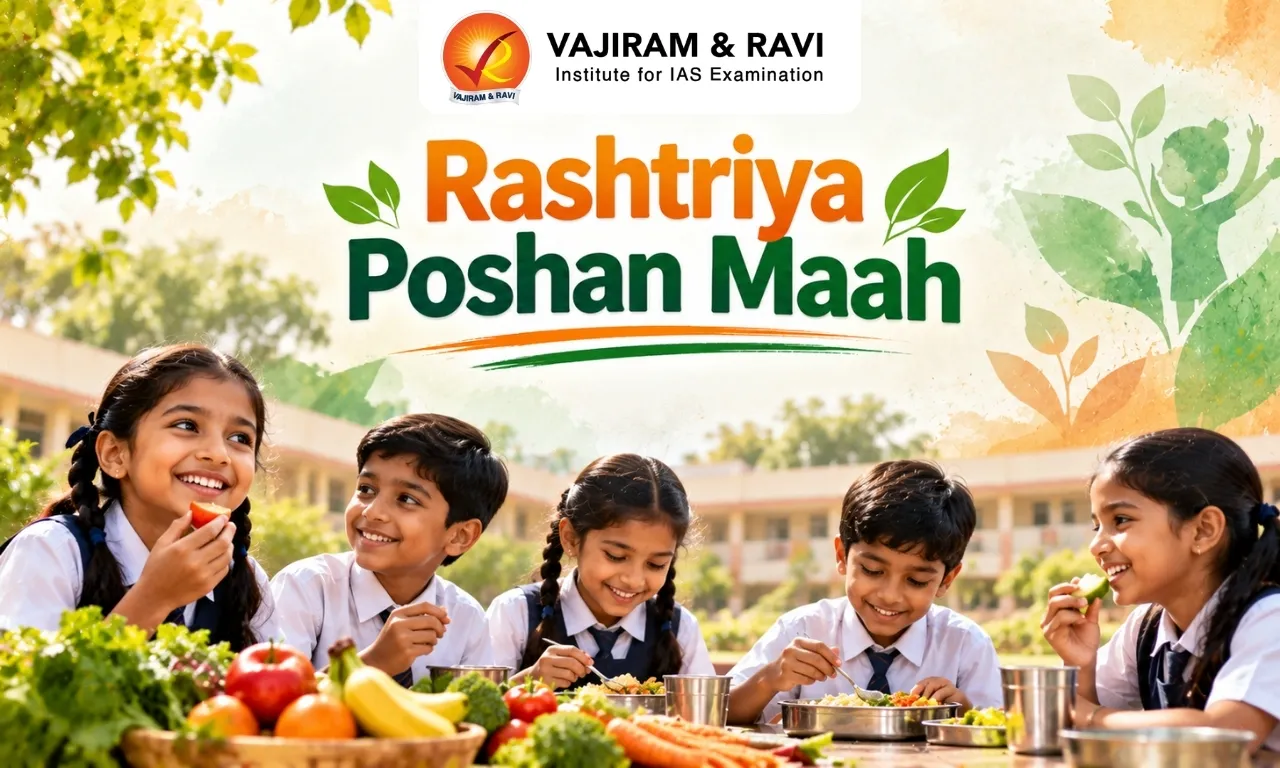
Rashtriya Poshan Maah, or National Nutrition Month, is an annual campaign run by the Ministry of Women and Child Development every September to fight malnutrition and promote healthy eating. It falls under POSHAN Abhiyaan, launched on 8 March 2018 in Jhunjhunu, Rajasthan, and focuses on children under six, pregnant women, lactating mothers and adolescent girls through community participation, better nutrition services and awareness drives. The 9th edition of Rashtriya Poshan Maah was launched on 9 September 2026 in Varanasi, Uttar Pradesh, under the theme “Hamari Anganwadi, Hamari Jimmedari.”
Rashtriya Poshan Maah 2026 Theme
- Central theme, “Hamari Anganwadi, Hamari Jimmedari”: The 9th edition of Rashtriya Poshan Maah (National Nutrition Month) places Anganwadi Centres at the heart of community action for nutrition, care and early childhood development.
- The theme asks every citizen to take shared ownership of their local Anganwadi. Another way the 2026 message is put is “Nutrition is everyone’s responsibility.”
- Launch and venue: The month-long campaign was set to begin on 9 September 2026 at the Rudraksh International Cooperation and Convention Centre in Varanasi, Uttar Pradesh. It recognises the role of Anganwadi Centres, the world’s largest childcare network, which reach children even in the remotest communities.
- Five key priorities: The campaign rests on five connected priorities. They are dietary diversity with enough protein, fresh and varied Hot Cooked Meals (HCM), community ownership through Anganwadi Management Committees (AMCs), nutrition and early stimulation for child development, and a celebration of 10 years of the Pradhan Mantri Matru Vandana Yojana (PMMVY).
Rashtriya Poshan Maah Objectives
Rashtriya Poshan Maah aims to improve nutrition and health outcomes across India by spreading awareness, promoting healthier food habits and strengthening community-based nutrition services. r
- Spread awareness and build better habits: Held every September, the campaign reaches pregnant women, lactating mothers, children, adolescents and their families. It reinforces healthy practices in maternal nutrition, infant and young child feeding (IYCF), growth monitoring and hygiene, and aims to cut down malnutrition across the country.
- Promote balanced, protein-rich diets: A varied plate with cereals and millets, pulses, fruits and vegetables, nuts and seeds, and milk products, plus protein from plant and animal sources, supports healthy growth. The campaign pushes dietary diversity at every life stage, especially during complementary feeding for young children.
- Improve the quality of Anganwadi meals: The campaign wants beneficiaries to get fresh, hygienic and varied Hot Cooked Meals made from local ingredients like millets, pulses and seasonal vegetables. This makes the Supplementary Nutrition Programme (SNP) more effective and encourages families to attend Anganwadi Centres regularly.
- Strengthen community ownership and accountability: Under guidelines issued on 23 June 2026, newly formed Anganwadi Management Committees, chaired by the Anganwadi Supervisor, will help monitor services. Together with SNP Menu Boards, they bring more transparency and community participation.
- Link nutrition with learning and maternal care: The campaign stresses that what a child eats affects how a child learns, making nutrition and early stimulation a key part of Early Childhood Care and Education (ECCE). It also highlights maternal nutrition and care during the first 1,000 days, supported by the PMMVY.


Rashtriya Poshan Maah Key Activities
Rashtriya Poshan Maah organises several activities at the village, block, district and national levels to promote nutritional awareness and encourage families to adopt healthier practices.
- Food and nutrition activities: Anganwadi Centres will hold healthy recipe demonstrations using affordable local ingredients and organise Poshan Melas with food displays and counselling on balanced meals. A protein-rich foods campaign and displays of Poshan Vatika produce encourage families to use seasonal, local foods at home.
- Hot Cooked Meal activities: States and UTs are encouraged to start weekly menu rotation, hold HCM demonstrations and run community tasting sessions with parents, Panchayats, SHGs and AMCs. A nationwide mission-mode quality testing of meals will be carried out with FSSAI to reinforce food safety.
- Community monitoring activities: AMCs will be activated at all Anganwadi Centres, with at least one meeting during Poshan Maah. SNP Menu Boards will be displayed at every centre. AMCs and Mothers’ Committees will also check meal quality, quantity and menu adherence through social audits.
- Child development activities: The revised Home Visit Scheduler, with 34 developmental milestones for children aged 0-3 years, will be rolled out faster to help Anganwadi Workers counsel caregivers. The Navchetna and Aadharshila curricula support early learning. Awareness drives will also promote referral of children with developmental delays through RBSK teams.
- PMMVY activities: A 100% saturation drive will enrol all eligible pregnant and lactating women, clear pending approvals and speed up Direct Benefit Transfers. There will be citizen awareness campaigns on eligibility, instalments and how to apply, and a PMMVY toolkit will be released in regional languages.
- Outreach and competitions: The month also features village, block and district-level outreach, identification drives, camps and home visits, along with a focus on exclusive breastfeeding and complementary feeding. Events like the Swasth Balak Spardha (Healthy Child Competition) encourage healthy competition around child nutrition.
Rashtriya Poshan Maah Government Initiatives
The Government of India has introduced several programmes and digital initiatives to support Rashtriya Poshan Maah and strengthen nutrition services across the country.
- POSHAN Abhiyaan: Launched by Prime Minister Narendra Modi on 8 March 2018 in Jhunjhunu, Rajasthan, it is a multi-ministerial convergence mission that puts nutrition at the centre of national development. Its full name is the Prime Minister’s Overarching Scheme for Holistic Nourishment, and it targets children under six, adolescent girls, pregnant women and lactating mothers.
- Mission Poshan 2.0: In the Union Budget 2021-22, these efforts were merged into one National Nutrition Mission, led by the Ministry of Women and Child Development. It brings together POSHAN Abhiyaan, Anganwadi Services/ICDS and the Scheme for Adolescent Girls under a single framework.
- Poshan Tracker: Launched on 1 March 2021, this digital platform allows near real-time monitoring of Anganwadi Centre openings, daily attendance, ECCE activities and growth monitoring. It gives each beneficiary a digital identity, sends automated alerts and records attendance of both beneficiaries and staff.
- Anganwadi network, as of 31 July 2026: India has nearly 13.99 lakh Anganwadi Centres with 13.30 lakh Anganwadi Workers, reaching almost 8.94 crore beneficiaries. Of these, over 7.2 crore are children aged 6 months to 6 years, and nearly 1.1 crore are pregnant women and lactating mothers.
- Poshan Pakhwada and Jan Andolan: Observed since 2018, Poshan Pakhwada is a two-week outreach campaign held in April. Its 8th edition (9-23 April 2026) focused on “Maximizing Brain Development in the First Six Years of Life,” since over 85% of brain development happens by age six. Poshan Maah and Poshan Pakhwada together are among India’s largest community mobilisation campaigns.
- Previous year and citizen participation: The 8th Poshan Maah (17 September-16 October 2025) was launched from Dhar, Madhya Pradesh, under the theme “Swasth Nari, Sashakt Parivar.” The campaign coincides with the Prime Minister’s birthday month, and citizens are encouraged to share local nutritious recipes on MyGov..
Significance of Rashtriya Poshan Maah in Combating Malnutrition in India
Rashtriya Poshan Maah plays an important role in making nutrition a national priority.
- Tackling a major public health challenge: Malnutrition still affects the health, growth, learning and productivity of women and children across their lives. Poshan Maah keeps this issue in the spotlight every year and pushes for a coordinated national response.
- Turning nutrition into a people’s movement: The campaign treats nutrition as a Jan Andolan, not just a government programme. Lasting change in infant feeding, dietary diversity, antenatal care, hand hygiene and health-seeking behaviour needs community ownership and ground-level participation.
- Focus on the first 1,000 days: Good nutrition and responsive caregiving in the first 1,000 days are vital for brain development, while undernutrition in this period can have lasting effects on cognitive, motor and socio-emotional growth. Poshan Maah brings this message to families and caregivers.
- Technology plus community action: By combining real-time tracking through Poshan Tracker with large-scale community mobilisation, the campaign helps close service-delivery gaps and promotes dietary diversity under Mission Poshan 2.0.
- Building a healthier India: Poshan Maah supports the vision of a malnutrition-free India and a stronger, healthier, more capable nation, with women’s health and nutrition seen as the foundation of strong families and Viksit Bharat.

 Last updated on Oct, 2026
→ UPSC 2027 Notification will be released on 13 January 2027 at upsconline.nic.in.
→ Check Nobel Prize 2026 Winners List here.
→ Check out the latest UPSC Syllabus here.
→ Download UPSC Calendar 2027 PDF Here.
Rashtriya Poshan Maah 2026 FAQs
Q1. What is Rashtriya Poshan Maah?+
Q2. What is the theme of Rashtriya Poshan Maah 2026?+
Q3. When and where was the 9th Rashtriya Poshan Maah 2026 launched?+
Q4. What are the key priorities of Poshan Maah 2026?+
Q5. Who benefits from Rashtriya Poshan Maah?+
Q6. What activities are held during Poshan Maah?+
Q7. What is the Poshan Tracker?+
Tags: rashtriya poshan maah