


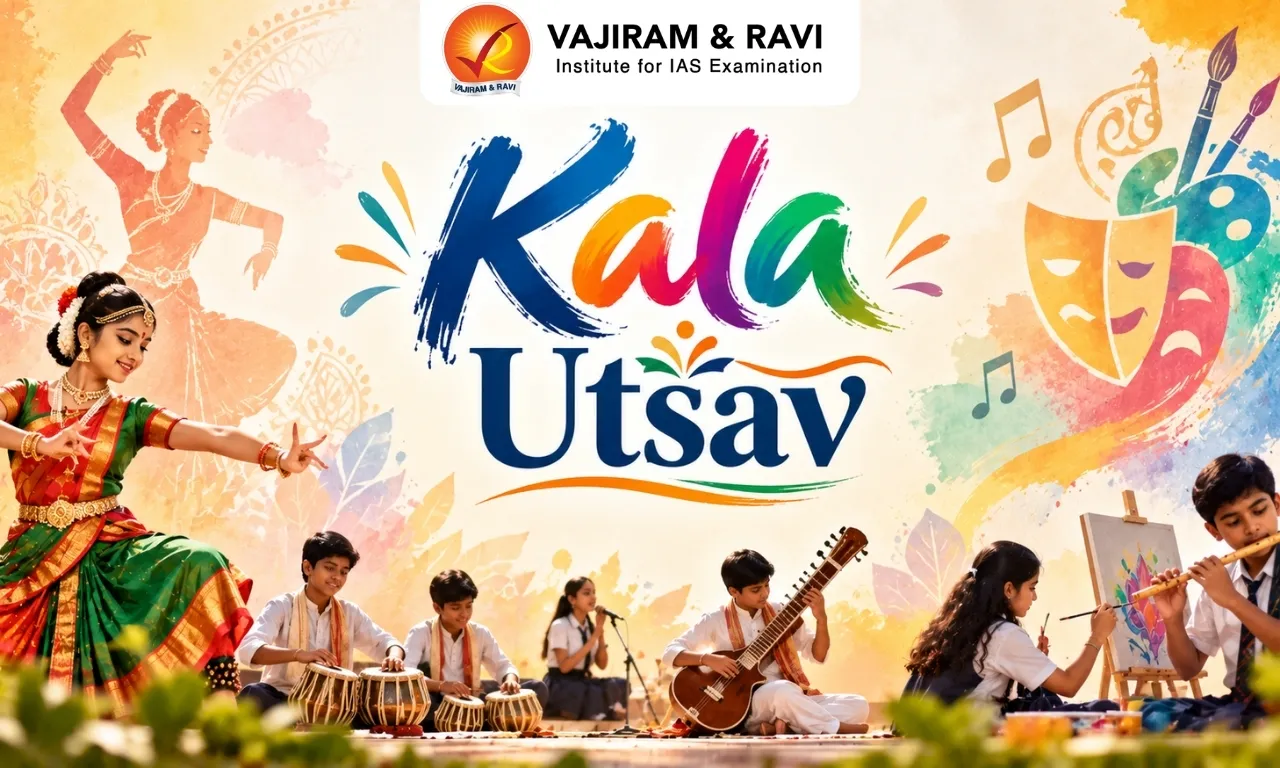
Kala Utsav is a national arts festival for school students, launched in 2015 by the Department of School Education and Literacy, Ministry of Education. Organised by NCERT, it gives students of Classes 9 to 12 a platform to showcase their talent in music, dance, theatre, visual arts and storytelling, while celebrating India’s cultural diversity. The festival is held at the school, district, state and national levels.
Kala Utsav Objectives
Kala Utsav was started to bring arts into mainstream school education. The objectives below reflect the latest guidelines.
- Promote arts in education: The programme aims to nurture and showcase the artistic talent of secondary-stage students, treating art as part of everyday learning rather than an add-on.
- Celebrate India’s cultural diversity: Students learn about and enjoy the traditions of different regions through music, dance, theatre, visual arts and storytelling.
- Give every student a stage: The festival offers an equal and inclusive platform to students from all sections of society. It makes learning more expressive, creative and joyful.
- Build unity through culture: It contributes to the vision of Ek Bharat, Shreshtha Bharat by bringing young artists from every State and UT together.
- Support NEP 2020 and NCF 2005: The programme follows the National Education Policy 2020, which stresses promoting arts and culture through education. It is also guided by the National Curriculum Framework 2005 for arts education.
- Encourage art-integrated teaching: Since the 10th edition (2024-25), the programme has also reached teachers through Samriddhi, in line with NEP 2020 and NCFSE 2023.
- Choose a national theme every year: The theme for the 11th edition (2025) was “Viksit Bharat: A Vision for Bharat in the year 2047.” Past themes include Beti Bachao Beti Padhao and Ek Bharat Shreshtha Bharat.
- Create a cultural ecosystem: The festival links artists, artisans, cultural institutions and schools, and prepares students to become ambassadors of Indian culture.
Kala Utsav Key Features and Art Categories
Kala Utsav provides students with a platform to showcase their artistic talents and celebrate India's rich cultural heritage through various art forms. The key features and art categories of the initiative are discussed below.
- 11th edition in Pune: Kala Utsav 2025 was organised by NCERT at the Yashwantrao Chavan Academy of Development Administration (YASHADA), Pune, from 20 to 23 December 2025. It marked a historic milestone in India’s cultural education landscape.
- Four-level competition: Students compete at the school, district, state and national levels. KVS, NVS and EMRS hold their own competitions among their schools, and their winners go to the national level.
- 12 categories under 6 art forms: In the 11th edition, the number of competitions rose from 6 to 12, giving equal chances to solo and group performers and to girls and boys. The six art forms are Vocal Music, Instrumental Music, Dance, Theatre, Visual Arts and Traditional Storytelling.
- Prizes: Winners get ₹25,000, ₹20,000 and ₹15,000 (1st, 2nd, 3rd), along with a trophy and medal. Group prizes are shared equally, and there are two consolation prizes of ₹5,000 each per category. The money is transferred directly to winners’ bank accounts.


Kala Utsav Eligibility and Participation Guidelines
Kala Utsav encourages students to participate in various art and cultural activities based on specific eligibility criteria and guidelines. The key eligibility requirements and participation guidelines are discussed below.
- Who can take part: Students of Classes 9, 10, 11 and 12 in government, government-aided and private schools affiliated to any state or central board. Private schools are explicitly included.
- Central government and other organisations: Schools run by bodies such as the Central Tibetan School Administration, Indian Railways, BSF, CRPF, Army, Air Force, Cantonment Boards, NDMC and Kasturba Gandhi Balika Vidyalaya compete at the district and state levels with other schools of their State/UT.
- KVS, NVS and EMRS route: These organisations hold their own internal competitions, and their winning teams go to the national level. EMRS joined the national competitions in the 11th edition.
- Up to 39 teams per category nationally: This is made up of 28 States, 8 UTs, KVS, NVS and EMRS. Each team can send one entry per category. At the national event in Pune, 37 teams took part.
- The national contingent in the 11th edition: It had 1,020 participants, made up of 895 students (498 girls and 397 boys) and 125 escorts. The teams represented the full range of India’s education system, including all States and UTs, KVS, NVS and EMRS.
- One category per student: A student can enter only one category. Professional artists or performers are not allowed.
- Rules on past winners: Earlier national winners (1st, 2nd, 3rd) cannot participate again. Students from a school that had a national winner in 2023 or 2024 cannot enter the same art form in the 11th edition.
- Equal participation of girls and boys: Authorities must ensure this at every level. They must also ensure active participation of socio-economically disadvantaged students and children with special needs.
- Submission requirements: Each student needs a detailed proforma and a valid APAAR ID. The state-level winning video (maximum 4 minutes) must be shared via an email drive link, as YouTube links are not accepted. A textual summary must be filed through a Google form, not as an image or PDF.
- Written summary content: It covers the art form, its place of origin, communities, occasions, costumes, instruments, techniques and materials. Up to 5 photos can support it.
- Escort rules: Every team needs one female and one male teacher as escorts. A team of more than 20 students can bring one extra escort, and each student with a disability can have an escort of the same gender.
- Approvals and permissions: Schools must get parental permission. Entries are approved by the State Education Secretary or, for KVS, NVS and EMRS, by the respective Commissioner.
Kala Utsav Significance and Impact on School Education
Kala Utsav plays an important role in promoting creativity, artistic skills, and cultural awareness among students. Its key significance and impact on school education are discussed below.
- Record participation in the 11th edition: About 1.5 lakh students from 23,000 schools competed at the district level. This shows how far the initiative now reaches across the country.
- A wide funnel to the top: From this large pool, 13,000 students from 5,500 schools moved on to the state level. Finally, 1,020 participants from 37 teams reached the national stage in Pune.
- Strong growth in one edition: In the 10th edition, about 80,332 students from 18,183 schools took part at the district level and 6,014 students from 2,434 schools at the state level. The 11th edition’s numbers are far higher at every stage.
- The 10th edition set the base: The 10th National Kala Utsav was held at RIE, Bhopal (inaugurated on 3 January 2025) with 529 students from 35 teams across more than 30 art forms.
- Evolving format: The festival began with group performances in 2015, shifted to solo events in 2018, added Indigenous Toys and Games in 2020, added solo theatre in 2022, introduced Traditional Storytelling in the 10th edition, and expanded to 12 categories in the 11th edition.
- A new jury experience: The 10th edition’s jury had 29 renowned artists. A new Open House with the Jury let students ask questions and see live demonstrations.
- Inclusion in practice: Children with special needs have taken part since the very first edition. NCERT’s report notes 87 CWSN participants in 2015 and 137 in 2016.
- Samriddhi for teachers: Introduced in the 10th edition, this annual competition recognises teachers of Classes IX to XII who use art-integrated pedagogy. Teams of two teachers compete at the district, state/UT and national levels. The first national round was held at NCERT, New Delhi, on 6-7 February 2025.
- A knowledge repository: Samriddhi collects the best practices in art-integrated teaching each year. This builds a resource that educators across India can use.
- Pratibha Samvardhan for winners: This 10-day residential programme offers mentorship, workshops, performances and cultural site visits. It was first held at National Bal Bhavan, New Delhi for the 2023 and 2024 winners, and it now runs every year. The 2025 programme involved institutions such as Sangeet Natak Akademi, Lalit Kala Akademi, IGNCA, National Bal Bhavan and INTACH.
- Life skills and cultural pride: The programme builds creativity, communication, teamwork, critical thinking and problem-solving, while strengthening students’ connection to India’s cultural heritage.

 Last updated on Oct, 2026
→ UPSC 2027 Notification will be released on 13 January 2027 at upsconline.nic.in.
→ Check Nobel Prize 2026 Winners List here.
→ Check out the latest UPSC Syllabus here.
→ Download UPSC Calendar 2027 PDF Here.
Kala Utsav FAQs
Q1. What is Kala Utsav?+
Q2. When was Kala Utsav launched?+
Q3. Who is eligible to participate in Kala Utsav?+
Q4. What are the main art categories in Kala Utsav?+
Q5. How can students participate in Kala Utsav?+
Q6. What are the prizes awarded in Kala Utsav?+
Tags: kala utsav