



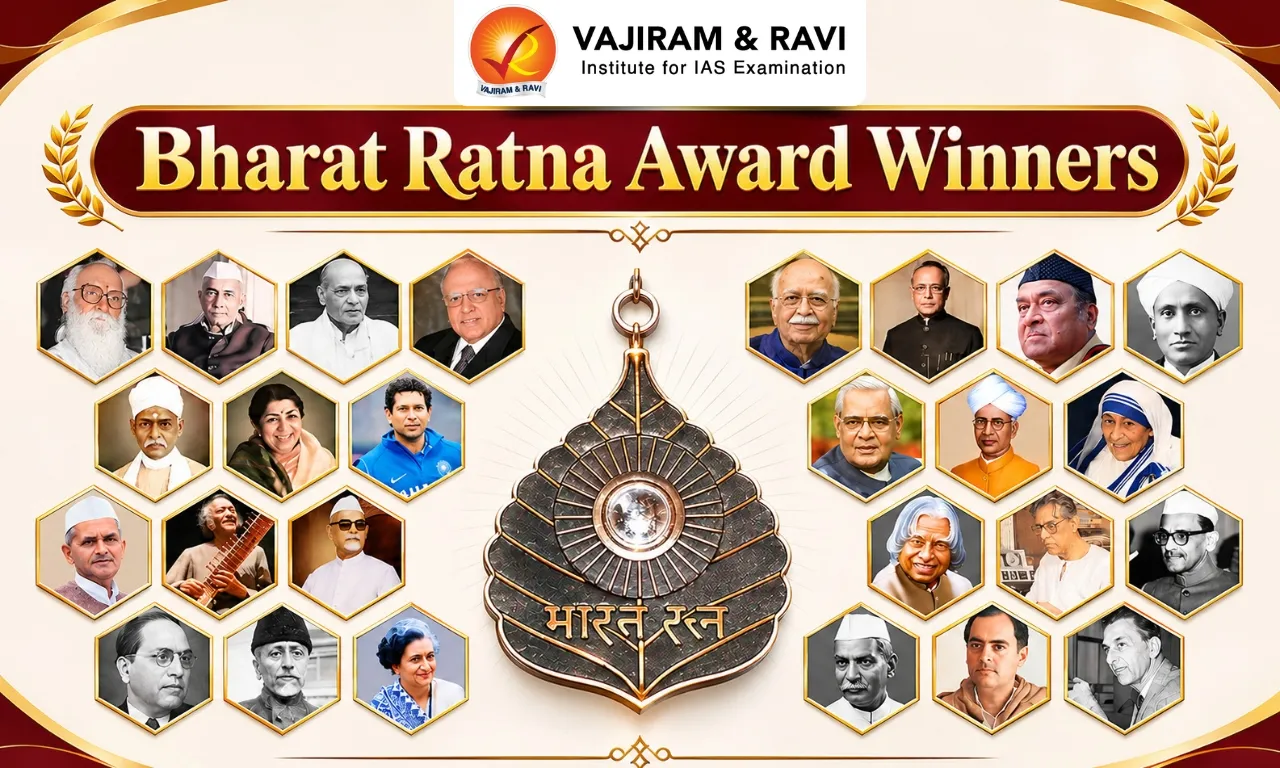
Bharat Ratna Award Winners represent individuals whose exceptional contributions have shaped India's national development, culture, science, public life and humanitarian progress. Established in 1954, the Bharat Ratna is the country's highest civilian honour, recognising outstanding service across different fields of human endeavour. Its recipients include distinguished political leaders, scientists, social reformers, artists, economists and sportspersons. Understanding the award's history, eligibility, selection process and year wise recipients provides valuable insight into India's most prestigious civilian recognition.
Bharat Ratna Award Winners 2026
The Bharat Ratna Award has been conferred on 53 individuals between 1954 and 2024. The Bharat Ratna Winners include prominent personalities such as Dr. C. V. Raman, Dr. B. R. Ambedkar, Mother Teresa, A. P. J. Abdul Kalam, Sachin Tendulkar and Atal Bihari Vajpayee. The award recognises exceptional contributions to society and the nation, irrespective of an individual's profession, background or nationality. It can also be conferred posthumously.
What is Bharat Ratna?
Bharat Ratna, meaning 'Jewel of India', is the highest civilian award of the Republic of India. It is presented by the President of India to individuals for exceptional achievements and distinguished service in any field of human endeavour. Initially, the award covered arts, literature, science and public services. However, its scope was expanded in 2011. Recipients receive a medallion and a Sanad signed by the President, without any monetary prize.


Bharat Ratna Award History
Instituted on 2 January 1954, the Bharat Ratna has evolved through constitutional, administrative and eligibility related developments over several decades.
- Establishment of the Award: President Dr. Rajendra Prasad instituted the Bharat Ratna in 1954 to recognise exceptional contributions and outstanding achievements in different areas of national importance.
- Maximum Number of Recipients: Normally, the award is restricted to three recipients in a year. However, exceptions occurred in 1999, with four awardees and 2024, with five recipients.
- Expansion of Eligibility: Initially restricted to four major fields, the award's scope was broadened in 2011 to recognise exceptional contributions across every field of human endeavour.
- Temporary Suspension: The award remained suspended between 1977 and 1980 and again from 1992 to 1995 because of political developments and legal challenges.
- Posthumous Recognition: The provision for awarding Bharat Ratna after death was introduced in 1966. Lal Bahadur Shastri became its first posthumous recipient.
- No Annual Conferment: There is no compulsory annual announcement of Bharat Ratna. The government decides when deserving individuals should receive this prestigious national recognition.
- Constitutional Restriction: Article 18(1) prohibits recipients from using Bharat Ratna as a title before or after their names. However, they can mention it in official biographies.
- Subhas Chandra Bose Controversy: The award announced posthumously for Subhas Chandra Bose in 1992 was subsequently withdrawn following objections from his family and legal challenges concerning the circumstances of his death.
Bharat Ratna Award Winners Eligibility
Bharat Ratna eligibility covers individuals who have demonstrated exceptional achievements and made significant contributions to humanity, society or national development.
- No Restriction on Profession: Individuals from any professional background can receive the award, including politics, science, education, literature, arts, sports, public service and social reform.
- Nationality Is Not a Restriction: Indian citizenship is not compulsory for receiving Bharat Ratna. Foreign nationals can also be recognised for exceptional contributions to humanity and society.
- Gender Neutral Recognition: The award does not differentiate between individuals based on gender, caste, religion, race, occupation or social and economic background.
- Posthumous Eligibility: Individuals can receive Bharat Ratna after their death. This provision was introduced in 1966, enabling recognition of extraordinary contributions made during their lifetime.
- Expanded Fields of Achievement: Since 2011, eligibility has extended to every field of human endeavour, moving beyond the original categories of arts, literature, science and public service.
- No Public Application: Individuals cannot independently apply or nominate themselves for Bharat Ratna. Recommendations are made directly by the Prime Minister to the President of India.
- Recognition of Foreign Personalities: Khan Abdul Ghaffar Khan, a Pakistani national, received the award in 1987, followed by South African leader Nelson Mandela in 1990.
List of Bharat Ratna Award Winners 2026
The following chronological table presents all 53 Bharat Ratna Award Winners, arranged from the latest award year to the inaugural year.
| List of Bharat Ratna Award Winners 1954 to 2024 | ||
|
Year |
Bharat Ratna Award Winners |
State/Origin |
|
2024 |
Karpoori Thakur* |
Bihar |
|
Lal Krishna Advani |
Karachi, British India |
|
|
M. S. Swaminathan |
Tamil Nadu |
|
|
Chaudhary Charan Singh* |
Uttar Pradesh |
|
|
P. V. Narasimha Rao* |
Andhra Pradesh |
|
|
2019 |
Pranab Mukherjee |
West Bengal |
|
Nanaji Deshmukh* |
Maharashtra |
|
|
Bhupen Hazarika* |
Assam |
|
|
2015 |
Madan Mohan Malaviya* |
Uttar Pradesh |
|
Atal Bihari Vajpayee |
Madhya Pradesh |
|
|
2014 |
C. N. R. Rao |
Karnataka |
|
Sachin Tendulkar |
Maharashtra |
|
|
2009 |
Bhimsen Joshi |
Karnataka |
|
2001 |
Lata Mangeshkar |
Maharashtra |
|
Bismillah Khan |
Uttar Pradesh |
|
|
1999 |
Jayaprakash Narayan* |
Bihar |
|
Amartya Sen |
West Bengal |
|
|
Gopinath Bordoloi* |
Assam |
|
|
Ravi Shankar |
Uttar Pradesh |
|
|
1998 |
M. S. Subbulakshmi |
Tamil Nadu |
|
Chidambaram Subramaniam |
Tamil Nadu |
|
|
1997 |
Gulzarilal Nanda |
Punjab |
|
Aruna Asaf Ali* |
West Bengal |
|
|
A. P. J. Abdul Kalam |
Tamil Nadu |
|
|
1992 |
Maulana Abul Kalam Azad* |
West Bengal |
|
J. R. D. Tata |
Maharashtra |
|
|
Satyajit Ray |
West Bengal |
|
|
1991 |
Rajiv Gandhi* |
Uttar Pradesh |
|
Vallabhbhai Patel* |
Gujarat |
|
|
Morarji Desai |
Gujarat |
|
|
1990 |
B. R. Ambedkar* |
Maharashtra |
|
Nelson Mandela |
South Africa |
|
|
1988 |
M. G. Ramachandran* |
Tamil Nadu |
|
1987 |
Khan Abdul Ghaffar Khan |
Pakistan |
|
1983 |
Vinoba Bhave* |
Maharashtra |
|
1980 |
Mother Teresa |
West Bengal (born in North Macedonia) |
|
1976 |
K. Kamaraj* |
Tamil Nadu |
|
1975 |
V. V. Giri |
Odisha |
|
1971 |
Indira Gandhi |
Uttar Pradesh |
|
1966 |
Lal Bahadur Shastri* |
Uttar Pradesh |
|
1963 |
Zakir Husain |
Andhra Pradesh |
|
Pandurang Vaman Kane |
Maharashtra |
|
|
1962 |
Rajendra Prasad |
Bihar |
|
1961 |
Bidhan Chandra Roy |
West Bengal |
|
Purushottam Das Tandon |
Uttar Pradesh |
|
|
1958 |
Dhondo Keshav Karve |
Maharashtra |
|
1957 |
Govind Ballabh Pant |
Uttarakhand |
|
1955 |
Bhagwan Das |
Uttar Pradesh |
|
M. Visvesvaraya |
Karnataka |
|
|
Jawaharlal Nehru |
Uttar Pradesh |
|
|
1954 |
C. Rajagopalachari |
Tamil Nadu |
|
Dr. Sarvepalli Radhakrishnan |
Tamil Nadu |
|
|
C. V. Raman |
Tamil Nadu |
|
*Asterisk indicates a posthumous recipient. The table covers the 53 recipients announced between 1954 and 2024.
Who was the First Bharat Ratna Award Winner?
The First Bharat Ratna recipients were C. Rajagopalachari, Dr. Sarvepalli Radhakrishnan and C. V. Raman, who received the honour in 1954. Rajagopalachari was a prominent freedom fighter and statesman, Radhakrishnan made significant contributions to education and public life, while Raman was a renowned physicist whose discovery of Raman Scattering earned him the Nobel Prize in Physics.
Bharat Ratna Award Winners President of India
Several recipients of Bharat Ratna have also served as Presidents of India, reflecting their exceptional contributions to public life and national development.
- Dr. Sarvepalli Radhakrishnan (1954): India's second President and first Vice President, he was recognised for his distinguished contributions to education, philosophy and public service.
- Dr. Rajendra Prasad (1962): India's first President received the honour for his significant role in the freedom movement and contributions to the nation's development.
- Dr. Zakir Husain (1963): India's third President was recognised for his contributions to education and public life, including his association with Aligarh Muslim University.
- Dr. V. V. Giri (1975): India's fourth President was honoured for his contributions as a freedom fighter and trade union leader who championed workers' rights.
- Dr. A. P. J. Abdul Kalam (1997): India's eleventh President received the award for his contributions to scientific research, missile development and India's technological advancement.
- Pranab Mukherjee (2019): India's thirteenth President was recognised for his extensive contributions to public administration, parliamentary affairs and national governance.
Bharat Ratna Award Medal Design
The Bharat Ratna Medallion features distinctive Indian symbols and inscriptions that represent the country's cultural heritage and national identity.
- Shape of the Medal: The Bharat Ratna medal is designed in the shape of a peepal leaf, reflecting its association with India's cultural and civilisational traditions.
- Front Side: The front features a sunburst design with the words Bharat Ratna inscribed underneath in Devanagari script, highlighting the identity of the national honour.
- Reverse Side: The reverse displays the State Emblem of India, accompanied by the national motto Satyameva Jayate in Devanagari script.
- Material Used: The medallion is primarily made of bronze, while platinum elements are used for the sunburst, emblem and outer rim.
- Official Certificate: Each recipient receives a Sanad bearing the President's signature, which serves as the official documentary recognition of the award.
- Manufacturing Location: Bharat Ratna medals are manufactured at the Alipore Mint in Kolkata, which produces several important national decorations.
- No Monetary Reward: The award does not include prize money. Its importance comes from the exceptional national recognition and prestige associated with receiving the honour.
Bharat Ratna Award Process
The Bharat Ratna selection process involves recommendations from the Prime Minister and formal approval by the President of India.
- Recommendation by Prime Minister: The selection process begins with the Prime Minister recommending deserving individuals for Bharat Ratna based on their exceptional contributions and achievements.
- Presidential Approval: The Prime Minister's recommendations are submitted to the President of India, who holds the constitutional authority to confer the award.
- Selection of Recipients: Individuals are considered based on the significance, quality and lasting impact of their contributions to the nation or humanity.
- Official Announcement: Following approval, the names of selected recipients are officially announced by the Government of India through an authorised declaration.
- Investiture Ceremony: The selected recipients are formally honoured during an investiture ceremony conducted by the President of India.
- Presentation of Award: Each recipient receives the Bharat Ratna medallion along with a Sanad signed by the President as formal recognition.
- Posthumous Conferment: The award can also be presented posthumously to recognise individuals whose exceptional contributions continue to hold national and historical significance.
Bharat Ratna Award Benefits
Bharat Ratna recipients receive national recognition along with certain official privileges and protocol related benefits associated with the prestigious civilian honour.
- Position in Order of Precedence: Bharat Ratna awardees are placed at position 7A in India's Table of Precedence, ensuring recognition during official government functions and ceremonies.
- Diplomatic Passport: Recipients are entitled to diplomatic passports, providing access to designated immigration facilities and other privileges associated with official diplomatic travel.
- Air Travel Privileges: Awardees receive lifetime complimentary executive class air travel on domestic routes, as part of the privileges associated with the honour.
- Official Travel Facilities: Recipients receive protocol related facilities during official visits, including arrangements and access to government guest houses wherever applicable.
- Official Recognition: Awardees receive a bronze medallion, its miniature replica and a Sanad bearing the President's signature as formal recognition of their achievements.
- National Prestige: Bharat Ratna recipients receive exceptional recognition across the country and their contributions become an enduring part of India's national and historical legacy.
- No Prize Money: The Bharat Ratna does not provide a monetary grant or fixed cash reward. Its value lies in the distinction and national honour it represents.
- No Automatic Family Benefits: The award does not provide separate official benefits to family members or legal heirs, including in cases of posthumous recognition.

 Last updated on Nov, 2026
→ UPSC 2027 Notification will be released on 13 January 2027 at upsconline.nic.in.
→ Check Nobel Prize 2026 Winners List here.
→ Check out the latest UPSC Syllabus here.
→ Download UPSC Calendar 2027 PDF Here.
Bharat Ratna Award Winner FAQs
Q1. Who received the first Bharat Ratna Award in India?+
Q2. Who was the first woman to receive the Bharat Ratna Award?+
Q3. Who is the youngest Bharat Ratna Award Winner?+
Q4. Who is the oldest person to receive the Bharat Ratna Award?+
Q5. How many Bharat Ratna Award Winners are there in India?+
Tags: bharat ratna award bharat ratna award list bharat ratna award winners bharat ratna list