




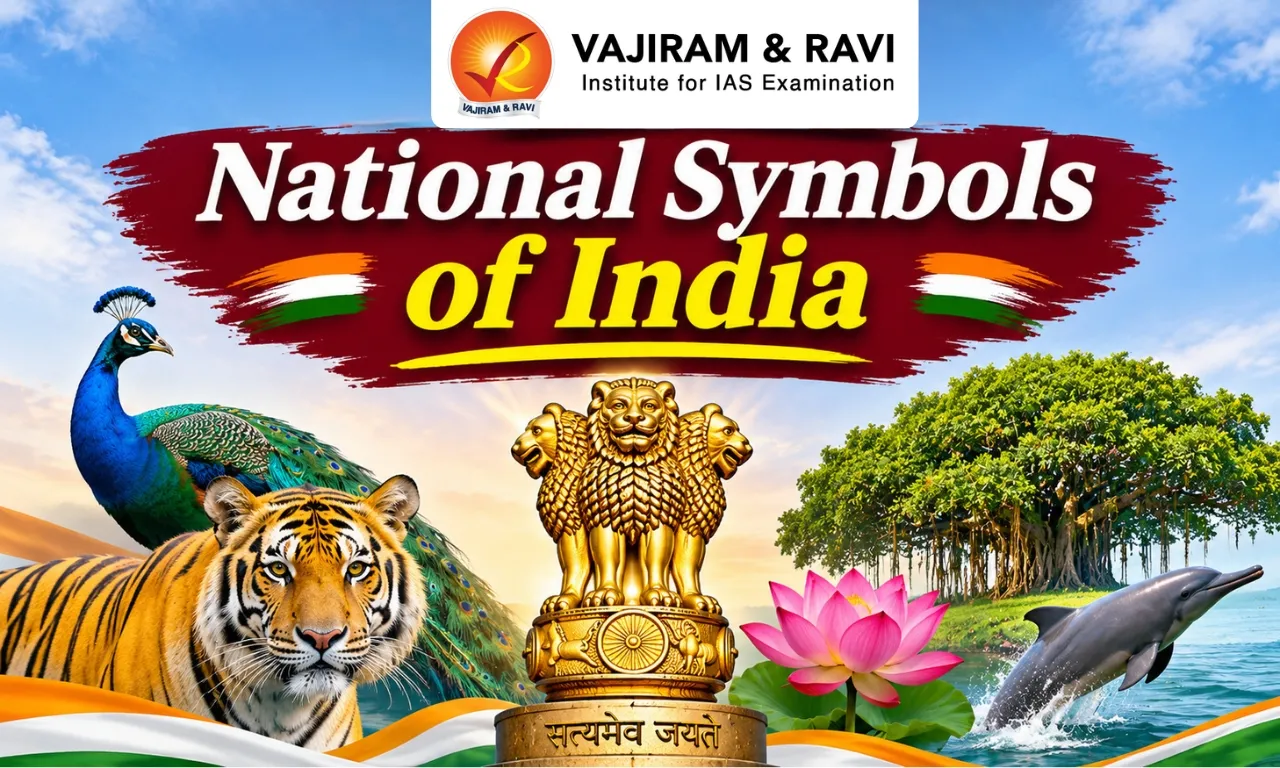
The National Symbols of India represent the country’s rich history, cultural heritage, traditions and national identity. They reflect India’s unity, diversity, independence and values. From the National Flag (Tiranga) and National Emblem (Lion Capital of Ashoka) to the Royal Bengal Tiger, Indian Peacock and Lotus, each symbol holds a special place in Indian society. They inspire patriotism, promote national pride and remind citizens of India’s historical achievements and natural heritage.
List of National Symbols of India
The list of National Symbols of India includes the National Flag, National Emblem, National Anthem, Royal Bengal Tiger, Lotus and River Ganga, among others. These symbols represent India's rich cultural heritage, national unity, diversity and identity. The important national symbols of India, along with their names, are listed below.
| List of National Symbols of India | ||
|
S. No. |
National Symbol |
Name |
|
1 |
National Flag |
Tiranga |
|
2 |
National Emblem |
Lion Capital of Ashoka |
|
3 |
National Anthem |
Jana Gana Mana |
|
4 |
National Song |
Vande Mataram |
|
5 |
National Animal |
Royal Bengal Tiger |
|
6 |
National Bird |
Indian Peacock |
|
7 |
National Flower |
Lotus |
|
8 |
National Tree |
Indian Banyan |
|
9 |
National Fruit |
Mango |
|
10 |
National River |
Ganga |
|
11 |
National Aquatic Animal |
Ganges River Dolphin |
|
12 |
National Heritage Animal |
Indian Elephant |
|
13 |
National Calendar |
Saka Calendar |
|
14 |
National Currency |
Indian Rupee (₹) |
|
15 |
National Pledge |
India is My Country |
|
16 |
National Vegetable (commonly cited) |
Pumpkin |
National Symbols of India with Name List
India has several important national symbols that reflect its cultural, historical and natural heritage. These include the National Flag, National Anthem, National Emblem, National Animal, National Bird and other widely recognised national identity elements. The following sections explain their names, features and significance.


National Flag of India
The National Flag of India, popularly known as the Tiranga, represents the country’s freedom, unity and sovereignty. It is one of India’s most respected national symbols.
- Adoption: The present design of the Indian National Flag was adopted by the Constituent Assembly on 22 July 1947, shortly before India’s independence.
- Design and Colours: The flag has three equal horizontal bands of saffron, white and green, with a navy-blue Ashoka Chakra containing 24 spokes at the centre.
- Symbolism: Saffron represents courage and sacrifice, white stands for peace and truth, and green reflects growth and prosperity. The Ashoka Chakra symbolises righteousness and continuous progress.
- Dimensions: The National Flag has a length-to-width ratio of 3:2. Its display and use are governed by the Flag Code of India, 2002, along with relevant legal provisions.
National Emblem of India
The National Emblem of India is adapted from the Lion Capital of Ashoka at Sarnath, Uttar Pradesh. It represents India’s authority, sovereignty and commitment to truth and justice.
- Adoption: The Lion Capital was adopted as the State Emblem of India on 26 January 1950, the day India became a republic.
- Design: The original sculpture features four Asiatic lions standing back-to-back on a circular base, although only three are visible in the usual representation of the emblem.
- Important Features: The base contains figures of an elephant, horse, bull and lion, separated by Dharma Chakras, reflecting India’s ancient artistic and cultural traditions.
- National Motto: The words Satyameva Jayate, meaning “Truth Alone Triumphs,” are written below the emblem in Devanagari script. The motto is taken from the Mundaka Upanishad and represents India’s commitment to truth.
National Anthem of India
The National Anthem of India is Jana Gana Mana, composed by Nobel laureate Rabindranath Tagore. It expresses national unity and celebrates India’s geographical and cultural diversity.
- Composition: Jana Gana Mana was originally composed in Bangla by Rabindranath Tagore and was first publicly sung on 27 December 1911 during the Calcutta session of the Indian National Congress.
- Official Adoption: The Constituent Assembly adopted its Hindi version as India’s National Anthem on 24 January 1950.
- Duration: The full version takes approximately 52 seconds, while a shorter version lasting about 20 seconds is used on certain occasions.
- Significance: The anthem is performed during national celebrations, official ceremonies and important events, promoting a shared sense of patriotism and respect for the country.
National Song of India
The National Song of India is Vande Mataram, written by Bankim Chandra Chatterjee. It played an important role in India’s freedom struggle and continues to represent devotion to the motherland.
- Composition: Vande Mataram was composed in Sanskrit by Bankim Chandra Chatterjee and included in his famous novel Anandamath, published in 1882.
- Freedom Movement: The song became a powerful expression of patriotism during the Indian independence movement, inspiring freedom fighters to unite against colonial rule.
- National Recognition: On 24 January 1950, the Constituent Assembly acknowledged its special place in India’s national life. It enjoys a status of honour equal to that of Jana Gana Mana.
- Significance: The song portrays India as a mother and expresses love, respect and dedication towards the nation.
National Animal of India
The National Animal of India is the Royal Bengal Tiger, scientifically known as Panthera tigris tigris. It represents strength, courage, grace and India’s rich wildlife heritage.
- National Recognition: The tiger became India’s national animal in 1973, replacing the lion, during the period when Project Tiger was launched to strengthen tiger conservation.
- Physical Features: The Royal Bengal Tiger is recognised by its orange coat, black stripes and powerful body, which help it blend into forest habitats.
- Ecological Importance: As a top predator, the tiger helps maintain the natural balance of forest ecosystems by regulating prey populations.
- Conservation: Tigers face threats from habitat loss, poaching and human-wildlife conflict. Project Tiger, launched in 1973, remains an important initiative for their protection.
National Bird of India
The National Bird of India is the Indian Peacock, scientifically known as Pavo cristatus. It is admired for its colourful feathers, graceful movements and strong connection with Indian culture.
- National Recognition: The Indian Peacock was declared the National Bird of India in 1963 because of its cultural importance, distinctive appearance and widespread presence.
- Physical Features: The male peacock has a bright blue neck, a fan-shaped crest and long, colourful tail feathers, while the female, called a peahen, is comparatively less colourful.
- Cultural Significance: The peacock holds an important place in Indian mythology, traditional paintings, literature and religious practices.
- Unique Feature: During courtship, the male peacock spreads its tail feathers and performs a distinctive dance, making it one of India’s most recognisable birds.
National Flower of India
The National Flower of India is widely recognised as the Lotus, scientifically known as Nelumbo nucifera. It symbolises purity, beauty, spiritual growth and the ability to overcome difficulties.
- Unique Characteristics: The lotus grows in ponds, lakes and other shallow water bodies. Despite growing in muddy water, its flowers remain beautiful and relatively free from dirt.
- Cultural Significance: The lotus holds a special place in Indian religious traditions and is associated with deities such as Goddess Lakshmi, Goddess Saraswati and Lord Vishnu.
- Symbolism: The flower represents purity, knowledge, enlightenment and spiritual awakening, as it rises above muddy surroundings.
- Historical Importance: Lotus motifs frequently appear in ancient Indian sculptures, temple architecture, paintings and literary works, reflecting their long-standing cultural importance.
National Tree of India
The National Tree of India is the Indian Banyan, scientifically known as Ficus benghalensis. It represents longevity, strength, stability and the continuity of Indian traditions.
- Distinctive Features: The banyan tree is famous for its large canopy and aerial roots, which grow downward from branches and eventually develop into supporting trunks.
- Long Lifespan: Banyan trees can survive for several centuries, making them symbols of long life, endurance and immortality.
- Cultural Importance: In Indian villages, banyan trees have traditionally provided shaded spaces for community gatherings, discussions and social activities.
- Religious Significance: The tree is considered sacred in several Indian traditions and is associated with wisdom, spiritual growth and the connection between nature and human life.
National Fruit of India
The National Fruit of India is the Mango, scientifically known as Mangifera indica. Popularly called the King of Fruits, mango is known for its taste, fragrance and cultural importance.
- Historical Importance: Mangoes have been cultivated in India for thousands of years and are closely connected with the country’s agricultural and culinary traditions.
- Major Varieties: India produces several popular varieties, including Alphonso, Dasheri, Langra, Kesar, Banganapalli and Himsagar, each known for its distinctive flavour.
- Cultural Significance: Mango leaves and fruits are used during festivals, religious ceremonies and traditional celebrations, symbolising prosperity and good fortune.
- Economic Importance: India is among the world’s leading mango producers, and mango cultivation supports farmers, food-processing industries and agricultural trade.
National River of India
The National River of India is the Ganga, one of the country’s most important rivers in terms of history, culture, agriculture and religious traditions.
- National Recognition: The Ganga was declared India’s National River in 2008, highlighting its importance to the country’s cultural heritage and environmental conservation.
- Geographical Importance: Originating in the Himalayas, the Ganga flows through northern India and supports a vast river basin that provides water for agriculture, industry and domestic use.
- Cultural Significance: The river is regarded as sacred in Hinduism and is closely associated with religious rituals, pilgrimage centres and historical settlements.
- Conservation Initiatives: Government programmes such as Namami Gange aim to reduce pollution, improve water quality, restore aquatic habitats and promote the ecological health of the river.
National Aquatic Animal of India
The National Aquatic Animal of India is the Ganges River Dolphin, scientifically known as Platanista gangetica. It is an endangered freshwater mammal and an important indicator of healthy river ecosystems.
- National Recognition: The decision to declare the Ganges River Dolphin as India’s National Aquatic Animal was taken in 2009 to highlight the need for its conservation.
- Natural Habitat: It is found mainly in the Ganga-Brahmaputra-Meghna river systems of India and neighbouring countries.
- Unique Characteristics: The dolphin has extremely limited eyesight and relies on echolocation, using sound waves to locate food and navigate through muddy river water.
- Conservation Status: Listed as Endangered on the IUCN Red List, it receives protection under Schedule I of the Wildlife (Protection) Act, 1972. Major threats include water pollution, fishing-net entanglement and habitat degradation.
National Heritage Animal of India
The National Heritage Animal of India is the Indian Elephant, a subspecies of the Asian elephant scientifically known as Elephas maximus indicus. It represents strength, wisdom and India’s natural and cultural heritage.
- National Recognition: The Indian Elephant was declared the National Heritage Animal in 2010, recognising its ecological, historical and cultural importance.
- Cultural Significance: Elephants have been associated with Indian religious traditions, royal processions, historical warfare and festivals for centuries.
- Ecological Importance: Elephants play an important role in forest ecosystems by dispersing seeds, creating pathways and maintaining biodiversity.
- Conservation Challenges: Habitat fragmentation, loss of elephant corridors and human-elephant conflict threaten their survival. Conservation efforts, including Project Elephant, focus on protecting the species and its natural habitats.
National Calendar of India
The National Calendar of India is the Saka Calendar, which is used alongside the Gregorian calendar for official government purposes.
- Official Adoption: The Government of India adopted the Saka Calendar on 22 March 1957 to establish a standardised calendar system for official use.
- Calendar Structure: It consists of 12 months, beginning with Chaitra, and is based on the Saka Era, which starts in 78 CE.
- Beginning of the Year: The Saka year generally begins on 22 March, or 21 March in a Gregorian leap year.
- Official Use: The calendar is used in government publications, official gazettes and other administrative communications, reflecting India’s historical traditions of timekeeping.
National Currency of India
The National Currency of India is the Indian Rupee (INR), represented by the symbol ₹. It serves as the country’s official medium of exchange and reflects India’s economic identity.
- Official Currency: The Indian Rupee is used for financial transactions throughout India, with the Reserve Bank of India (RBI) responsible for issuing and managing banknotes.
- Currency Symbol: The symbol ₹ was officially adopted in 2010 and designed by D. Udaya Kumar, combining elements of the Devanagari letter 'र' and the Roman letter ‘R’.
- Unique Design: The two horizontal lines in the rupee symbol are commonly interpreted as representing equality and the Indian tricolour.
- Economic Importance: The rupee plays a central role in domestic trade, savings, investment and international transactions, representing India’s financial sovereignty.
National Pledge of India
The National Pledge of India, beginning with the words “India is my country,” is a patriotic declaration that promotes unity, responsibility and respect for the nation.
- Origin: The pledge was written in Telugu by Pydimarri Venkata Subba Rao in 1962 and later translated into several Indian languages.
- Core Message: It encourages citizens to respect their country, appreciate its rich and diverse heritage and treat people with dignity and kindness.
- Educational Importance: The pledge is commonly recited during school assemblies, national celebrations and educational programmes to develop a sense of citizenship.
- Significance: It highlights values such as national unity, brotherhood, respect for elders, social responsibility and collective progress.
The National Pledge is widely used in educational and patriotic settings, although it is not among the principal national identity elements listed by the National Portal of India.
National Vegetable of India
The Pumpkin, popularly known as Kaddu or Kashiphal, is often mentioned as the National Vegetable of India. However, there is no verified official Government of India declaration recognising pumpkin as the national vegetable.
- Widespread Cultivation: Pumpkin is cultivated in different regions of India and grows under a variety of climatic conditions, making it an important vegetable crop.
- Nutritional Importance: It provides essential nutrients, including beta-carotene, vitamins, minerals and dietary fibre, supporting a balanced diet.
- Culinary Uses: Pumpkin is used in several Indian dishes, including vegetables, curries, soups, sweets and traditional festive preparations.
- Agricultural Significance: Its adaptability, nutritional value and extensive use in Indian cuisine make pumpkin an important part of the country’s food and agricultural traditions.
National Symbols of India Significance
The National Symbols of India play an important role in representing the country’s identity, cultural diversity, sovereignty and historical achievements. Their significance extends beyond national celebrations, as they also encourage environmental awareness, patriotism and respect for shared values.
- Promote National Unity: National symbols bring together people from different religions, languages, regions and traditions, strengthening the idea of unity in diversity.
- Represent India’s Sovereignty: The National Flag and National Emblem highlight India’s independence, constitutional identity and position as a sovereign nation.
- Preserve Cultural Heritage: Symbols such as the Lotus, Banyan Tree, National Anthem and National Song reflect India’s ancient traditions, spiritual beliefs and historical journey.
- Encourage Wildlife Conservation: The Royal Bengal Tiger, Indian Elephant and Ganges River Dolphin draw attention to the importance of protecting endangered wildlife, forests and aquatic ecosystems.
- Inspire Patriotism and Responsibility: National symbols encourage citizens to respect their country, uphold democratic values and contribute towards national development.
- Strengthen International Identity: These symbols represent India’s unique history, natural diversity and cultural achievements at international events, diplomatic meetings and global institutions.

 Last updated on Nov, 2026
→ UPSC 2027 Notification will be released on 13 January 2027 at upsconline.nic.in.
→ Check Nobel Prize 2026 Winners List here.
→ Check out the latest UPSC Syllabus here.
→ Download UPSC Calendar 2027 PDF Here.
National Symbols of India FAQs
Q1. What are the national symbols of India?+
Q2. What is the national flag of India called?+
Q3. When was the Indian national flag adopted?+
Q4. What is the national emblem of India?+
Q5. Who wrote the national anthem and national song of India?+
Q6. What are the national animal, bird and flower of India?+
Q7. What are the national tree, fruit and river of India?+
Q8. What is the national aquatic animal and national heritage animal of India?+
Tags: national symbols national symbols of india