



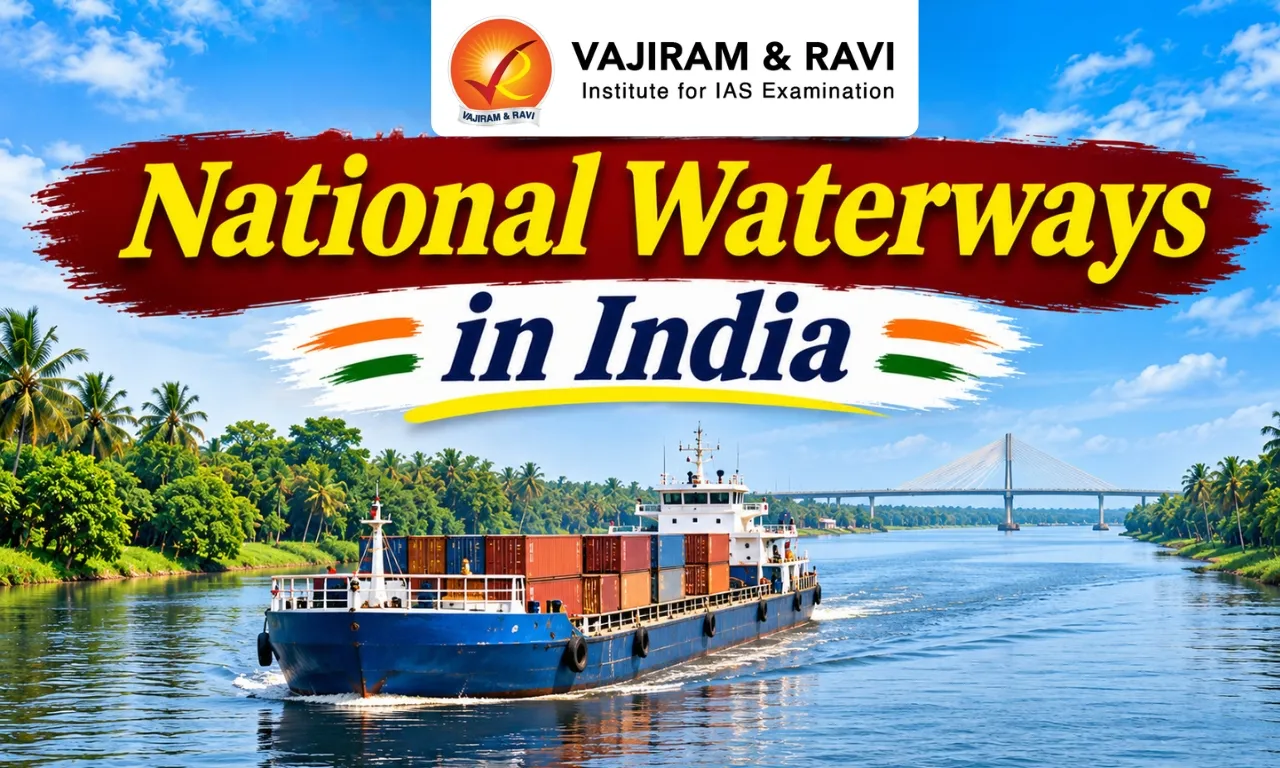
India has an extensive network of rivers, canals, backwaters and creeks that can support inland water transport. To utilise this potential, the Central Government has declared 111 inland waterways as National Waterways, covering approximately 20,187 km across the country.
National Waterways provide an alternative mode of transportation for passengers and cargo, particularly bulk goods. Their development can reduce logistics costs, improve regional connectivity and ease pressure on road and railway networks.
What are National Waterways?
National Waterways are inland waterways declared by law for shipping and navigation under the control of the Central Government.
They include navigable stretches of:
- Rivers
- Canals
- Backwaters
- Creeks
- Other inland water bodies
These waterways are developed for the movement of cargo and passengers through vessels. Their effective use requires adequate water depth, navigable channels, terminals and navigation facilities.
Development of National Waterways in India
India initially had five National Waterways, which were declared under separate laws between 1986 and 2008. To expand the inland water transport network, the government enacted the National Waterways Act, 2016.
- The Act retained the original five National Waterways and declared 106 additional inland waterways.
- This increased the total number of National Waterways to 111.
- The declared network extends across 23 States and four Union Territories.
- As of March 2026, 32 National Waterways were operational, covering approximately 5,155 km.
An important distinction: Declaration as a National Waterway does not automatically make a route operational. Regular navigation requires adequate water depth, navigable channels, terminals and other essential facilities.
Also Read:- National Waterways in India


Important National Waterways in India
The first five National Waterways form the foundation of India's inland water transport network. Several other waterways have also been declared to improve connectivity across different regions.
Five Original National Waterways
The first five National Waterways were declared between 1986 and 2008 and continue to be important routes for inland navigation.
|
National Waterway |
River or Waterway |
Route and Geographical Coverage |
|
NW-1 |
Ganga-Bhagirathi-Hooghly River System |
Haldia to Prayagraj; Uttar Pradesh, Bihar, Jharkhand and West Bengal |
|
NW-2 |
Brahmaputra River |
Dhubri to Sadiya; Assam |
|
NW-3 |
West Coast Canal |
Kottapuram to Kollam, including Champakara and Udyogmandal Canals; Kerala |
|
NW-4 |
Kakinada-Puducherry Canal System, Godavari and Krishna Rivers |
Includes stretches in Andhra Pradesh, Tamil Nadu and Puducherry |
|
NW-5 |
East Coast Canal and Brahmani-Kharsua-Dhamra River System |
Includes Mahanadi delta rivers; Odisha and West Bengal |
Some important features of these waterways are:
- NW-1: Approximately 1,620 km long, it connects the Haldia-Kolkata port region with the hinterland of northern India.
- NW-2: Approximately 891 km long, it is important for transport and connectivity in the Brahmaputra Valley.
- NW-3: Approximately 205 km long, it supports inland navigation along Kerala's coastal region.
- NW-4: Its river and canal network provides inland transport connectivity across parts of southern India.
- NW-5: It has potential for transporting coal, minerals and other bulk cargo from industrial and mineral-rich regions.
Other Important National Waterways
Apart from the first five, several other waterways have been declared National Waterways to utilise the navigable potential of rivers and water bodies across India.
|
National Waterway |
River or Waterway |
State(s) |
|
NW-16 |
Barak River |
Assam |
|
NW-27 |
Cumberjua River |
Goa |
|
NW-48 |
Jawai-Luni-Rann of Kutch River System |
Gujarat and Rajasthan |
|
NW-53 |
Kalyan-Thane-Mumbai Waterway, Vasai Creek and Ulhas River System |
Maharashtra |
|
NW-64 |
Mahanadi River |
Odisha |
|
NW-68 |
Mandovi River |
Goa |
|
NW-73 |
Narmada River |
Madhya Pradesh and Gujarat |
|
NW-87 |
Sabarmati River |
Gujarat |
|
NW-97 |
Sundarbans Waterway |
West Bengal |
|
NW-100 |
Tapi River |
Maharashtra and Gujarat |
|
NW-101 |
Tizu-Zungki River System |
Nagaland |
|
NW-110 |
Yamuna River |
Delhi, Haryana and Uttar Pradesh |
|
NW-111 |
Zuari River |
Goa |
The complete list of all 111 National Waterways, along with their notified stretches, is provided in the Schedule to the National Waterways Act, 2016.
Legal and Institutional Framework
The development and regulation of National Waterways are governed by a central legal framework, with the Inland Waterways Authority of India serving as the principal implementing agency.
National Waterways Act, 2016
The National Waterways Act, 2016 provides the legal basis for declaring inland waterways as National Waterways and developing them for shipping and navigation.
Its major provisions include:
- It retained the first five National Waterways declared under earlier laws.
- It declared 106 additional inland waterways as National Waterways.
- It increased the total number of National Waterways in India to 111.
- Its Schedule specifies the waterways and their notified limits.
Inland Waterways Authority of India (IWAI)
The Inland Waterways Authority of India (IWAI) is a statutory authority established in 1986 under the Inland Waterways Authority of India Act, 1985.
It functions under the Ministry of Ports, Shipping and Waterways and is responsible for the development and regulation of National Waterways for shipping and navigation.
Its major functions include:
- Developing and maintaining navigable channels along National Waterways.
- Constructing and maintaining terminals, jetties and other infrastructure.
- Providing navigation aids to support safe movement of vessels.
- Promoting cargo and passenger transportation through inland waterways.
- Coordinating with State Governments and other agencies for waterway development.
Significance of National Waterways in India
National Waterways can strengthen India's transport network by providing an economical alternative for cargo and passenger movement.
- Cost-Effective Transportation : Water transport is generally more fuel-efficient and economical than road and rail transport, particularly for moving heavy and bulk cargo over long distances.
- Reduces Pressure on Roads and Railways : National Waterways provide an alternative transport network, helping reduce congestion on highways and railway corridors.
- Improves Regional Connectivity : They connect remote and riverine regions with markets, ports and major transport networks. This is particularly important for the Northeast and parts of eastern India.
- Supports Trade and Industrial Development : Waterways facilitate the transportation of commodities such as coal, cement, fertilisers, food grains and minerals, supporting industrial and commercial activities.
- Promotes Environmentally Sustainable Transport : Inland water transport generally consumes less fuel per tonne-kilometre than road transport. It can therefore help reduce greenhouse gas emissions and air pollution.
- Creates Employment Opportunities : The development of waterways generates employment in vessel operations, terminal management, logistics, shipbuilding and river-based tourism.
Challenges in the Development of National Waterways
Despite their potential, the development of National Waterways faces geographical, infrastructural, environmental and institutional challenges.
- Seasonal Variations in Water Levels: Many Indian rivers experience significant fluctuations in water levels, particularly during dry seasons, affecting navigation.
- Sedimentation and Shallow Channels: Siltation and changes in river courses reduce navigable depth and increase the cost of maintaining waterways.
- Inadequate Infrastructure: Several declared waterways lack sufficient terminals, jetties, navigation aids and modern vessels.
- Environmental Concerns: Dredging and construction activities may affect river ecosystems, aquatic biodiversity and natural river flows.
- Inter-State Coordination: Development of waterways often requires coordination among multiple states and government agencies.
- Limited Multimodal Connectivity: Inadequate connections between waterways, roads, railways and ports can increase the overall cost and time of transportation.
Way Forward
The potential of National Waterways can be realised through better infrastructure, effective coordination and environmentally sustainable development.
- Develop Essential Infrastructure: Improve navigable channels, terminals, jetties and navigation facilities along technically and economically viable waterways.
- Strengthen Multimodal Connectivity: Integrate inland waterways with road, rail and port infrastructure to improve logistics efficiency.
- Ensure Environmental Sustainability: Adopt environmentally responsible dredging practices and protect river ecosystems.
- Modernise Inland Vessels: Encourage energy-efficient vessels suited to India's river conditions.
- Promote Private Investment: Encourage private sector participation in terminal development, vessel operations and logistics services.
- Strengthen Regional Cooperation: Improve cross-border inland water transport connectivity, particularly through the Indo-Bangladesh Protocol routes.

 Last updated on Nov, 2026
→ UPSC 2027 Notification will be released on 13 January 2027 at upsconline.nic.in.
→ Check Nobel Prize 2026 Winners List here.
→ Check out the latest UPSC Syllabus here.
→ Download UPSC Calendar 2027 PDF Here.
National Waterways in India FAQs
Q1. How many National Waterways are there in India?+
Q2. Which is the longest National Waterway in India?+
Q3. Which is the first National Waterway in India?+
Q4. Which National Waterway is located on the Brahmaputra River?+
Q5. Which Act declared 111 National Waterways in India?+
Q6. Which authority is responsible for the development of National Waterways in India?+
Tags: national waterways national waterways in india