



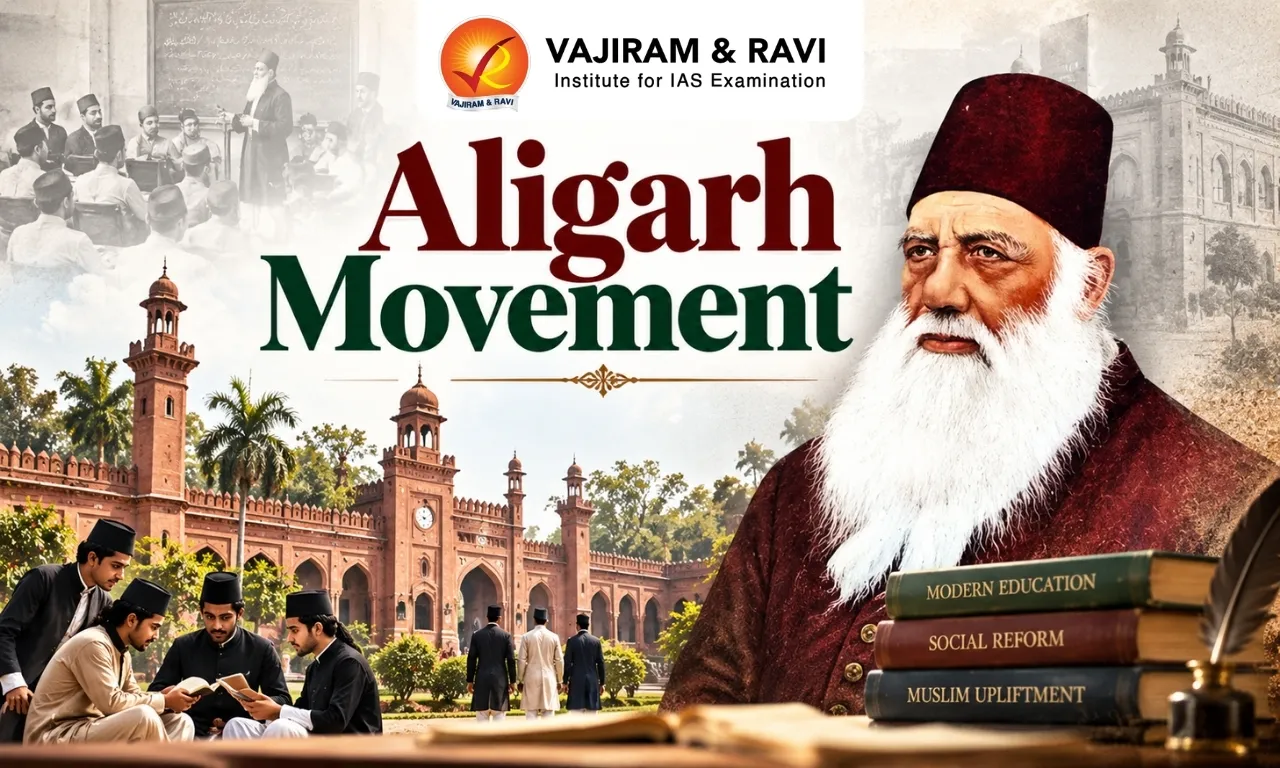
Aligarh Movement was a 19th-century educational and social reform movement started by Sir Syed Ahmad Khan among Indian Muslims during British rule. Its main aim was to improve the condition of Muslims through modern education, English learning, scientific knowledge and social reform. The movement encouraged Muslims to accept new ideas while maintaining their religious and cultural values. It played an important role in the development of modern Muslim education in India.
What Was the Aligarh Movement?
The Aligarh Movement began during the second half of the 19th century. After the Revolt of 1857, many Muslims faced political, economic and educational difficulties. Their access to modern education and government jobs was limited in many areas.
At that time, Sir Syed Ahmad Khan believed that Muslims needed to learn English, science and modern subjects to improve their social and economic conditions. He also believed that religious beliefs and scientific knowledge could exist together.
Founder of the Aligarh Movement Sir Syed Ahmad Khan
Sir Syed Ahmad Khan (1817-1898) was an Indian Muslim reformer, educationist and writer. He worked to improve the educational and social conditions of Muslims during British rule.
He believed that modern education was necessary for the progress of society. According to him, Muslims needed to study English, science, mathematics and other modern subjects to gain better employment opportunities and understand the changing world.
His major contributions included establishing the Scientific Society in 1864, starting the journal Tahdhib-ul-Akhlaq in 1870 and founding the Muhammadan Anglo-Oriental (MAO) College at Aligarh. These efforts became the foundation of the Aligarh Movement.


Causes of the Aligarh Movement
The Aligarh Movement developed because of the educational, economic and social problems faced by many Muslims in 19th-century India.
- Impact of the Revolt of 1857: After the revolt, the British government viewed sections of the Muslim population with suspicion. Political changes also affected their social and economic position.
- Decline of traditional employment: The end of the Mughal Empire and changes in administration reduced many traditional employment opportunities.
- Lack of modern education: Many Muslims had limited access to English education and Western scientific knowledge, which were becoming important for government jobs and professional careers.
- Economic difficulties: Limited educational opportunities affected employment and economic progress among sections of the Muslim community.
- Resistance to Western education: Some people feared that English education and Western ideas could weaken religious beliefs and traditional values.
- Need for social reform: Sir Syed Ahmad Khan believed that harmful customs, superstitions and resistance to modern knowledge were obstacles to progress.
Objectives of the Aligarh Movement
The main objective of the Aligarh Movement was to promote educational, social and economic progress among Muslims.
- Promote modern education: Encourage Muslims to study English, science, mathematics and other modern subjects.
- Encourage scientific thinking: Promote reason, observation and scientific knowledge instead of blind belief in superstitions.
- Combine modern and religious education: Show that modern knowledge and Islamic values could be followed together.
- Improve social conditions: Encourage better social practices, moral values and awareness.
- Increase employment opportunities: Help Muslims gain the education required for government jobs and modern professions.
- Promote Urdu literature: Use Urdu to spread knowledge and reformist ideas among people.
- Improve relations with the British: Encourage cooperation with the British government to create better opportunities for education and employment.
Major Features of the Aligarh Movement
The Aligarh Movement, led by Sir Syed Ahmad Khan, focused on modern education, scientific thinking and social reform to improve the condition of Muslims in India.
- Promotion of Modern Education: Encouraged English education and the study of science, mathematics and other modern subjects.
- Scientific Thinking and Rationalism: Promoted reason, logical thinking and scientific knowledge while discouraging superstitions.
- Religious Reform: Emphasised that Islamic beliefs and modern scientific knowledge could coexist.
- Social and Moral Reform: Encouraged better social practices, moral values and the rejection of harmful customs.
- Development of Urdu Literature: Promoted Urdu prose and used publications to spread educational and reformist ideas.
- Cooperation with the British: Favoured cooperation with the British government to improve educational and employment opportunities for Muslims.
- Educational Institution Building: Established institutions such as the Scientific Society and MAO College to promote modern learning.
- Intellectual Development: Encouraged Muslims to adopt new ideas and participate in the changing social and economic environment.
Major Institutions and Initiatives of the Aligarh Movement
The Major Institutions and Initiatives of the Aligarh Movement have been discussed below.
1. Scientific Society (1864)
The Scientific Society was established by Sir Syed Ahmad Khan at Ghazipur in 1864. It was later shifted to Aligarh.
The main purpose of the society was to make modern scientific and literary knowledge available to Indian readers. Its major objectives were:
- Translate Western books into Urdu and other Indian languages.
- Make scientific knowledge easier to understand.
- Encourage modern education and intellectual development.
- Promote discussions on scientific and social issues.
2. Aligarh Institute Gazette (1866)
The Aligarh Institute Gazette was launched in 1866. It published information about education, science, society and contemporary developments.
The publication helped spread modern ideas and encouraged people to learn about new developments in different fields. It also supported the educational and reformist objectives of the Aligarh Movement.
3. Tahdhib-ul-Akhlaq (1870)
Tahdhib-ul-Akhlaq was a journal started by Sir Syed Ahmad Khan in 1870. Its name is commonly understood as Improvement of Manners and Morals.
The journal aimed to improve social behaviour and encourage rational thinking among Muslims. Its main contributions were:
- Promoting social and moral reform.
- Criticising harmful customs and superstitions.
- Encouraging modern education.
- Developing rational and scientific thinking.
- Spreading reformist ideas through Urdu.
4. Muhammadan Anglo-Oriental College (1875-1877)
The Muhammadan Anglo-Oriental (MAO) College was established at Aligarh in 1875 as a school. It developed into a college in 1877.
Sir Syed Ahmad Khan wanted to create an institution that provided modern education while respecting Muslim cultural and religious traditions. He was influenced by the educational systems of British universities, including Oxford and Cambridge.
Its major contributions included:
- Promoting English education and modern sciences.
- Preparing students for government jobs and professional careers.
- Encouraging intellectual development.
- Creating a generation of educated Muslim professionals and leaders.
In 1920, the MAO College became Aligarh Muslim University (AMU). This was the most important institutional legacy of the Aligarh Movement.
5. All India Muhammadan Educational Conference (1886)
The All India Muhammadan Educational Conference was established by Sir Syed Ahmad Khan in 1886. Its main aim was to spread modern education among Muslims across India. It brought together teachers, reformers and community leaders to discuss educational issues.
Impact and Significance of the Aligarh Movement
The Aligarh Movement had a significant impact on education, society, literature and political awareness among Indian Muslims.
- Growth of Modern Education: Encouraged Muslims to pursue English education, science and modern subjects.
- Rise of an Educated Middle Class: Helped develop a new generation of educated Muslim professionals, teachers, lawyers and administrators.
- Social and Intellectual Reform: Promoted rational thinking and encouraged people to reconsider harmful customs and superstitions.
- Development of Urdu Literature: Improved Urdu prose and spread modern educational and reformist ideas through publications.
- Growth of Political Awareness: Contributed to the development of political consciousness among sections of the Muslim community.
- Development of Muslim Political Organisations: Formed part of the wider historical background to the establishment of the All-India Muslim League in 1906.
- Promotion of Scientific Thinking: Encouraged the study of modern science and the use of reason to understand social and religious issues.
- Establishment of Aligarh Muslim University: The MAO College developed into Aligarh Muslim University in 1920, creating a lasting legacy in higher education.
- Influence on Muslim Society: Encouraged educational advancement and discussions about the relationship between religious values and modern knowledge.
Limitations and Criticism of the Aligarh Movement
Despite its contributions, the Aligarh Movement faced criticism from different sections of society.
- Opposition from conservative religious scholars: Some ulema disagreed with its emphasis on Western education and rational interpretations of religious texts.
- Differences with the Deoband school: The Aligarh Movement focused on modern education, while the Deoband movement placed greater emphasis on traditional Islamic learning.
- Pro-British approach: Sir Syed's support for cooperation with the British government was criticised by people who favoured stronger opposition to colonial rule.
- Limited social reach: The movement initially benefited more from its influence among educated and economically better-positioned sections of the Muslim community. Its benefits did not reach all groups equally.
- Debates about political identity: Sir Syed's views on Muslim political interests and representative government contributed to wider debates about political representation in colonial India.
Aligarh Movement and Deoband Movement Key Differences
The differences between the Aligarh Movement and Deoband Movement have been tabulated below.
|
Basis |
Aligarh Movement |
Deoband Movement |
|
Main focus |
Modern education and social reform |
Islamic religious education and reform |
|
Educational approach |
English, science and modern subjects |
Traditional Islamic studies and religious scholarship |
|
Major institution |
MAO College, later Aligarh Muslim University |
Darul Uloom Deoband |
|
Approach to Western education |
Encouraged modern scientific and English education |
Gave primary importance to traditional religious education |
|
Political approach |
Sir Syed initially supported cooperation with the British |
Political views varied; some Deobandi scholars later participated in anti-colonial movements |

 Last updated on Oct, 2026
→ UPSC 2027 Notification will be released on 13 January 2027 at upsconline.nic.in.
→ Check Nobel Prize 2026 Winners List here.
→ Check out the latest UPSC Syllabus here.
→ Download UPSC Calendar 2027 PDF Here.
Aligarh Movement FAQs
Q1. Who started the Aligarh Movement?+
Q2. What was the main objective of the Aligarh Movement?+
Q3. When was the Scientific Society established?+
Q4. What was the role of MAO College in the Aligarh Movement?+
Q5. What was Tahdhib-ul-Akhlaq?+
Q6. What was the significance of the Aligarh Movement?+
Q7. Who opposed the Aligarh Movement?+
Q8. How did the Aligarh Movement influence Indian politics?+
Tags: aligarh movement