



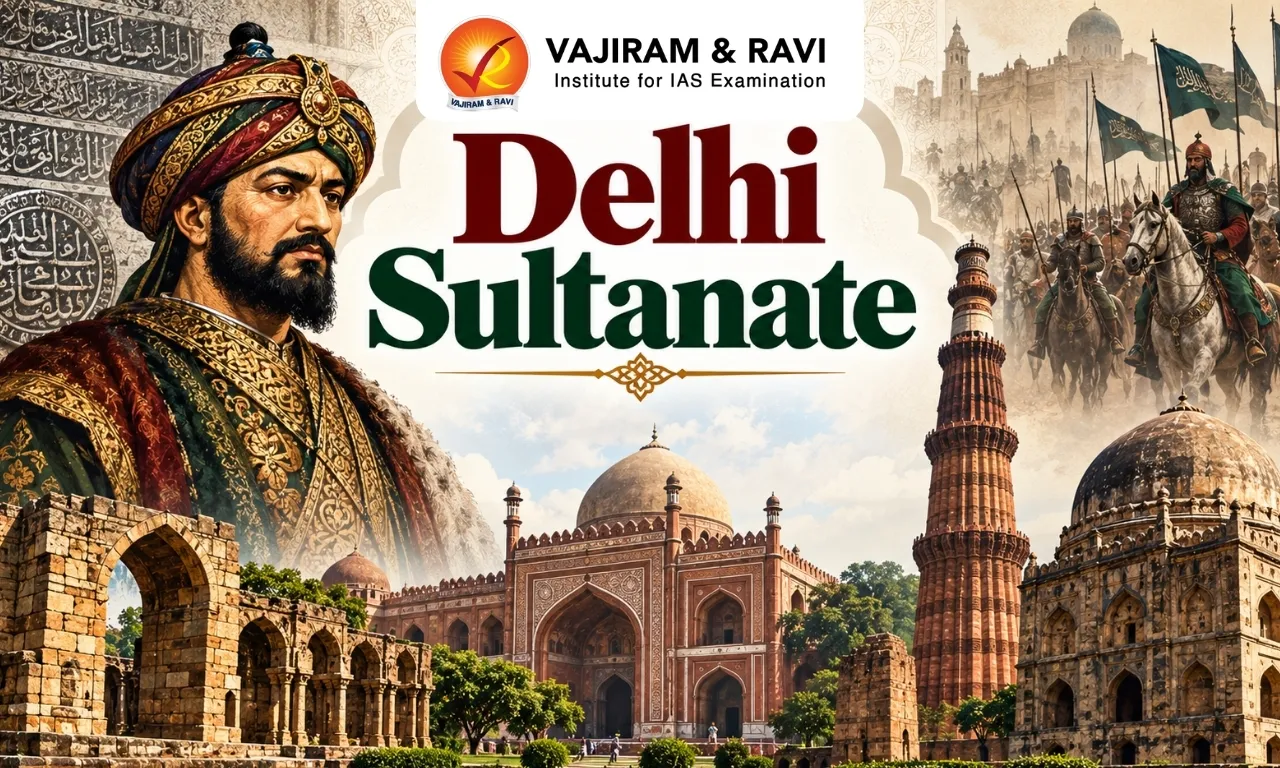
The Delhi Sultanate was a major political power in medieval Indian history, ruling large parts of northern India between 1206 and 1526 CE. It witnessed the rise of five dynasties, important administrative changes, military expansion, economic development and the growth of Indo-Islamic culture. Its history reflects changing political relationships, regional resistance, technological advancements and evolving social institutions that shaped the subcontinent before the establishment of Mughal rule.
Delhi Sultanate
The Delhi Sultanate was a medieval kingdom established in 1206 CE by Qutb-ud-din Aibak after Muhammad Ghori's death. The Sultanate developed a centralised monarchy, expanded its territories and introduced administrative, military and economic measures that influenced medieval Indian political institutions. Its rule continued for approximately 320 years and passed through five dynasties before ending in 1526.
Delhi Sultanate Features
The key highlighting features of the Delhi Sultanate has been listed below:
- Founder of the Delhi Sultanate: Qutb-ud-din Aibak established independent rule in 1206 CE.
- Delhi Sultanate Period: The Sultanate existed from 1206 to 1526 CE.
- Delhi Sultanate Rulers: Important rulers included Iltutmish, Balban, Alauddin Khalji, Muhammad bin Tughlaq, Firuz Shah Tughlaq and Sikandar Lodi.
- Delhi Sultanate Dynasties: Five dynasties ruled during this period: Mamluk, Khalji, Tughlaq, Sayyid and Lodi Dynasty.
- Delhi Sultanate Capital: The Delhi Sultanate had different capitals under its dynasties. The Slave Dynasty began with Lahore under Qutbuddin Aibak, while Iltutmish shifted the capital to Delhi. The Khilji Dynasty used Delhi, Kilokhri and Siri; the Tughlaq Dynasty used Delhi, with Muhammad bin Tughlaq transferring it to Daulatabad. The Sayyid Dynasty and Lodi Dynasty had Delhi as their capital, while Sikandar Lodi established Agra as an important administrative centre in 1504.
- Territorial Expansion: The Sultanate expanded under the Khalji and Tughlaq rulers. Its greatest geographical extent came during Muhammad bin Tughlaq's reign, when its authority reached extensive parts of the Indian subcontinent.
- Historical Significance: The Sultanate strengthened Delhi's position as a political centre, developed new administrative arrangements and contributed to cultural interaction, urban growth, technological change and Indo-Islamic architectural traditions.


Delhi Sultanate History
The origins of the Delhi Sultanate lie in the Ghurid expansion into northern India. Its establishment followed earlier invasions, the defeat of regional kingdoms and the emergence of independent Turkish rule.
- Mahmud of Ghazni conducted repeated raids into northern India between 997 and 1030, mainly to acquire wealth rather than establish permanent rule.
- Muhammad Ghori expanded Ghurid territories into northern India and defeated Prithviraj Chauhan in the Second Battle of Tarain in 1192, weakening Rajput power.
- In 1206, after Muhammad Ghori’s death, Qutb-ud-din Aibak established an independent kingdom centred on Delhi, marking the beginning of the Delhi Sultanate.
- Iltutmish strengthened the Sultanate by defeating rival claimants, expanding territorial control, securing recognition from the Abbasid Caliph and improving administration.
- The Khalji dynasty expanded into Gujarat, Rajasthan and southern India. Alauddin Khalji also resisted Mongol attacks and introduced military, financial and market regulations.
- The Tughlaq dynasty expanded Sultanate territory, but rebellions and economic difficulties weakened its control. Timur’s invasion of Delhi in 1398 accelerated its decline, followed by the Sayyid and Lodi dynasties.
Delhi Sultanate Dynasties
The Delhi Sultanate passed through five successive dynasties between 1206 and 1526 CE as highlighted below:
1. Mamluk Dynasty (1206-1290)
The Mamluk dynasty, commonly called the Slave dynasty, established the independent Sultanate and developed its early political and administrative foundations.
- Timeline: The dynasty ruled from 1206 to 1290. Its establishment followed the death of Muhammad Ghori, while its end resulted from a political transition that brought Jalaluddin Khalji to power.
- Important Rulers: Qutb-ud-din Aibak, Iltutmish, Razia Sultan and Ghiyasuddin Balban were prominent rulers.
- Founder: Aibak founded the Sultanate, while Iltutmish consolidated it. Iltutmish defeated competing claimants, extended territorial control and obtained recognition from the Abbasid Caliph, strengthening the legitimacy of his government.
- Razia Sultan: Razia ruled from 1236 to 1240 and was the first female Sultan of the Delhi Sultanate.
- Balban: Balban strengthened royal authority through strict discipline, centralisation and suppression of rebellious nobles. He also improved frontier defence against Mongol threats, reinforcing the military position of the Sultanate.
- Administrative Developments: Iltutmish strengthened the Iqta System and introduced the Silver Tanka and Copper Jital.
- Architecture: Aibak initiated the construction of the Qutb Minar and built the Quwwat-ul-Islam Mosque. Iltutmish continued construction and expanded the Qutb complex, establishing important early examples of Indo-Islamic architecture.
- End of the Dynasty: Internal rivalries and weakening royal authority created opportunities for the Khaljis. Jalaluddin Khalji's rise in 1290 ended Mamluk rule and began a new phase of territorial expansion.
2. Khalji Dynasty (1290-1320)
The Khalji dynasty strengthened the Delhi Sultanate through military expansion, resistance to Mongol invasions, market regulation and changes in agricultural taxation.
- Timeline: The dynasty ruled from 1290 to 1320.
- Founder: Jalaluddin Khalji became its first ruler after the end of Mamluk rule.
- Major Ruler: Alauddin Khalji ruled from 1296 to 1316 and became the dynasty's most influential ruler. He expanded the Sultanate, strengthened the army and introduced measures to control prices and increase state revenue.
- Territorial Expansion: Khalji campaigns extended Sultanate influence into Gujarat, Malwa, Rajasthan and parts of southern India. Military commanders, including Malik Kafur, led expeditions that brought wealth and tribute to the ruling power.
- Mongol Resistance: The dynasty faced repeated Mongol attacks from the northwest. Alauddin strengthened military preparations and defended the Sultanate, preventing these invasions from permanently undermining its authority.
- Agrarian Measures: Alauddin increased agricultural revenue demands and introduced land measurement through the policy known as hukm-i-misahat. Direct revenue collection and payments in kind strengthened the state's control over agricultural resources.
- Military Organisation: The dynasty strengthened its army and introduced Dagh, the branding of horses and huliyah, the recording of soldiers' descriptions.
- End of the Dynasty: After Alauddin's death, court rivalries and political assassinations weakened Khalji authority. Ghiyasuddin Tughlaq defeated Khusrau Khan in 1320, establishing the Tughlaq dynasty.
3. Tughlaq Dynasty (1320-1412)
The Tughlaq dynasty reached the Sultanate's greatest territorial extent but later experienced administrative difficulties, provincial rebellions and a major external invasion.
- Timeline and Founder: The dynasty began in 1320 under Ghiyasuddin Tughlaq.
- Muhammad bin Tughlaq: Ruling from 1325 to 1351, Muhammad bin Tughlaq expanded the kingdom and introduced ambitious administrative experiments.
- Capital: Muhammad bin Tughlaq shifted the administrative centre from Delhi to Daulatabad. The relocation created hardship and opposition and the experiment was eventually reversed, although Daulatabad retained administrative importance.
- Token Currency: The Sultan introduced copper and brass alloy coins assigned the value of silver currency. Counterfeiting undermined the experiment, causing economic disruption and demonstrating the difficulties of implementing monetary reforms without adequate controls.
- Provincial Revolts: Several regions challenged the Sultan's authority during Muhammad bin Tughlaq's reign. The emergence of independent powers, including Vijayanagara and the Bahmani Sultanate, reduced Delhi's influence over southern and central India.
- Firuz Shah Tughlaq: Firuz Shah ruled from 1351 to 1388 and promoted canals, irrigation, public works and new towns. His policies aimed to improve agricultural production and stabilise the kingdom after earlier unrest.
- Architecture: Tughlaq rulers developed distinctive buildings and fortified settlements. Tughlaqabad, Firoz Shah Kotla and the tomb of Ghiyasuddin Tughlaq illustrate the dynasty's architectural preferences and its emphasis on durable construction.
- Timur's Invasion: Timur invaded Delhi in 1398, exploiting political divisions and dynastic rivalries. The invasion devastated the capital, weakened the remaining Tughlaq government and accelerated the fragmentation of the Sultanate.
4. Sayyid Dynasty (1412-1451)
The Sayyid Dynasty ruled a weakened Delhi Sultanate after Timur's invasion, exercising limited authority while regional powers continued to expand.
- Timeline: The dynasty's rule is generally dated from 1414 to 1451, following the political disruption caused by Timur's invasion.
- Founder: Khizr Khan established Sayyid rule in the early fifteenth century.
- Khizr Khan: The founder governed under the influence of the Timurid power and struggled to restore Delhi's former territorial authority. His rule depended on managing local chiefs and the competing interests of regional elites.
- Mubarak Shah: Mubarak Shah succeeded Khizr Khan and attempted to recover lost territories. He ended his predecessor's nominal allegiance to Timur but faced continued resistance from regional powers and local opponents.
- Limited Territorial Control: The dynasty controlled a much smaller area than earlier Sultanate rulers. Its authority was concentrated around Delhi and nearby territories, while several provincial regions operated with substantial independence.
- Political Instability: Weak central institutions, limited military resources and continuing disputes restricted the dynasty's effectiveness. The rulers struggled to restore the political unity that had characterised the Sultanate during its strongest phases.
- Regional Powers: Gujarat, Malwa and Jaunpur emerged as important regional centres during the period of declining Delhi authority. Their growth reduced the Sultanate's ability to exercise influence across northern India.
- Alam Shah: Alauddin Alam Shah was the last Sayyid ruler. His withdrawal from active rule created an opportunity for Bahlul Lodi to take control of Delhi and establish a new dynasty.
- End of Sayyid Rule: Bahlul Lodi established the Lodi dynasty in 1451. His accession marked an attempt to revive the Sultanate through stronger Afghan political networks and renewed territorial consolidation.
5. Lodi Dynasty (1451-1526)
The Lodi dynasty was the final ruling house of the Delhi Sultanate, seeking to restore political strength before its defeat by Babur.
- Timeline: The dynasty ruled from 1451 to 1526.
- Founder: Bahlul Lodi founded the Lodi Dynasty.
- Bahlul Lodi: Bahlul strengthened the kingdom by challenging rival powers, including the Jaunpur Sultanate. His efforts restored some territories to Delhi's control and provided a stronger foundation for subsequent Lodi rulers.
- Sikandar Lodi: Sikandar ruled from 1489 to 1517 and consolidated Afghan power. He expanded the kingdom towards Bihar and founded Agra in 1504, developing it into an important administrative centre.
- Ibrahim Lodi: Ibrahim succeeded Sikandar in 1517. His conflicts with nobles and regional leaders weakened political unity, while his inability to secure sufficient support made the Sultanate vulnerable to external intervention.
- Babur's Intervention: Daulat Khan Lodi, the governor of Lahore, invited Babur to intervene against Ibrahim. This invitation contributed to the political circumstances preceding the Mughal Invasion of Northern India.
- End of Delhi Dynasty: Babur defeated Ibrahim Lodi in First Battle of Panipat 1526. Ibrahim's death ended Lodi rule and brought the Delhi Sultanate to a close, establishing the foundation of Mughal Rule in northern India.
Delhi Sultanate Decline
The Decline of the Delhi Sultanate resulted from weakening central authority, succession disputes, provincial independence and external invasions. These developments gradually reduced its territorial control until Babur's victory in 1526 ended Sultanate rule.
- Weak Successors: After powerful rulers died, successors often struggled to control nobles and provincial governors. Court rivalries, disputed succession and ineffective leadership weakened the monarchy and reduced its ability to maintain political unity.
- Administrative and Economic Challenges: Muhammad bin Tughlaq's unsuccessful experiments, including token currency and the capital transfer, created financial and political difficulties. Rebellions and declining revenues further weakened the state's capacity to govern distant territories.
- Provincial Revolts: Regional governors and local rulers increasingly asserted independence. The establishment of Vijayanagara in 1336 and the Bahmani Sultanate in 1347 reduced Delhi's influence, particularly across southern and central India.
- Decline after Firuz Shah Tughlaq: Firuz Shah's death in 1388 was followed by succession struggles and instability.
- Timur's Invasion (1398): Timur invaded Delhi during a period of political division, devastating the city and causing widespread loss of life and property. His campaign further damaged the Sultanate's economy, military strength and administrative authority.
- Rise of Regional Kingdoms: Gujarat, Malwa, Jaunpur and other regional powers gained greater independence as Delhi's influence contracted. The Sayyid rulers could not reverse this fragmentation, while the Lodi rulers faced continuing challenges from powerful nobles.
- Conflict under Ibrahim Lodi: Ibrahim Lodi struggled to manage Afghan nobles and regional chiefs. His conflicts with influential political figures weakened internal unity, encouraging opponents to seek outside support against the Sultan.
- First Battle of Panipat (1526): Babur defeated Ibrahim Lodi in this battle, ending the Delhi Sultanate. The victory established the foundation of the Mughal Empire in northern India.
Delhi Sultanate Political Administration
The Delhi Sultanate followed a hierarchical administrative structure comprising central, provincial and local levels.
- Sultan: The Sultan headed the state and exercised extensive military, administrative and judicial authority. His effectiveness depended on controlling nobles, managing provincial officials, maintaining the army and securing sufficient revenue.
- Central Administration and Wazir: The Diwan-i-Wizarat, headed by the Wazir (Prime Minister), managed state finances and advised the Sultan. The department supervised revenue and expenditure, supported military campaigns and coordinated several specialised financial offices.
- Financial Departments: The Mustaufi-i-Mumalik audited expenditure, while the Mushrif-i-Mumalik maintained income records. The Diwan-i-Mustakhraj, established by Alauddin Khalji, pursued outstanding revenue payments to strengthen state finances.
- Military Department: The Diwan-i-Arz, headed by the Ariz-i-Mumalik, managed military organisation. Alauddin Khalji introduced horse branding (Dagh) and descriptive records of soldiers (Huliya).
- Army Organisation: Barani’s Tarikh-i-Firoz Shahi mentions Hasham-i-qalb (central contingents) and hasham-i-atraf (provincial contingents). Garrisons operated under Kotwals, while Khilji and Tughlaq soldiers received cash payments or itlaq drafts.
- Correspondence and Justice: The Diwan-i-Insha handled royal correspondence, while the Diwan-i-Risalat dealt with religious matters and aspects of justice. The Diwan-i-Mazalim supervised judicial and public order officials when required.
- Provincial Administration: Provinces, known as iqtas, were administered by governors called wali or muqti. They collected revenue, maintained law and order, commanded military forces and prevented challenges to the central government.
- Local Administration: Rural administration involved villages and parganas. Village officials included the muqaddam and patwari, while the chaudhary, amil and karkun performed important revenue collection and accounting functions at the pargana level.
- Intelligence and Royal Household: The Barid-i-Mumalik supervised intelligence activities, while the Wakil-i-Dar managed the royal household. Other officials handled court ceremonies, royal protection and the organisation of the Sultan's immediate establishment.
Delhi Sultanate Economy and Trade
Agriculture formed the foundation of the Delhi Sultanate's economy, with land revenue providing the principal income to the state. The key features of the economy under Delhi Sultanate are:
- Agriculture and Land Revenue: Agriculture remained the principal occupation and the state collected a share of agricultural produce. Revenue officials called ‘Amils’ collected payments from cultivators and transferred state income to the treasury.
- Khalisa and Iqta: Khalisa referred to land whose revenue went directly to the Sultan's treasury. An Iqta was a revenue assignment held by a Muqti at the Sultan's pleasure, linking revenue collection with administration.
- Land Tax and Measurement: Kharaj was the principal land tax, while Alauddin Khalji introduced actual land measurement to regulate assessment. He also increased revenue demands and strengthened direct collection from agricultural producers. Mawas were the regions that refused to pay Kharaj.
- Agricultural Credit and Irrigation: Muhammad bin Tughlaq introduced agricultural loans called sondhar and established the Diwan-i-Amir Kohi to encourage cultivation. Firuz Shah Tughlaq promoted canals and imposed an irrigation tax known as haqq-i-sharb and a separate Jizya Tax.
- Currency System: Iltutmish introduced the Silver Tanka and Copper Jital. Muhammad bin Tughlaq later introduced token coins made from base metals. Dehliwal Coins continued depicting Goddess Lakshmi, Bull, Horseman with name of ruler inscribed on it.
- Inland and Overseas Trade: Local markets connected villages with towns through food-grain exchange, while long distance merchants traded higher value commodities. Sea routes connected Gujarat with Persian Gulf and Red Sea ports and eventually Europe.
- Imports and Exports: Horses and precious metals were important imports, while brocade and silk arrived from regions including Iraq and China. India exported grain, textiles, indigo and other goods to overseas and regional markets.
- Merchant Communities: Karwanis or Nayaks specialised in grain transportation, while Multanis conducted long distance trade. Their activities supported market connections between agricultural areas, towns and commercial centres.
Delhi Sultanate Art and Architecture
The Delhi Sultanate contributed to the development of Indo-Islamic Architecture by combining Persian and Central Asian forms with Indian materials, craftsmanship and decorative traditions.
- Arches and Domes: Arches and domes became important architectural features during the Sultanate period. The development of true arches and domes enabled builders to construct larger covered spaces and more durable monumental structures.
- Qutb Minar: Construction began under Qutb-ud-din Aibak and continued under Iltutmish and later rulers. The minaret became a prominent example of early Sultanate architecture, featuring multiple storeys, inscriptions and intricate surface decoration.
- Mosques and Religious Buildings: The Quwwat-ul-Islam Mosque in Delhi and Adhai Din Ka Jhonpra in Ajmer represent early Sultanate architecture. These buildings demonstrate the interaction between imported architectural forms and established Indian building traditions.
- Khalji Architecture: Alauddin Khalji expanded the Qutb complex and commissioned the Alai Darwaza, completed in 1311. Its arches, dome, stonework and decorative elements demonstrate advances in Indo-Islamic architectural techniques.
- Tughlaq Architecture: Tughlaq buildings often emphasised strength, sloping walls and relatively restrained decoration. Tughlaqabad Fort, the tomb of Ghiyasuddin Tughlaq and Firoz Shah Kotla illustrate the dynasty's architectural approach.
- Lodi Architecture: Lodi period buildings included tombs, mosques and garden complexes. Structures in the present day Lodi Gardens reflect developments in tomb architecture and the use of domes, enclosed spaces and landscaped surroundings.
- Decorative Features: Arabic inscriptions, Quranic verses, geometric designs and floral motifs decorated many buildings. Indian craftsmen incorporated local decorative elements, including lotus and bell motifs, into the developing architectural style.
- Construction Materials and Techniques: Builders increasingly used lime mortar, stonework, arches and domes. Indian stone cutters and craftsmen contributed significantly to construction, helping combine different technical traditions into a distinctive architectural form.
Delhi Sultanate Society and Culture
Society during the Delhi Sultanate period included diverse religious communities, occupational groups and social hierarchies. Cultural interaction influenced language, education, customs, religious practices and relationships between ruling elites and local populations.
- Social Structure: Caste continued to shape social relationships among Hindu communities, while distinctions of rank and occupation influenced wider society. Political elites, merchants, cultivators, artisans, servants and religious scholars occupied different positions.
- Position of Women: Women generally faced restrictions within patriarchal social structures. Early marriage and purdah were practised in different communities, particularly among aristocratic families, while educational opportunities remained limited for most women.
- Family Customs: Ceremonies associated with birth, education and marriage reflected religious practices, community identities and established social customs.
- Marriage: Hindu marriages generally took place within the same sub caste, while intermarriage between different varnas was restricted. Among Muslims, individuals had greater freedom in choosing their spouse
- Education: Access to education varied according to social position and resources. Religious institutions and maktabs provided learning opportunities, while educated women such as Razia Sultan demonstrated that some aristocratic families also supported female education.
- Religious Institutions: The ulema advised rulers on theological and religious matters, while scholars associated with religious law and judicial administration held important positions. Religious institutions influenced education, public life and state policies.
- Slavery and Servitude: Slaves performed domestic, military and administrative duties, with some receiving specialised training. Certain individuals rose to positions of considerable influence, demonstrating the importance of military service and court patronage within the Sultanate.
- Religious Practices and Tensions: Hindu and Muslim communities maintained distinct religious traditions, while rulers followed different policies towards religious institutions. The period included instances of temple destruction and religious discrimination, alongside documented cases of temple protection or repair.
- Language and Cultural Interaction: Hindavi developed through interaction among regional vernaculars and Persianate cultural influences. Amir Khusrau's writings reflect this linguistic environment, while broader exchanges shaped literature, music, clothing and aspects of urban life.
- Social Issues: Ibn Battuta mentioned Sati, which required the Sultan’s prior permission, while Jauhar was practised among Rajputs. Purdah prevailed among Hindu and Muslim aristocracy, while widows could inherit and dispose of their son less husbands’ private property.
Delhi Sultanate Technological Developments
Technological developments during the Delhi Sultanate Period influenced agriculture, textile production, irrigation and construction. The adoption and wider use of mechanical devices supported productive activities and transformed aspects of urban and rural life.
- Persian Wheel: The geared Persian wheel, known as saqiya, improved the lifting of water from wells. Its use supported irrigation and helped cultivators access water for agricultural activities more efficiently.
- Spinning Wheel: The charkha became an important technology for spinning cotton yarn. Isami's Futuh-us-Salatin, written in 1350, provides an early clear literary reference to the spinning wheel in India.
- Cotton Processing: Improvements in cotton processing equipment, including the cotton gin, supported textile production. Such technologies helped process raw cotton more efficiently and contributed to the growth of textile crafts and commercial activity.
- Irrigation Canals: Firuz Shah Tughlaq promoted canal construction and renovation to expand irrigation. These works improved access to water in agricultural areas and supported cultivation, although their benefits depended on local conditions and maintenance.
- Construction Technology: Wider use of true arches, domes and lime mortar improved building techniques. These methods enabled the construction of larger structures and influenced the development of mosques, tombs, forts and other monumental buildings.
- Paper Production: Paper was used more widely in parts of the subcontinent during the later medieval period. Its availability supported written communication, record keeping and literary activity, although paper had reached India before the Sultanate's establishment.
- Mechanical Devices: Water raising equipment and mechanisms using gears, pulleys, cams and cranks became more prominent. Their adoption reflected technological exchanges across regions and contributed to changes in agricultural and craft production.
Important Rulers of the Delhi Sultanate
Several rulers shaped the establishment, expansion and decline of the Delhi Sultanate through military campaigns, administrative reforms, economic policies and efforts to strengthen royal authority.
- Qutb-ud-din Aibak (1206-1210): Aibak established the independent Sultanate after Muhammad Ghori's death. He initiated the construction of the Qutb Minar and helped establish the foundations of Turkish political authority in northern India.
- Iltutmish (1211-1236): Iltutmish consolidated the Sultanate by defeating rivals and strengthening administration. He reinforced the Iqta system, introduced the silver Tanka and copper Jital and obtained recognition from the Abbasid Caliph.
- Razia Sultan (1236-1240): Razia became the first female Sultan of the Delhi Sultanate. Her reign highlighted the challenges women rulers faced within a political system dominated by powerful nobles and competing aristocratic interests.
- Ghiyasuddin Balban (1266-1287): Balban strengthened the monarchy through centralisation, strict discipline and suppression of rebellious nobles. He also improved frontier defence, particularly against Mongol threats to the Sultanate's northwestern territories.
- Alauddin Khalji (1296-1316): Alauddin expanded the Sultanate into several regions and resisted Mongol invasions. His market regulations, price controls, agricultural taxation and military reforms strengthened the state's resources and military organisation.
- Muhammad bin Tughlaq (1325-1351): Muhammad bin Tughlaq expanded the kingdom to its greatest territorial extent but introduced controversial administrative experiments. His token currency and capital transfer policies encountered difficulties, while provincial revolts weakened central control.
- Firuz Shah Tughlaq (1351-1388): Firuz Shah promoted irrigation canals, public works and new towns. His reign emphasised construction and agricultural development, although the Sultanate's later political instability limited the durability of central authority.
- Sikandar Lodi (1489-1517): Sikandar strengthened Afghan political power and expanded the kingdom. He founded Agra in 1504, which developed into an important administrative centre and later became a major city under the Mughal Empire.
- Ibrahim Lodi (1517-1526): Ibrahim was the last Sultan of Delhi. His conflicts with nobles and regional leaders weakened the kingdom and his defeat by Babur at the First Battle of Panipat ended Sultanate rule.
Delhi Sultanate vs Mughal Empire
The key difference between the Delhi Sultanate and Mughal Empire lies in their political organisation and historical development as tabulated below:
| Delhi Sultanate vs Mughal Empire | ||
| Aspect | Delhi Sultanate | Mughal Empire |
|
Time period |
1206-1526 CE |
1526-1857 CE |
|
Established By |
Qutb-ud-din Aibak |
Babur |
|
Dynasties |
Mamluk, Khalji, Tughlaq, Sayyid and Lodi |
Mughal dynasty |
|
Political Background |
Turkish, Afghan and Central Asian ruling groups |
Turko-Mongol imperial dynasty |
|
Capital |
Delhi was the principal political centre |
Capitals included Agra and Delhi at different times |
|
Administrative system |
Iqta system and provincial assignments |
Mansabdari and jagirdari systems |
|
Provincial officials |
Muqtis and Iqtadars |
Subahdars, mansabdars and jagirdars |
|
Land revenue |
Kharaj, etc. |
Zabti, Jagirs, etc. |
|
Military organisation |
Cavalry forces, provincial contingents and centrally maintained troops |
Mansabdari organisation, cavalry, artillery and imperial forces |
|
Architecture |
Early Indo-Islamic forms, minarets, arches, domes and fortified structures |
Mature Mughal style, known for large gardens, symmetry, domes and extensive marble work |
Delhi Sultanate UPSC CSE PYQs
The important questions asked in UPSC CSE related to Delhi Sultanate are given below:
Q1. [UPSC CSE Mains 2023] - What were the major technological changes introduced during the Sultanate period? How did those technological changes influence Indian society?
Q2. [UPSC CSE Prelims 2022] - With reference to Indian history, consider the following statements:
The first Mongol invasion of India happened during the reign of Jalal-ud-din Khalji.
During the reign of Ala-ud-din Khalji, one Mongol assault marched up to Delhi and besieged the city.
Muhammad-bin-Tughlaq temporarily lost portions of the north-west of his kingdom to Mongols.
Which of the statements given above is/are correct?
(a) 1 and 2
(b) 2 only
(c) 1 and 3
(d) 3 only
Ans: (b)
Q3. [UPSC CSE Prelims 2022] - With reference to Indian history, which of the following were known as "Kulah-Daran"?
(a) Arab merchants
(b) Qalandars
(c) Persian calligraphists
(d) Sayyids
Ans: (d)
Q4. [UPSC CSE Prelims 2021] - Consider the following statements:
It was during the reign of Iltutmish that Chengiz Khan reached the Indus in pursuit of the fugitive Khwarezm prince.
It was during the reign of Muhammad bin Tughluq that Taimur occupied Multan and crossed the Indus.
It was during the reign of Deva Raya II of the Vijayanagara Empire that Vasco da Gama reached the coast of Kerala.
Which of the statements given above is/are correct?
(a) 1 only
(b) 1 and 2
(c) 3 only
(d) 2 and 3
Ans: (a)
Q5. [UPSC CSE Prelims 2021] - With reference to medieval India, which one of the following is the correct sequence in ascending order in terms of size?
(a) Paragana- Sarkar- Suba
(b) Sarkar-Paragana-Suba
(c) Suba-Sarkar-Paragana
(d) Paragana-Suba-Sarkar
Ans: (a)

 Last updated on Oct, 2026
→ UPSC 2027 Notification will be released on 13 January 2027 at upsconline.nic.in.
→ Check Nobel Prize 2026 Winners List here.
→ Check out the latest UPSC Syllabus here.
→ Download UPSC Calendar 2027 PDF Here.
Delhi Sultanate FAQs
Q1. Who came first, Mughals or Delhi Sultanate?+
Q2. Who was the first female Sultan of India?+
Q3. What are the five dynasties of the Delhi Sultanate?+
Q4. Who founded the Delhi Sultanate in India?+
Q5. What was the time period of the Delhi Sultanate?+
Tags: delhi delhi sultanate