




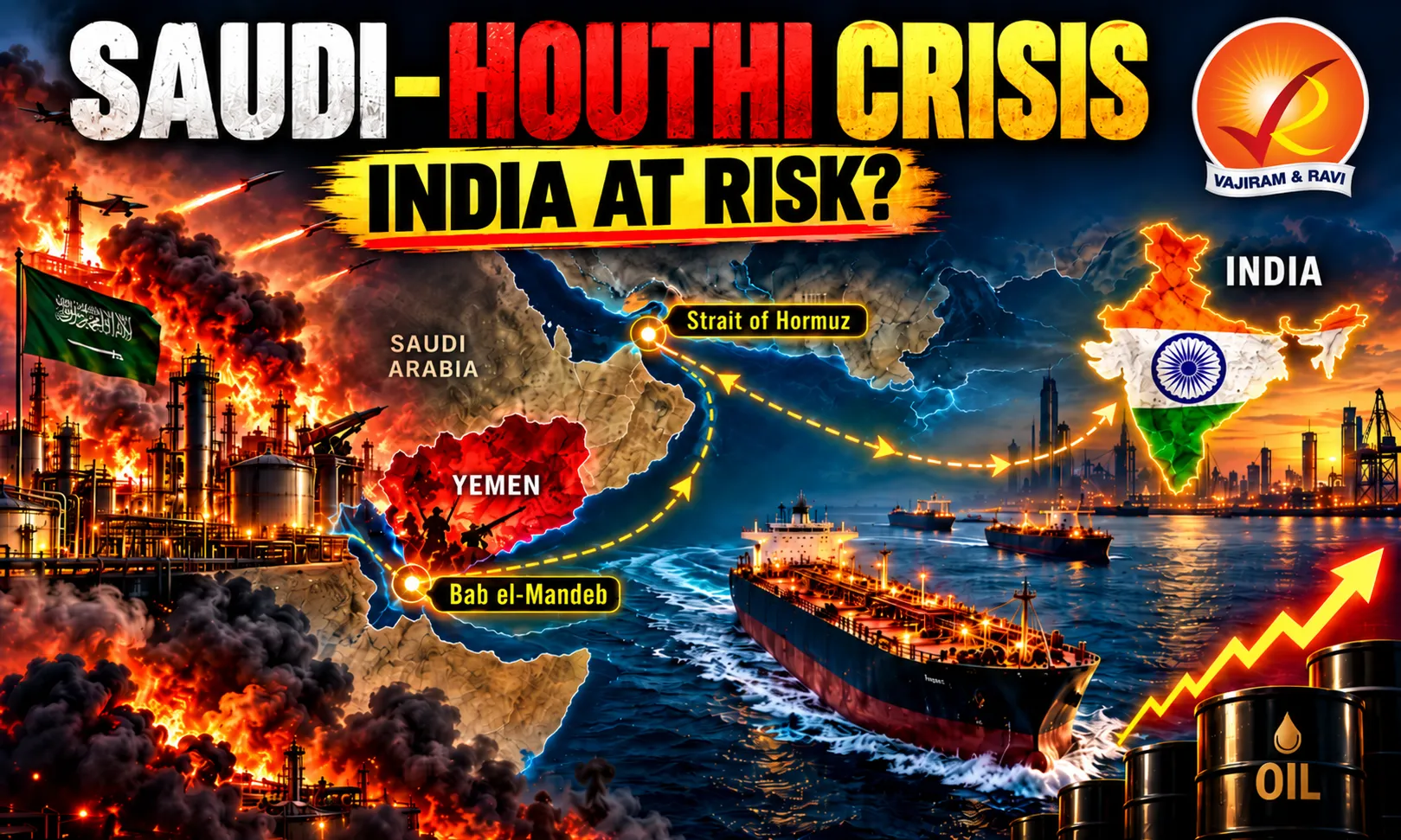
The Saudi–Houthi conflict escalated in October 2026 after renewed attacks on Saudi infrastructure, including airports and facilities associated with Saudi Aramco, a major oil and natural gas producer. The attacks raised concerns over civilian safety, regional stability, energy security and maritime trade.
- October 2026: Houthi missile attacks targeted King Khalid International Airport in Riyadh, causing civilian casualties and disrupting air travel.
- 21 October 2026: An attack on King Fahd International Airport in Dammam killed two people, including an Indian national, and injured eight others. A separate drone incident near Saudi Aramco’s Shaybah oil field caused casualties from falling debris after the drone was intercepted.
India condemned the attacks on civilian and critical infrastructure. The Indian Embassy in Riyadh also coordinated with Saudi authorities to assist affected Indian nationals.
Who Are the Houthis?
The Houthis, also known as Ansar Allah, are an armed political movement that emerged from Yemen’s Zaydi Shia community. They captured Yemen’s capital, Sanaa, in 2014 and became a major force in the country’s civil war. In 2015, Saudi Arabia led a military coalition to support Yemen’s internationally recognised government against the Houthis. Iran supports the movement, although the Houthis also pursue their own political and military objectives. They control parts of Yemen, including areas along the Red Sea coast, giving them the ability to threaten important maritime routes near the Bab el-Mandeb Strait.
Why Are the Houthis Attacking Saudi Arabia?
The attacks are linked to Saudi Arabia’s involvement in Yemen’s civil war, retaliation for military strikes and the wider regional rivalry between Saudi Arabia and Iran.
- Retaliation for Military Strikes: In July 2026, Saudi-backed Yemeni forces struck the runway at Houthi-controlled Sanaa International Airport to prevent an Iranian aircraft from landing. The Houthis retaliated by attacking Abha International Airport in Saudi Arabia.
- Opposition to Saudi Intervention in Yemen: Saudi Arabia led a military coalition in 2015 to support Yemen’s internationally recognised government against the Houthis. The Houthis view Saudi Arabia as a key opponent in the conflict.
- Regional Rivalry with Iran: Iran supports the Houthis, while Saudi Arabia has backed the opposing Yemeni government. This connects the conflict to the wider competition for regional influence, although it does not mean that every Houthi action is directly ordered by Iran.
- Pressure on the Saudi Government: Attacks on airports and energy facilities can disrupt transport, raise security costs and threaten economic activity. Such attacks can be used to pressure Saudi Arabia and demonstrate the Houthis’ ability to strike important targets.
- Unresolved Conflict in Yemen: The UN-brokered truce in 2022 reduced fighting but did not produce a lasting political settlement. The underlying disputes remain unresolved, leaving scope for renewed hostilities and retaliation.


Implications for the World
The conflict has implications beyond West Asia, as threats to energy supplies, maritime routes and civilian infrastructure can disrupt global trade, increase economic uncertainty and undermine regional stability.
- Disruption of Global Energy Supplies: Saudi Arabia is a major oil producer and an important supplier to international markets. Attacks on airports, oil facilities and energy infrastructure can raise concerns about supply disruptions, potentially increasing oil-price volatility and transportation costs.
- Threat to Maritime Trade: The Bab el-Mandeb Strait connects the Red Sea with the Gulf of Aden and forms part of a major shipping route between Asia and Europe through the Suez Canal. Houthi attacks or threats to shipping can force vessels to take longer routes around Africa, increasing fuel consumption, freight costs and delivery times.
- Risks to Regional Stability: The conflict may draw in regional and external powers, increasing the possibility of a wider confrontation. Further military escalation could also undermine diplomatic efforts to stabilise Yemen and the broader West Asian region.
- Disruption to Civil Aviation: Attacks on international airports threaten passengers, airport staff and airline operations. They can lead to flight suspensions, diversions and travel uncertainty, affecting tourism, business travel and international connectivity.
- Pressure on Global Trade and Inflation: Higher oil prices, shipping costs and insurance premiums can increase the cost of imported goods. Countries dependent on imported energy and goods may face additional inflationary pressure.
Implications for India
The conflict poses significant risks to India’s energy security, trade routes and overseas citizens, given its dependence on imported oil and its economic and strategic ties with West Asia.
- Energy Security: India imports around 88.7% of its crude oil requirements, based on the 2025–26 estimate. Any sustained disruption to oil supplies from West Asia could raise import costs, increase the current account deficit and put pressure on domestic fuel prices.
- Exposure to Maritime Disruptions: India depends on shipping routes through the Red Sea and the Bab el-Mandeb Strait for trade with Europe and other markets. Rerouting ships around Africa can increase freight costs, extend delivery times and affect Indian exporters and importers.
- Importance of the Strait of Hormuz: The Strait of Hormuz, located between Iran and Oman, connects the Persian Gulf with the Gulf of Oman. Around 20 million barrels of oil and petroleum products passed through it per day in 2025, representing roughly one-fifth of global petroleum liquids consumption and about one-quarter of global seaborne oil trade. Escalation affecting this route could have serious consequences for India’s energy imports.
- Safety of Indian Nationals: India has a large expatriate community in Saudi Arabia and other Gulf countries. Attacks on airports and energy facilities put Indian workers and other residents at risk. The death of an Indian national in the Dammam airport attack highlights the human cost of the conflict.
- Impact on Trade and the Economy: Higher energy and shipping costs can affect manufacturing, transport, fertilisers and other sectors. Disruptions to flights may also affect Indian travellers, workers and pilgrims.
- Need for Energy Diversification: Saudi Arabia’s East–West Pipeline, also known as Petroline, transports crude oil from Abqaiq in eastern Saudi Arabia to Yanbu on the Red Sea. Its reported capacity of up to 7 million barrels per day provides an alternative route that reduces dependence on shipments through the Strait of Hormuz. However, its ability to sustain flows at full capacity during a major crisis remains a consideration.
- Role of Strategic Petroleum Reserves: India’s Phase I Strategic Petroleum Reserve (SPR) facilities have a combined capacity of 5.33 million metric tonnes at Visakhapatnam, Mangaluru and Padur. These reserves can help manage temporary supply disruptions, although they cannot fully offset a prolonged crisis.
Way Forward
- Diplomatic Engagement: India should continue to support dialogue among regional stakeholders and diplomatic efforts to reduce tensions and prevent further escalation.
- Protection of Civilian Infrastructure: All parties should avoid attacks on airports, energy facilities and other civilian infrastructure. Protecting civilians and essential services must remain a priority.
- Secure Maritime Routes: India should cooperate with regional and international partners to protect freedom of navigation and the safety of commercial shipping through the Red Sea and the Bab el-Mandeb Strait.
- Diversification of Energy Sources: India should broaden its sources of crude oil and natural gas, strengthen energy partnerships and improve its ability to respond to supply disruptions.
- Strengthening Strategic Reserves: India should expand and improve its emergency energy-storage capacity, while developing contingency plans for disruptions to oil imports and maritime transport.
- Protection of Indian Nationals: Indian missions in West Asia should maintain communication with expatriate communities, issue timely safety advisories and coordinate with local authorities to assist citizens during emergencies.
- Long-Term Political Settlement in Yemen: A durable solution requires negotiations addressing Yemen’s political divisions, security concerns and humanitarian needs. Renewed diplomatic efforts are essential to prevent repeated cycles of violence.
The Saudi–Houthi conflict demonstrates how instability in one part of West Asia can affect global energy markets, international trade and the safety of Indian nationals. For India, a combination of diplomatic engagement, energy diversification, maritime security and emergency preparedness is essential to reduce these risks.

 Last updated on Oct, 2026
→ UPSC 2027 Notification will be released on 13 January 2027 at upsconline.nic.in.
→ Check Nobel Prize 2026 Winners List here.
→ Check out the latest UPSC Syllabus here.
→ Download UPSC Calendar 2027 PDF Here.
Saudi-Houthi Conflict 2026 FAQs
Q1. What is the Saudi-Houthi conflict?+
Q2. Why are the Houthis attacking Saudi Arabia?+
Q3. How does the Saudi-Houthi conflict affect India?+
Q4. Why is the Bab el-Mandeb Strait important?+
Q5. How can India reduce the impact of the Saudi-Houthi conflict?+
Tags: saudi houthi conflict