



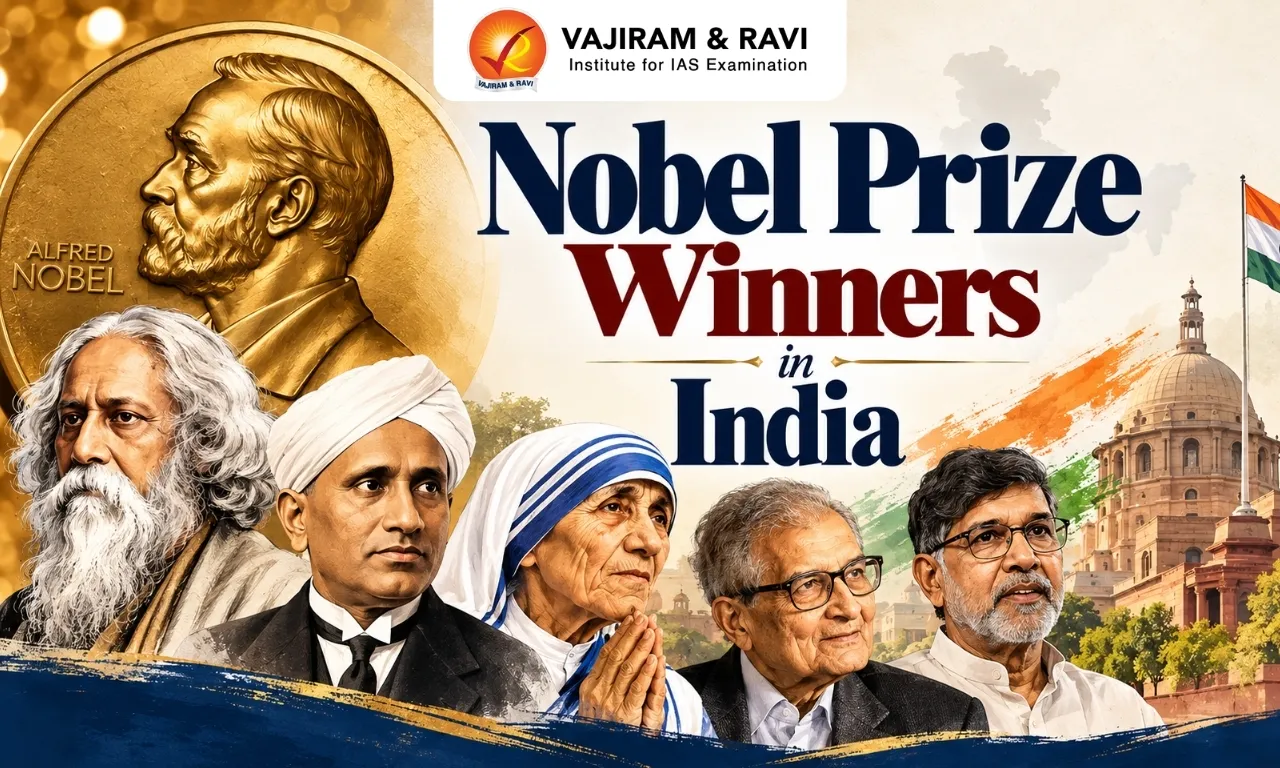
Nobel Prize winners in India include Rabindranath Tagore, C. V. Raman, Mother Teresa, Amartya Sen and Kailash Satyarthi, who were Indian citizens when they received the award. Other laureates, including Har Gobind Khorana, Subrahmanyan Chandrasekhar, Venkatraman Ramakrishnan and Abhijit Banerjee, were born in India but received the award after establishing careers abroad. Indian-origin laureates born outside India form a separate category.
The Nobel Prize recognises outstanding contributions to humanity in Physics, Chemistry, Physiology or Medicine, Literature and Peace. The Sveriges Riksbank Prize in Economic Sciences in Memory of Alfred Nobel, commonly called the Nobel Prize in Economics, was established later and was first awarded in 1969.
Nobel Prize Winners in India: List of Indian Laureates
India has five Nobel laureates who were Indian citizens at the time of receiving the award: Rabindranath Tagore, C. V. Raman, Mother Teresa, Amartya Sen and Kailash Satyarthi. Four other laureates - Har Gobind Khorana, Subrahmanyan Chandrasekhar, Venkatraman Ramakrishnan and Abhijit Banerjee were born in India but held foreign citizenship when they received the award.
| Year | Nobel laureate | Category | Major contribution |
|
1913 |
Rabindranath Tagore |
Literature |
Poetry, particularly Gitanjali |
|
1930 |
C. V. Raman |
Physics |
Discovery of the Raman Effect |
|
1968 |
Har Gobind Khorana |
Physiology or Medicine |
Interpretation of the genetic code |
|
1979 |
Mother Teresa |
Peace |
Humanitarian work among the poor and vulnerable |
|
1983 |
Subrahmanyan Chandrasekhar |
Physics |
Theoretical studies of stellar structure and evolution |
|
1998 |
Amartya Sen |
Economic Sciences |
Contributions to welfare economics |
|
2009 |
Venkatraman Ramakrishnan |
Chemistry |
Studies of the structure and function of ribosomes |
|
2014 |
Kailash Satyarthi |
Peace |
Campaign against child exploitation and for children's education |
|
2019 |
Abhijit Banerjee |
Economic Sciences |
Experimental approach to alleviating global poverty |
Nobel Prize Winners in India Major Contributions
The following Nobel laureates have made significant contributions to literature, science, economics, peace and human welfare. Their achievements and the reasons for receiving the award are outlined below.
1. Rabindranath Tagore (1913)
Rabindranath Tagore became the first Indian to receive the Nobel Prize, winning the Nobel Prize in Literature in 1913.
- Tagore was the first non-European Nobel laureate in Literature.
- He received the award for his poetry, particularly the English version of Gitanjali: Song Offerings.
- His literary works include poems, songs, short stories, novels, plays and essays.
- He founded an experimental school at Santiniketan, which later developed into Visva-Bharati University.
- He composed the national anthems of India, Jana Gana Mana, and Bangladesh, Amar Shonar Bangla.
2. C. V. Raman (1930)
Sir Chandrasekhara Venkata Raman received the Nobel Prize in Physics in 1930 for his discovery of the Raman Effect.
- The Raman Effect refers to the change in the wavelength of light when it is scattered by molecules.
- It provides information about the molecular structure and properties of materials.
- The discovery contributed to the development of Raman spectroscopy, used in chemical analysis and materials research.
National Science Day is observed on 28 February in India to commemorate the discovery of the Raman Effect in 1928.
3. Har Gobind Khorana (1968)
Har Gobind Khorana shared the Nobel Prize in Physiology or Medicine in 1968 with Marshall W. Nirenberg and Robert W. Holley.
- Their work helped explain how the genetic code determines protein synthesis.
- Khorana contributed to understanding the relationship between nucleotide sequences and the amino acids that make up proteins.
- His research advanced molecular biology and the study of genetic information.
4. Mother Teresa (1979)
Mother Teresa received the Nobel Peace Prize in 1979 for her humanitarian work among poor and vulnerable communities.
- She founded the Missionaries of Charity in 1950 in Kolkata.
- The organisation provides care and support to people facing poverty, illness and social exclusion.
- She was born Agnes Gonxha Bojaxhiu in Skopje, now in North Macedonia, and later became an Indian citizen.
5. Subrahmanyan Chandrasekhar (1983)
Subrahmanyan Chandrasekhar shared the Nobel Prize in Physics in 1983 with William A. Fowler.
- He was recognised for theoretical studies of the physical processes important to the structure and evolution of stars.
- He is known for the Chandrasekhar limit, which describes the maximum mass of a stable white dwarf star, approximately 1.4 times the mass of the Sun.
- His work contributed to modern understanding of stellar evolution and compact astronomical objects.
6. Amartya Sen (1998)
Amartya Sen received the Nobel Memorial Prize in Economic Sciences in 1998 for his contributions to welfare economics.
- His research examined poverty, famines, social choice and the distribution of economic welfare.
- He highlighted the role of people's access to food and resources in understanding famines.
- His work contributed to the development of the capability approach, which evaluates development in terms of people's freedoms and opportunities.
7. Venkatraman Ramakrishnan (2009)
Venkatraman Ramakrishnan shared the Nobel Prize in Chemistry in 2009 with Thomas A. Steitz and Ada E. Yonath.
- They were recognised for studies of the structure and function of ribosomes.
- Ribosomes are cellular structures that synthesise proteins by translating messenger RNA into chains of amino acids.
- Their research improved scientific understanding of protein synthesis and supported research relevant to antibiotic development.
8. Kailash Satyarthi (2014)
Kailash Satyarthi shared the Nobel Peace Prize in 2014 with Malala Yousafzai.
- He was recognised for his struggle against the exploitation of children and his efforts to secure children's right to education.
- He founded Bachpan Bachao Andolan, a movement against child labour and child exploitation.
- His work has contributed to international efforts to protect children's rights.
9. Abhijit Banerjee (2019)
Abhijit Banerjee shared the Nobel Memorial Prize in Economic Sciences in 2019 with Esther Duflo and Michael Kremer.
- They were recognised for their experimental approach to alleviating global poverty.
- Their research used field experiments to evaluate interventions in areas such as education and healthcare.
- This approach helped policymakers assess which poverty-reduction measures work in specific contexts.


Indian-Origin Nobel Prize Winners
Indian-origin Nobel laureates are individuals born outside India who have Indian ancestry. They are distinct from laureates born in India who later acquired foreign citizenship.
| Year | Laureate | Category | Contribution |
|
2001 |
V. S. Naipaul |
Literature |
Literary works exploring identity, colonialism and postcolonial societies |
|
2026 |
Navanethem “Navi” Pillay |
Peace |
Contributions to human rights, international law and accountability for serious international crimes |
V. S. Naipaul (2001)
- S. Naipaul, born in Trinidad and Tobago to a family of Indian ancestry, received the Nobel Prize in Literature in 2001.
- His writing explored colonialism, migration, identity and postcolonial societies.
- His major works include A House for Mr Biswas and In a Free State.
Navi Pillay (2026)
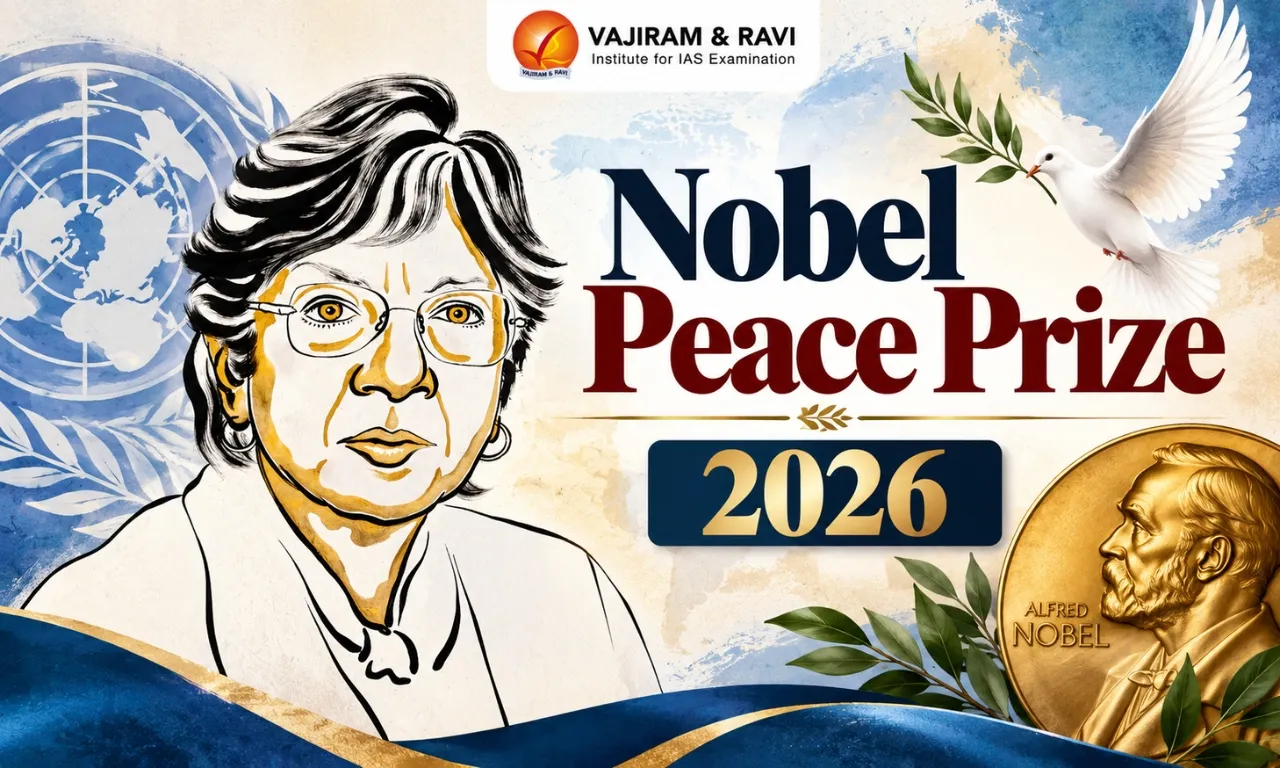
Navanethem “Navi” Pillay, a South African jurist of Indian Tamil origin, received the 2026 Nobel Peace Prize, according to the announcement on 9 October 2026.
- She served as the United Nations High Commissioner for Human Rights from 2008 to 2014.
- Her career has focused on human rights, international justice and accountability for war crimes, crimes against humanity and genocide.
- She was the first non-White woman to serve on South Africa's High Court.

 Last updated on Oct, 2026
→ UPSC 2027 Notification will be released on 13 January 2027 at upsconline.nic.in.
→ Check Nobel Prize 2026 Winners List here.
→ Check out the latest UPSC Syllabus here.
→ Download UPSC Calendar 2027 PDF Here.
Nobel Prize Winners in India FAQs
Q1. Who was the first Indian Nobel Prize winner?+
Q2. How many Indian Nobel Prize winners are there?+
Q3. Who was the first Indian to win the Nobel Prize in Physics?+
Q4. Which Indian Nobel Prize winners received the Nobel Peace Prize?+
Q5. Who are some Nobel Prize winners of Indian origin?+
Tags: nobel prize winners in india