




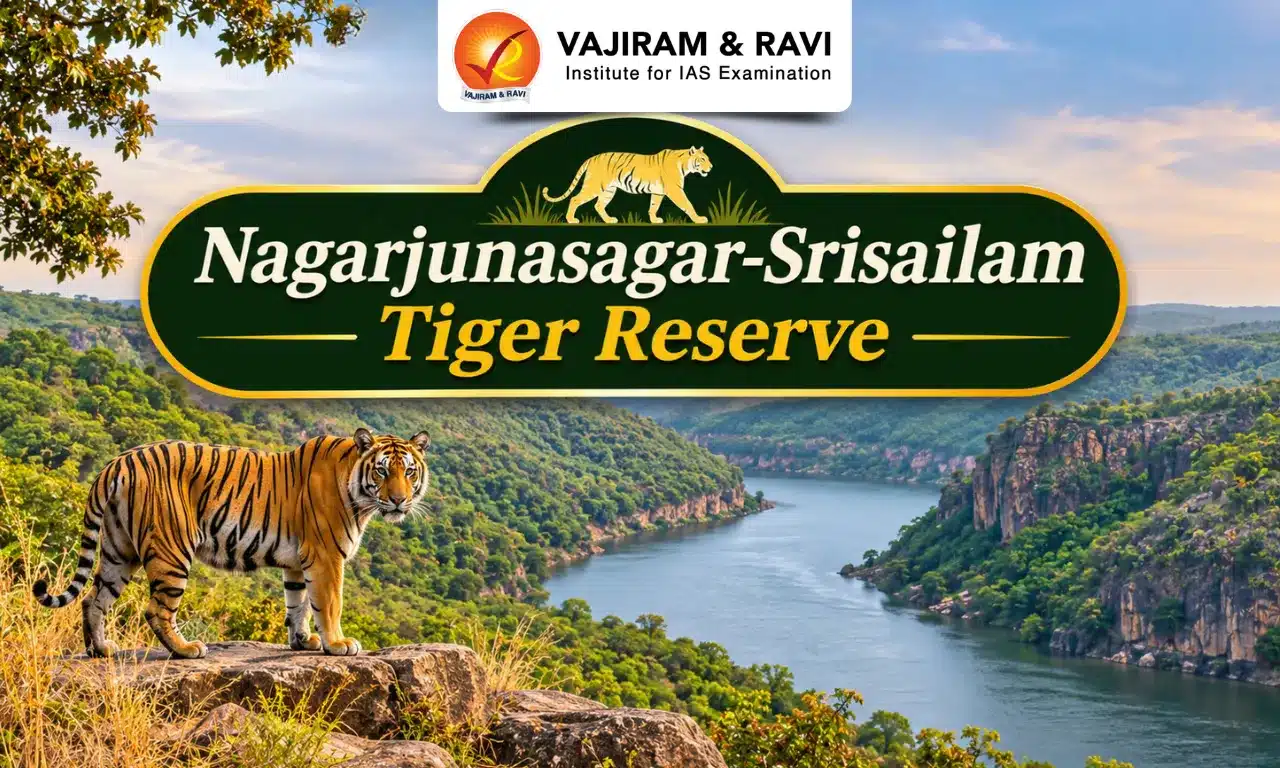
Nagarjunasagar-Srisailam Tiger Reserve (NSTR) is one of India's most important wildlife conservation areas, located in the Nallamala Hills of Andhra Pradesh, part of the Eastern Ghats. Established as a Tiger Reserve in 1983 under Project Tiger, it is recognised as India's largest tiger reserve by area. The reserve is known for its rich biodiversity, dense forests, diverse wildlife and the Krishna River, which flows through it. It plays a vital role in tiger conservation, biodiversity protection and maintaining ecological balance.
Nagarjunasagar-Srisailam Tiger Reserve Geographical Features
Nagarjunasagar-Srisailam Tiger Reserve (NSTR) is located in the Nallamala Hills of Andhra Pradesh, which form part of the Eastern Ghats. Covering approximately 3,727.82 sq. km, it is recognised as India's largest tiger reserve by notified area. The reserve is known for its dense forests, rugged hills, deep valleys and rich wildlife.
- Location: Spread across the Prakasam, Nandyal and Palnadu districts of Andhra Pradesh.
- Total Area: Covers 3,727.82 sq. km, including core and buffer zones, with approximately 2,444 sq. km of critical tiger habitat.
- Mountain Range: Located in the Nallamala Hills, an extension of the southern Eastern Ghats.
- Major River: The Krishna River flows through the reserve for approximately 270 km, supporting its forests and wildlife.
- Topography: Features rugged hills, plateaus, ridges, steep cliffs, deep valleys and gorges.
- Important Plateaus: Amrabad, Srisailam, Peddacheruvu, Sivapuram and Nekkanti.
- Major Waterfalls: Ethipothala Falls, Pedda Dukudu, Gundam and Chaleswaram.
- Highest Peak: Durgamkonda, located in the Markapur Reserve Forest, rises to approximately 917 metres above sea level.
- Climate: Experiences hot summers and moderate winters, with temperatures ranging from 16°C to 43°C and average annual rainfall of around 676 mm.
- Rainfall: Receives most rainfall from the Southwest Monsoon, while eastern areas also receive Northeast Monsoon rainfall.
Nagarjunasagar-Srisailam Tiger Reserve History
Nagarjunasagar-Srisailam Tiger Reserve was declared a Tiger Reserve in 1983 under Project Tiger. Apart from wildlife conservation, the region holds historical, religious and cultural importance because of its ancient temples, Buddhist heritage and archaeological sites.
- Establishment: Declared a Tiger Reserve in 1983 to protect Bengal tigers and their natural habitat.
- Wildlife Sanctuaries: Comprises two important protected areas:
- Rajiv Gandhi Wildlife Sanctuary
- Gundla Brahmeswaram Wildlife Sanctuary (GBM)
- Religious Significance: Home to the famous Srisailam Mallikarjuna Temple, associated with one of India's 12 Jyotirlingas and 18 Maha Shakti Peethas.
- Buddhist Heritage: Contains historical remains associated with Nagarjuna Viswa Vidyalayam, reflecting the region's ancient Buddhist learning traditions.
- Ancient Cave Sites: Important locations include Akka Mahadevi Caves, Dattatreya Bhilam, Uma Maheshwaram, Kadalivanam and Palankasari.


Nagarjunasagar-Srisailam Tiger Reserve Flora and Fauna
Nagarjunasagar-Srisailam Tiger Reserve supports rich biodiversity, including tropical dry deciduous and moist deciduous forests. Its varied landscape, river systems and forest habitats support numerous mammals, birds, reptiles, amphibians and medicinal plants.
Floral Diversity
- Forest Types: Dominated by southern tropical dry deciduous forests, with moist deciduous vegetation near rivers and streams.
- Plant Diversity: Around 1,521 angiosperm taxa, belonging to 149 families, have been documented.
- Medicinal Plants: Contains approximately 353 medicinal plant species and 29 recorded grass species.
- Major Trees: Nallamaddi (Terminalia tomentosa), Chirumanu (Anogeissus latifolia), Billudu (Chloroxylon swietenia), Yepi (Hardwickia binata) and Arjuna (Terminalia arjuna).
- Other Vegetation: Bamboo, grasses, shrubs, climbers and thorny scrub are found across different habitats.
Faunal Diversity
The reserve supports a wide range of wildlife, including several important predators and herbivores.
- Major Carnivores: Bengal tiger, leopard, sloth bear, Asiatic wild dog (dhole), hyena and jackal.
- Major Herbivores: Sambar, spotted deer (chital), nilgai, chousingha, mouse deer, chinkara and wild boar.
- Other Mammals: Indian giant squirrel, Indian porcupine and honey badger (ratel).
- Bird Species: Indian grey hornbill, Malabar whistling thrush and Asian paradise flycatcher.
- Aquatic Wildlife: The Krishna River supports mugger crocodiles, otters, turtles and freshwater fish.
- Reptiles and Amphibians: The reserve's habitats support 54 reptile species and several amphibian species.
- Insect Diversity: Includes butterflies, moths, beetles, dragonflies and damselflies.
Nagarjunasagar-Srisailam Tiger Reserve Conservation Efforts
Nagarjunasagar-Srisailam Tiger Reserve (NSTR) plays an important role in protecting Bengal tigers, endangered wildlife and forest ecosystems. Conservation efforts focus on habitat protection, biodiversity preservation and sustainable management of natural resources.
- Project Tiger: Declared a Tiger Reserve in 1983 under Project Tiger to protect Bengal tigers and their habitats.
- Habitat Protection: Conserves tropical dry and moist deciduous forests, river ecosystems and natural wildlife habitats.
- Wildlife Corridors: Maintains connected forest landscapes to support animal movement, breeding and genetic diversity.
- Biodiversity Conservation: Protects important mammals, birds, reptiles, amphibians and medicinal plants.
- Water Resource Protection: Conserves the Krishna River ecosystem, forest catchments and natural water sources to maintain ecological balance.
Nagarjunasagar-Srisailam Tiger Reserve Ecological Significance
Nagarjunasagar-Srisailam Tiger Reserve is an important biodiversity hotspot in the Eastern Ghats, supporting wildlife conservation, carbon storage, water security and climate regulation.
- Biodiversity Protection: Provides natural habitats for Bengal tigers, leopards, sloth bears, deer and numerous bird species.
- Water Conservation: Supports water availability through the Krishna River system, with ecosystem services valued at approximately.
- Carbon Sequestration: Forests absorb and store atmospheric carbon, providing benefits estimated at ₹20.50 billion annually.
- Climate Regulation: Helps regulate regional climate and environmental conditions, with services valued at ₹43.01 billion annually.
- Waste Assimilation: Natural ecosystems help process waste and maintain environmental quality.
- Economic Value: An assessment estimated annual ecosystem service flows of ₹162.02 billion and ecosystem asset values of ₹501.30 billion.

 Last updated on Nov, 2026
→ UPSC 2027 Notification will be released on 13 January 2027 at upsconline.nic.in.
→ Check Nobel Prize 2026 Winners List here.
→ Check out the latest UPSC Syllabus here.
→ Download UPSC Calendar 2027 PDF Here.
Nagarjunasagar-Srisailam Tiger Reserve FAQs
Q1. Where is Nagarjunasagar-Srisailam Tiger Reserve located?+
Q2. Why is Nagarjunasagar-Srisailam Tiger Reserve famous?+
Q3. When was Nagarjunasagar-Srisailam Tiger Reserve established?+
Q4. Which river flows through Nagarjunasagar-Srisailam Tiger Reserve?+
Q5. What animals are found in Nagarjunasagar-Srisailam Tiger Reserve?+
Q6. Which wildlife sanctuaries are part of Nagarjunasagar-Srisailam Tiger Reserve?+
Tags: nagarjunasagar srisailam tiger reserve