

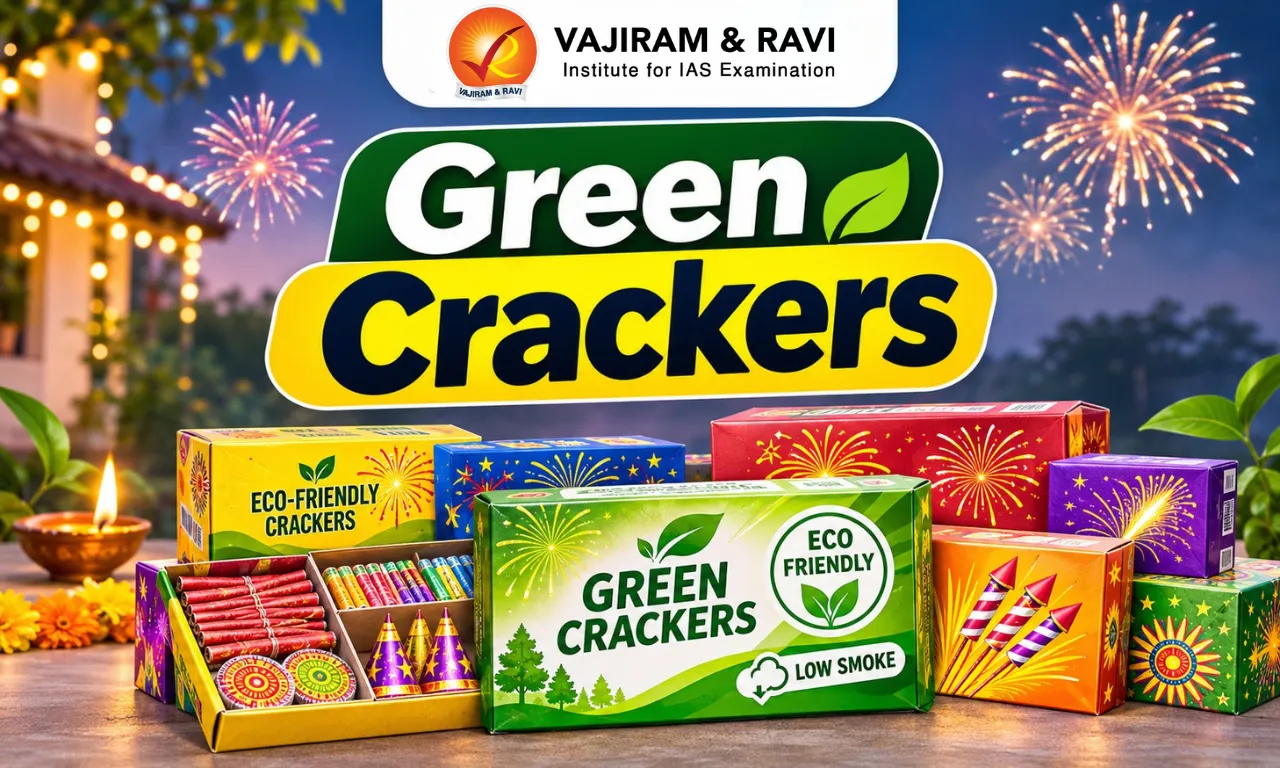
Supreme Court Allows Green Crackers in Delhi NCR through a conditional relaxation of firecracker restrictions for Diwali 2026. The decision highlights the need to balance cultural traditions with environmental protection, public health and constitutional rights, particularly amid rising concerns over Delhi Air Pollution and seasonal Winter Air Pollution.
Supreme Court Allows Green Crackers
The Supreme Court of India permitted the use of certified Green Crackers in Delhi NCR on November 7 and 8, subject to specified timings and safety conditions. The decision recognises cultural significance of the festival Diwali while prioritising environmental protection and citizens' right to health under Article 21.
Supreme Court Firecracker Ruling 2026
The Supreme Court of India introduced temporary relaxation with strict conditions to prevent excessive pollution and protect vulnerable populations during festive celebrations.
- Permitted Dates and Timings: Certified Green Crackers can be burst on November 7 and 8, between 6 AM and 7 AM and 8 PM and 10 PM.
- Restricted Locations: Firecracker use is prohibited within 300 metres of hospitals, nursing homes, health centres, old age homes, educational institutions and designated silence zones.
- No Cracker Zones: Authorities must identify and publicly mark restricted areas to prevent violations and protect patients, elderly persons, children and other vulnerable individuals.
- Constitutional Basis: Article 25 of the Constitution of India guarantees religious freedom, subject to public order, morality and health. On the other hand, Article 21 of the Indian Constitution protects life, including the right to a healthy environment.
- Environmental Considerations: The Court highlighted the contribution of conventional firecrackers to increased AQI, particulate pollution, noise pollution and solid waste, particularly during festive periods.


Firecracker Regulation in India 2026
Firecracker Regulation in India involves environmental legislation, explosives related laws, certification requirements and judicial directions to minimise pollution and ensure public safety.
- Explosives Act 1884: This legislation provides the primary legal framework governing the manufacture, possession, storage, transportation and sale of explosives, including fireworks.
- Explosive Rules 2008: These rules establish regulatory requirements for handling, manufacturing, licensing and selling explosives, ensuring that firecracker related activities comply with prescribed safety standards.
- Noise Pollution (Regulation and Control) Rules 2000: Under these rules, firecrackers must comply with prescribed noise limits of 125 dB(AI) or 145 dB(C)pk, measured at four metres.
- CSIR NEERI and PESO Certification: Green Crackers must receive appropriate certification from CSIR NEERI and the Petroleum and Explosives Safety Organisation (PESO) to establish their regulatory compliance.
- Restrictions on Conventional Crackers: Barium containing crackers and joined firecracker strings, commonly called ladis, are prohibited under applicable restrictions to reduce harmful emissions and associated environmental damage.
- Sale and Identification Requirements: Only authorised Green Crackers carrying product specific QR codes are permitted under the temporary relaxation. Online firecracker sales through e-commerce platforms are also restricted.
What are Green Crackers?
Green Crackers are specially developed fireworks designed to reduce harmful emissions and particulate pollution compared with conventional firecrackers.
- Developed By: The Council of Scientific and Industrial Research National Environmental Engineering Research Institute (CSIR NEERI) developed Green Crackers following the Supreme Court's restrictions on conventional firecrackers in 2017.
- Chemical Composition: These crackers exclude barium compounds and significantly reduce aluminium and sulphur content, using cleaner oxidisers to limit toxic emissions.
- Reduced Pollution: Green Crackers can reduce particulate matter, sulphur dioxide (SO2) and nitrogen dioxide (NO2) emissions by at least 30% compared with conventional alternatives.
- Identification: Genuine products carry the official Green Fireworks logo and a unique QR code, which can be scanned through the CSIR NEERI Green QR Code mobile application.
- Types: There are usually three main types of Green Crackers as given below:
- SWAS: Safe Water Releasable (SWAS) crackers use water based technology to suppress dust particles and reduce the release of harmful emissions during combustion.
- STAR: Safe Thermite Cracker (STAR) is another category of green fireworks developed to reduce particulate emissions while maintaining the visual experience of traditional celebrations.
- SAFAL: Safe Minimal Aluminium (SAFAL) crackers use reduced aluminium content, helping minimise the release of harmful substances during the burning process.
Firecracker Regulation Challenges
Despite judicial directions and regulatory restrictions, effective implementation remains difficult because of illegal sales, monitoring gaps and seasonal pollution pressures. The major Firecracker Regulation Challenges include:
- Illegal Firecracker Sales: Inadequate enforcement has allowed unauthorised products to enter markets, weakening restrictions and making it difficult for consumers to distinguish certified crackers from conventional alternatives.
- Implementation Gaps: The Supreme Court expressed concerns over the ineffective implementation of restrictions introduced since 2015, highlighting weaknesses in coordination and regulatory supervision.
- Seasonal Pollution: Firecracker emissions aggravate Delhi Air Pollution during winter, when unfavourable atmospheric conditions contribute to Winter Air Pollution and deteriorating AQI levels.
- GRAP Implementation: The Graded Response Action Plan (GRAP) forms part of the broader pollution control response. Firecracker restrictions complement wider efforts to address deteriorating air quality.
- Public Health Concerns: Fine particulate matter can enter the respiratory system, creating health risks. Children, elderly people and persons with disabilities remain particularly vulnerable to pollution exposure.
- Enforcement and Accountability: Effective monitoring, stock verification, market inspections and coordination among police, government authorities and regulatory agencies are essential to prevent violations and ensure compliance.

 Last updated on Nov, 2026
→ UPSC 2027 Notification will be released on 13 January 2027 at upsconline.nic.in.
→ Check Nobel Prize 2026 Winners List here.
→ Check out the latest UPSC Syllabus here.
→ Download UPSC Calendar 2027 PDF Here.
Supreme Court Allows Green Crackers FAQs
Q1. Why did the Supreme Court Allow Green Crackers in Delhi NCR?+
Q2. When are Green Crackers allowed in Delhi NCR for Diwali 2026?+
Q3. What are the three types of Green Crackers?+
Q4. Which organisations certify Green Crackers in India?+
Q5. How can genuine Green Crackers be identified?+
Tags: green crackers supreme court supreme court allows certified green crackers