


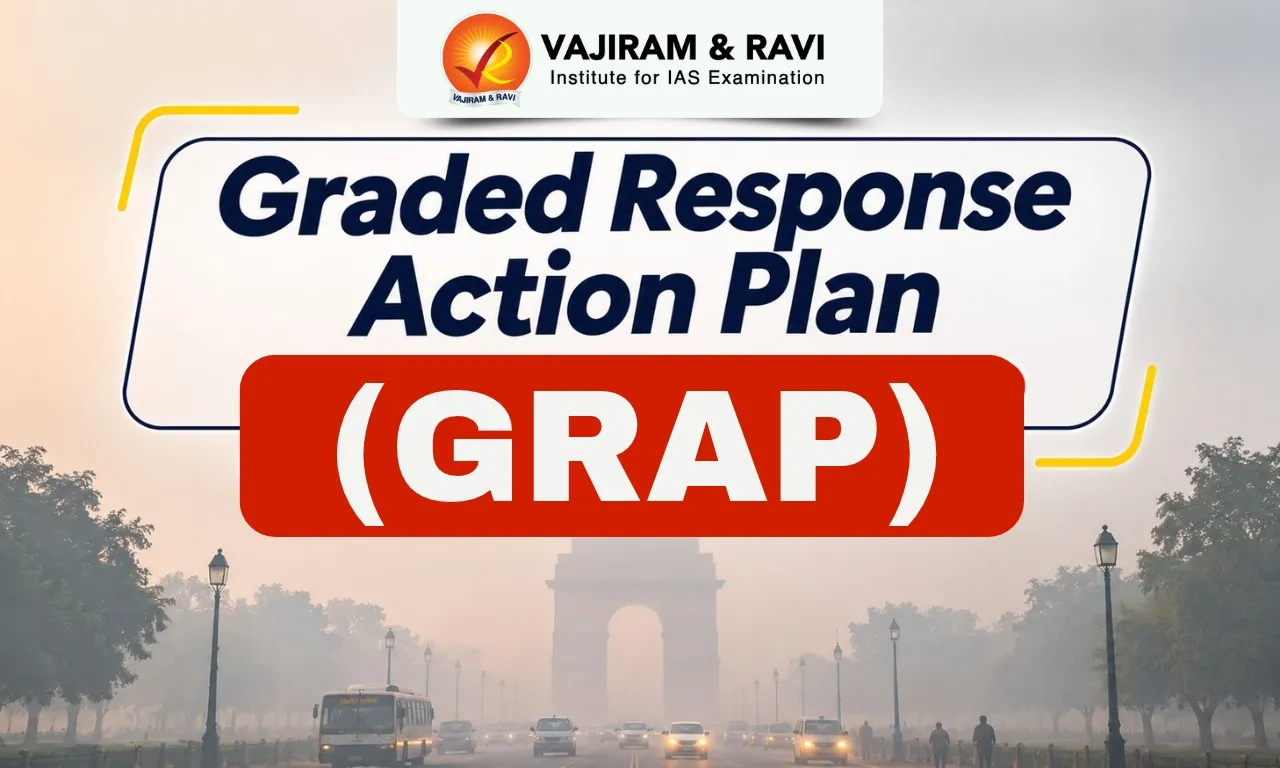
The Graded Response Action Plan (GRAP) is an emergency framework for controlling air pollution in Delhi-NCR. It prescribes a series of progressively stricter measures based on the severity of air pollution, covering major sources such as vehicular emissions, construction dust, industrial activities and waste burning.
What is the Graded Response Action Plan (GRAP)?
The Graded Response Action Plan (GRAP) is a framework of emergency measures to control air pollution in Delhi-NCR. It classifies deteriorating air quality into four stages and prescribes corresponding restrictions to address pollution from vehicles, construction activities, industries and waste burning.
- GRAP was first notified in January 2017 by the Ministry of Environment, Forest and Climate Change (MoEFCC), following directions of the Supreme Court.
- The Commission for Air Quality Management (CAQM) supervises its implementation across Delhi-NCR.
- Measures become progressively stricter as air quality deteriorates from the Poor to the Severe+ category.
- Its implementation requires coordinated action by Delhi, Haryana, Uttar Pradesh, Rajasthan and other concerned NCR authorities.
- CAQM approved the latest revision of the GRAP schedule in September 2026, modifying measures across all four stages.
Objectives of Graded Response Action Plan (GRAP)
The major objectives of the Graded Response Action Plan are to:
- Prevent further deterioration: Take timely action when air pollution reaches specified levels.
- Control pollution sources: Reduce emissions from vehicles, industries, construction activities and waste burning.
- Ensure coordinated action: Bring different state governments and enforcement agencies under a common framework.
- Adopt a graded approach: Introduce restrictions according to the severity of air pollution rather than relying on a uniform response.
- Protect public health: Reduce exposure to harmful pollutants, particularly among children, older persons and people with respiratory conditions.
- Promote cleaner practices: Encourage public transport, cleaner fuels, dust management and responsible waste disposal.


Graded Response Action Plan (GRAP) Four Stages and their AQI Limits
Graded Response Action Plan (GRAP) is divided into four stages based on the severity of air pollution in Delhi-NCR.
|
GRAP Stage |
AQI Category |
AQI Range |
|
Stage I |
Poor |
201-300 |
|
Stage II |
Very Poor |
301-400 |
|
Stage III |
Severe |
401-450 |
|
Stage IV |
Severe+ |
Above 450 |
The AQI thresholds determine the level of response. The CAQM may also take forecast-based action in anticipation of worsening air quality.
Restrictions Under Different Stages of Graded Response Action Plan (GRAP)
Each stage introduces additional restrictions to address the sources contributing to air pollution. Measures imposed under earlier stages generally continue when a higher stage is invoked.
1. GRAP Stage I – Poor Air Quality (AQI 201-300)
Stage I focuses on preventing further deterioration through routine pollution-control measures.
Major measures include:
- Dust control: Mechanised road sweeping, water sprinkling and dust suppressants on roads, particularly in pollution hotspots.
- Construction activities: Mandatory dust-control measures at construction and demolition (C&D) sites, including covering materials and transporting construction waste in covered vehicles.
- Waste management: Regular collection of municipal solid waste, C&D waste and industrial waste; prohibition of open waste burning and illegal dumping.
- Vehicular pollution: Strict enforcement of Pollution Under Control (PUC) certificates and action against visibly polluting vehicles.
- Industrial emissions: Inspection of industries, brick kilns and thermal power plants to ensure compliance with emission standards and approved fuel requirements.
- Traffic management: Measures to reduce congestion and divert non-destined heavy vehicles through the Eastern and Western Peripheral Expressways.
- Diesel generator sets: Regulation of diesel generator (DG) sets, with prescribed emission-control requirements and restrictions on their use.
- Public awareness: Campaigns encouraging public transport, carpooling, waste segregation and reduced use of polluting vehicles.
2. GRAP Stage II – Very Poor Air Quality (AQI 301-400)
Stage II introduces additional measures to reduce pollution from road dust, traffic and other local sources.
Major restrictions and measures include:
- Road dust management: Daily mechanised or vacuum-based sweeping of roads, followed by water sprinkling and dust suppressants.
- Construction sites: Intensified inspections to ensure compliance with dust-control guidelines.
- Pollution hotspots: Targeted action at identified pollution hotspots and congested traffic corridors.
- Parking charges: Increased parking fees to discourage private vehicle use.
- Public transport: Increased frequency of CNG and electric buses, Metro and other public transport services.
- Power supply: Ensuring uninterrupted electricity supply to reduce dependence on diesel generator sets.
- Office timings: Staggering timings of government and municipal offices in Delhi and NCR to reduce traffic congestion.
- Residential welfare associations: Resident Welfare Associations (RWAs) are directed to provide electric heaters to security staff to prevent the use of biomass and other polluting fuels for heating.
3. GRAP Stage III – Severe Air Quality (AQI 401-450)
Stage III introduces stricter restrictions on construction, industrial activities and polluting vehicles. Major measures include:
- Construction restrictions: Ban on several dust-generating construction and demolition activities, including excavation, drilling, piling, demolition, masonry, road construction and other specified activities.
- Vehicle restrictions: Restrictions on the plying of BS-III petrol and BS-IV diesel or older Light Motor Vehicles (LMVs) in Delhi and specified NCR districts, including Gurugram, Faridabad, Ghaziabad, Gautam Buddha Nagar and Sonipat.
- Goods vehicles: Restrictions on specified older diesel-operated Light and Medium Goods Vehicles (LGVs and MGVs), as prescribed under the revised schedule.
- Industrial activities: Closure or restrictions on specified polluting industrial units, stone crushers and mining activities, as applicable.
- Educational institutions: State governments may consider shifting classes up to Class V to a hybrid mode, allowing students to attend either physically or online.
- Public transport: Further augmentation of public transport services to reduce dependence on private vehicles.
Certain essential and public utility projects may be permitted subject to specified conditions.
4. GRAP Stage IV – Severe+ Air Quality (AQI Above 450)
Stage IV represents the highest level of emergency response under GRAP. It imposes stricter restrictions on vehicles, construction activities and certain public services. Major measures include:
- Truck entry restrictions: Entry of specified older diesel-operated trucks into Delhi is prohibited, subject to the applicable provisions of the revised schedule.
- Goods vehicles: Restrictions apply to Delhi-registered BS-IV and below diesel-operated Heavy Goods Vehicles (HGVs) and Medium Goods Vehicles (MGVs), as specified under the schedule.
- Construction activities: Restrictions on construction and demolition activities are extended to specified linear public infrastructure projects, such as highways, roads, flyovers, power transmission lines and pipelines.
- Educational institutions: Governments may introduce hybrid classes for students in Classes VI-IX and Class XI.
- Office operations: Governments may consider measures such as work from home or reduced physical attendance in offices.
- Commercial activities: State governments may consider additional restrictions on non-essential commercial activities, depending on the prevailing situation.
The implementation of additional measures depends on the decisions of the competent governments and authorities.
Who implements Graded Response Action Plan (GRAP)?
The Commission for Air Quality Management (CAQM) is the nodal authority responsible for coordinating and overseeing the implementation of GRAP in Delhi-NCR.
Its implementation involves several agencies:
- CAQM: Issues directions and decides when to invoke or intensify GRAP measures.
- Central Pollution Control Board (CPCB): Monitors air quality and provides technical inputs.
- State governments: Delhi, Haryana, Uttar Pradesh and Rajasthan implement the prescribed measures in their respective areas.
- Pollution control boards: Monitor industrial emissions and enforce pollution-control standards.
- Municipal bodies: Manage road dust, construction waste, municipal solid waste and sanitation.
- Traffic police and transport departments: Enforce vehicle restrictions and manage traffic congestion.
- Other agencies: Public works departments, power distribution companies and transport authorities implement measures relevant to their responsibilities.
How is Graded Response Action Plan (GRAP) invoked?
Graded Response Action Plan (GRAP) is invoked according to the severity of air pollution and the air-quality forecasts for Delhi-NCR.
- AQI monitoring: The CPCB and other monitoring agencies assess air quality through the established monitoring network.
- Weather forecasts: The India Meteorological Department (IMD) and Indian Institute of Tropical Meteorology (IITM) provide forecasts on likely changes in air quality and meteorological conditions.
- CAQM assessment: The CAQM Sub-Committee on GRAP reviews the prevailing AQI, forecasts and pollution trends.
- Stage-wise invocation: The Sub-Committee issues directions to implement the appropriate stage across Delhi-NCR.
- Escalation and withdrawal: Restrictions may be intensified when air quality deteriorates and withdrawn or relaxed when conditions improve, based on the assessment of the Sub-Committee.
Importantly, GRAP measures can be invoked in anticipation of worsening air quality based on forecasts; authorities do not always have to wait until the AQI crosses the threshold.
Key Changes in the Revised GRAP Schedule (September 2026)
The CAQM approved a revised GRAP schedule in September 2026 to strengthen pollution-control measures and improve enforcement. Important changes include:
- Measures shifted to Stage I: Restrictions relating to diesel generator sets and entry of specified BS-IV and below buses from NCR and adjoining states were moved from Stage II to Stage I.
- Expanded vehicle restrictions: Restrictions on BS-III petrol and BS-IV diesel or older LMVs under Stage III were extended to Sonipat, in addition to Gurugram, Faridabad, Ghaziabad and Gautam Buddha Nagar.
- Changes in goods vehicle exemptions: Exemptions for certain BS-IV and below goods vehicles carrying essential commodities under Stage III and Stage IV were removed.
- Construction monitoring: Dust-monitoring requirements through the CAQM web portal were extended to eligible construction and demolition projects beyond municipal limits.
- Consolidation of measures: Repeated provisions relating to dust control, municipal solid waste and transport were consolidated to improve clarity and implementation.
The revised schedule contains 25 actions under Stage I, 8 under Stage II, 10 under Stage III and 5 under Stage IV.
Significance of Graded Response Action Plan (GRAP)
The Graded Response Action Plan (GRAP) is an important instrument of air pollution management in Delhi-NCR for the following reasons:
- Enables timely preventive action before air pollution reaches more dangerous levels.
- Promotes regional coordination by addressing pollution across administrative boundaries.
- Targets multiple pollution sources, including transport, construction, industries, waste burning and road dust.
- Protects public health by reducing exposure to harmful pollutants.
- Establishes clear responsibilities for government departments and enforcement agencies.
- Allows progressively stricter measures as air quality deteriorates.
Challenges in the Implementation of Graded Response Action Plan (GRAP)
Despite its structured approach, GRAP faces several implementation challenges:
- Pollution originating outside Delhi requires coordinated action across multiple states.
- Low wind speed, temperature inversion and unfavourable weather conditions can trap pollutants near the surface.
- Multiple pollution sources, including vehicles, industries, construction and biomass burning, require different control strategies.
- Weak monitoring, inadequate inspections and non-compliance undermine enforcement.
- Repeated reliance on temporary restrictions fails to address the structural causes of air pollution.
- Inadequate public transport connectivity and capacity limit the shift away from private vehicles.
- Restrictions on construction, transport and industrial activities can affect workers, businesses and economic activity.
Way Forward
Effective air pollution management requires a shift from emergency restrictions towards sustained pollution prevention.
- Strengthen regional coordination among NCR states to control transport, industrial emissions, waste and agricultural residue burning.
- Expand public transport, electric buses, Metro connectivity and EV charging infrastructure to reduce vehicular emissions.
- Improve dust management through mechanised road cleaning, construction-site monitoring and scientific disposal of C&D waste.
- Enforce emission standards through regular inspections and technology-based monitoring of industries, power plants, brick kilns and vehicles.
- Ensure affordable and reliable public transport to reduce dependence on private vehicles.
- Adopt year-round pollution-control strategies instead of relying mainly on winter restrictions.
- Encourage public participation through carpooling, waste segregation, responsible fuel use and reporting of pollution violations.

 Last updated on Nov, 2026
→ UPSC 2027 Notification will be released on 13 January 2027 at upsconline.nic.in.
→ Check Nobel Prize 2026 Winners List here.
→ Check out the latest UPSC Syllabus here.
→ Download UPSC Calendar 2027 PDF Here.
Graded Response Action Plan (GRAP) FAQs
Q1. What is the Graded Response Action Plan (GRAP)? +
Q2. Who implements GRAP in Delhi NCR?+
Q3. How many stages are there in GRAP?+
Q4. At what AQI level is GRAP Stage IV imposed?+
Q5. Can GRAP be invoked before the AQI reaches the prescribed threshold?+
Q6. Does GRAP apply only to Delhi?+
Tags: graded response action plan grap grap 1 grap 2 grap 3 grap 4