



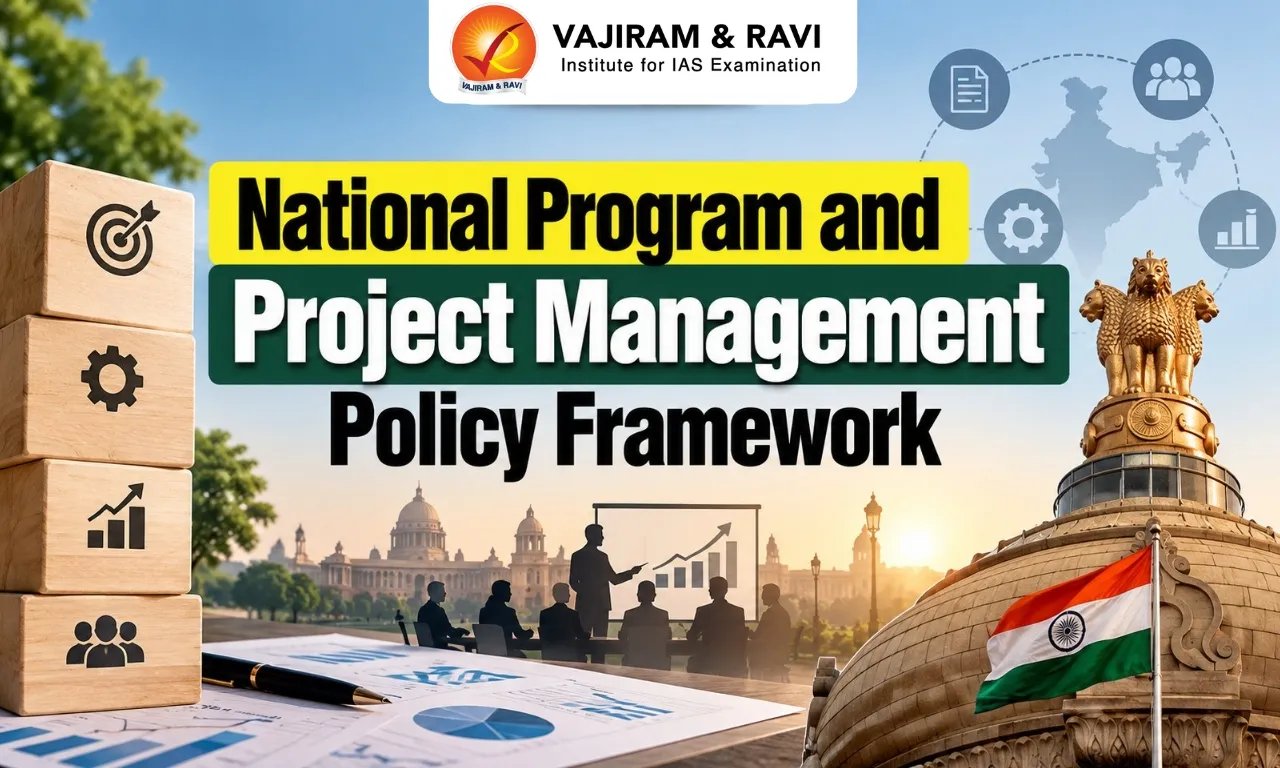
National Program and Project Management Policy Framework is an initiative by NITI Aayog and the Quality Council of India (QCI) to improve how large infrastructure projects are planned and delivered in India. It aims to reduce delays and cost overruns, build a pool of certified program and project managers, and bring transparency and accountability to infrastructure delivery. The Indian Infrastructure Body of Knowledge (InBoK) and a four-level certification system are central to this effort.
What is the National Program and Project Management Policy Framework (NPMPF)?
- National Program and Project Management Policy Framework (NPMPF) is an initiative by NITI Aayog and the Quality Council of India (QCI). It aims to change how large and mega infrastructure projects are planned and carried out in India.
- It was launched with the goal of bringing radical reforms to the way infrastructure projects are executed.
- The framework was launched by Union Minister Nitin Gadkari, together with Union Minister Piyush Goyal, the then NITI Aayog CEO Amitabh Kant and QCI Chairman Adil Zainulbhai. The event also drew representatives from government departments, Public Sector Undertakings (PSUs), infrastructure companies and financial institutions.
- The idea grew out of a Task Force on Project and Program Management formed under NITI Aayog, which released its report on 14 June 2019.
- The Task Force saw an urgent need to standardise program and project management in India and to introduce a common language across government and industry.
- The framework fits into the National Infrastructure Pipeline (NIP) 2020-25, released on 31 December 2019. The pipeline backs the Prime Minister’s vision of a $5 trillion economy and Rs 100 lakh crore of infrastructure investment.
National Program and Project Management Policy Framework Objectives
- Reduce time and cost overruns: The framework targets the delays and budget overshoots that often hit large public and PPP infrastructure projects, especially those costing more than ₹500 crore.
- Improve efficiency and transparency: It aims to strengthen accountability, pre-planning, risk-sharing and procurement transparency.
- Support Aatmanirbhar Bharat: Gadkari said the framework helps build good-quality infrastructure and cut costs and waste without harming the environment and ecology, with time-bound, result-oriented delivery.
- Build a skilled workforce: It seeks to institutionalise and promote the profession of program and project management and create a pool of trained professionals.
- Strengthen capacity: It wants to improve the institutional capacity and capability of the people who deliver infrastructure projects.
- Adopt a program approach: Infrastructure development should follow a program and project management approach rather than isolated, one-off project handling.


National Program and Project Management Policy Framework Key Features
- Common language of project management: The framework introduces shared concepts and terms for everyone working on infrastructure, from government departments to private firms.
- Indian Infrastructure Body of Knowledge (InBoK): A guidebook made specially for Indian infrastructure projects and practitioners.
- Four-level certification system: Professionals are certified at four levels based on competence and experience, from early-career professionals to veterans.
- Scale-linked competence: Certification is tied to the scale and complexity of projects, so more complex programs go to more experienced professionals.
- Focus on front-end planning: The framework stresses pre-planning, strong governance and the use of modern technology.
- Wide placement of professionals: Certified professionals are meant to work in government, PSUs, private firms, project management consultancies, banks and rating agencies.
- Pillars of certification: Three pillars support it:
- A self-paced learning system
- A rigorous exam at each level
- Continued professional development
National Program and Project Management Policy Framework Major Components
- Indian Infrastructure Body of Knowledge (InBoK):
- A complete guide for running programs and the projects within them
- Built around a baseline approach to execution
- Developed with industry experts and premier institutes
- Will be the basis for assessing Chartered Project Professionals
- Future sector-specific extensions are planned, such as one for roadways
- National Institute for Chartered Program/Project Professionals (NICPP):
- A proposed nodal body to develop, promote and regulate the profession
- Would standardise, license and certify professionals
- Four-level charter system:
- Early levels focus on project management
- Higher levels focus more on program management
- Each level has a unique assessment, conducted centrally by NICPP
- Levels were designed after studying public sector projects and time and cost overrun trends
- In future, public-sector and PPP projects of a given size may be handed to professionals based on their certification level
- Distinguished Fellows: An honorary recognition from NICPP for people with a lifetime of distinguished contribution to program management. They add expertise, credibility and guidance and help speed up adoption.
- Training and capability development:
- An online self-learning course based on InBoK
- A Capability Development Program for quick impact on large projects
National Program and Project Management Policy Framework Implementation
- Two-fold mandate from the Task Force:
- Institutionalisation: Set up a nodal body (NICPP) for program and project managers
- Policy: Develop the NPMPF to suggest policy and procedural changes and place capable managers across all stakeholders, including government, infrastructure firms and financial institutions
- Action plan: Adopt a program and project management approach, institutionalise the profession and build a workforce of professionals, and enhance institutional capacity.
- Certification rollout: Professionals are assessed through a central exam for each level, with the exam linked to InBoK.
- Learning support: An online self-learning course helps candidates understand the fundamentals before certification.
- Capability Development Program: To create impact for projects already being planned or executed, it includes:
- Awareness workshops to sensitise infrastructure stakeholders to institutionalising program management
- Capsule training for government and PSU officials, with focused, module-based sessions for mission-critical projects
- Existing use of these methods: Gadkari noted that program and project management tools are already used in mega projects like Bharatmala and Sagarmala, along with innovative financing such as hybrid annuity models.
- Accountability measures: He called for monitoring, transparency, a corruption-free system, fast decision-making, technical and financial qualification checks and performance audits.
Role of NITI Aayog and Quality Council of India in NPMPF
- NITI Aayog:
- Set up the Task Force that recommended the framework
- Led the policy vision for reforming infrastructure delivery
- CEO Amitabh Kant delivered the inaugural address and stressed that program and project management helps meet economic goals through coordination of multiple projects
- Quality Council of India (QCI):
- Works with NITI Aayog to run the Steering and Technical Committees’ deliberations
- Compiles committee inputs to develop guidelines and regulations
- Builds the ecosystem for certification and licensing of professionals
- Chairman Adil Zainulbhai explained that the certification system links project scale and complexity to professional competence
- Wider participation: The launch drew government officials, infrastructure experts, global project management firms, large contractors such as L&T India, PSUs and development banks.
Significance of NPMPF for Infrastructure Development in India
- Huge investment need: India needs about $4.5 trillion by 2040 for infrastructure to sustain growth. Smooth execution matters a great deal at this scale.
- Tackles chronic delays: Better planning and trained managers can lower time and cost overruns.
- Boosts transparency and governance: The framework supports transparent procurement, PPP risk-sharing and strong project governance, as Piyush Goyal noted. He said monitoring and accountability decide a project’s success.
- Matches big plans: Goyal pointed to the Railways reforms and mega projects with investment of Rs 50 lakh crore and more by 2030, which need this kind of structure.
- Creates a professional cadre: Certified professionals who understand InBoK can change how infrastructure is delivered.
- Gives a common reference: InBoK serves as a shared guide for everyone in the industry.
- Supports self-reliance: It helps build quality infrastructure with lower waste and cost while protecting the environment.

 Last updated on Nov, 2026
→ UPSC 2027 Notification will be released on 13 January 2027 at upsconline.nic.in.
→ Check Nobel Prize 2026 Winners List here.
→ Check out the latest UPSC Syllabus here.
→ Download UPSC Calendar 2027 PDF Here.
National Program and Project Management Policy Framework (NPMPF) FAQs
Q1. What is the National Program and Project Management Policy Framework (NPMPF)?+
Q2. Who launched the NPMPF?+
Q3. What is the Indian Infrastructure Body of Knowledge (InBoK)?+
Q4. What is the four-level certification system under NPMPF?+
Q5. What is NICPP?+
Q6. What are the main objectives of the NPMPF?+
Q7. Why is the NPMPF important for India's infrastructure?+
Tags: national program and project management policy framework