



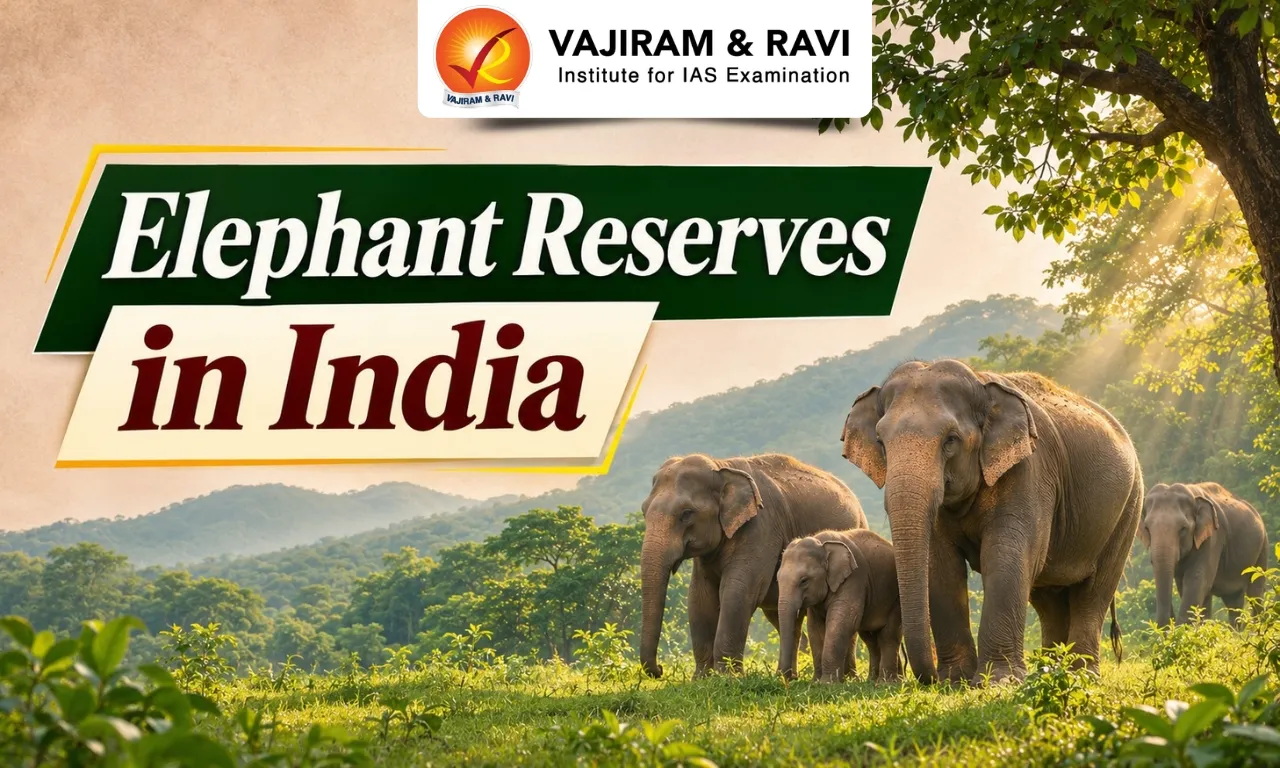
Elephant Reserves in India are important conservation landscapes that protect wild elephants, their habitats and movement corridors. They are managed under Project Elephant, a Centrally Sponsored Scheme launched in 1991-92 to support elephant conservation and reduce human-elephant conflict.
What are Elephant Reserves in India?
Elephant Reserves are identified landscapes that support the conservation of wild elephants and their habitats. They aim to protect elephant populations, maintain habitat connectivity and facilitate the movement of elephants between forests.
- Landscape-based conservation: They cover forests, protected areas, reserve forests and other suitable habitats used by elephants.
- Habitat connectivity: They help maintain traditional elephant movement routes and link fragmented habitats.
- Human-elephant conflict management: They provide a landscape-level framework for addressing conflict between people and elephants.
Elephant Reserves are administrative conservation units under Project Elephant. Their declaration does not, by itself, give them the same statutory status as National Parks or Wildlife Sanctuaries.
How many Elephant Reserves are there in India?
India has 33 Elephant Reserves across 14 states, covering approximately 80,777 sq. km, according to the Wildlife Institute of India (WII).
State-wise list of Elephant Reserves in India
| State | Elephant Reserves | Number |
|
Andhra Pradesh |
Rayala |
1 |
|
Arunachal Pradesh |
Kameng, South Arunachal |
2 |
|
Assam |
Chirang-Ripu, Dhansiri-Lungding, Dihing-Patkai, Kaziranga-Karbi-Anglong, Sonitpur |
5 |
|
Chhattisgarh |
Sarguja-Jashpur, Lemru |
2 |
|
Jharkhand |
Singhbhum |
1 |
|
Karnataka |
Dandeli, Mysore |
2 |
|
Kerala |
Anamudi, Nilambur, Periyar, Wayanad |
4 |
|
Meghalaya |
Garo Hills |
1 |
|
Nagaland |
Intanki, Singphan |
2 |
|
Odisha |
Mahanadi, Mayurbhanj, Sambalpur |
3 |
|
Tamil Nadu |
Anamalai, Coimbatore, Nilgiri, Srivilliputhur, Agasthyamalai |
5 |
|
Uttar Pradesh |
Uttar Pradesh, Terai |
2 |
|
Uttarakhand |
Shivalik |
1 |
|
West Bengal |
Eastern Dooars, Mayurjharna |
2 |
|
Total |
|
33 |
Which is the largest and smallest Elephant Reserve in India?
- Largest: Singhbhum Elephant Reserve in Jharkhand, covering approximately 13,440 sq. km according to the WII 2023 Atlas.
- Smallest: Singphan Elephant Reserve in Nagaland, covering approximately 23.5 sq. km.


Functions of Elephant Reserves
Elephant Reserves provide a landscape-level framework for conserving elephants, maintaining ecological connectivity and promoting coexistence between people and wildlife.
- Habitat Protection: Conserve forests, grasslands, water sources and other habitats essential for elephant survival.
- Corridor Conservation: Protect and restore traditional elephant movement routes to maintain connectivity between fragmented habitats.
- Population Conservation: Support the long-term survival of wild elephant populations through habitat management, monitoring and scientific conservation.
- Human-Elephant Conflict Mitigation: Facilitate measures such as early-warning systems, community participation and conflict-response mechanisms.
- Biodiversity Conservation: Protect ecosystems that also provide habitats for other wildlife species and maintain ecological processes.
- Coordination and Management: Promote coordinated conservation planning among forest departments, elephant-range states and local communities.
Significance of Elephant Reserves in India
Elephant Reserves support biodiversity conservation and maintain ecological processes across large forest landscapes.
- Biodiversity conservation: Protect habitats that support elephants and other wildlife species.
- Maintaining ecological balance: Elephants disperse seeds and influence vegetation patterns through their feeding and movement.
- Landscape connectivity: Help maintain links between fragmented forests and enable seasonal movement.
- Protection of watersheds: Forest habitats within elephant landscapes contribute to soil conservation, water retention and ecological stability.
- Local livelihoods: Healthy forest ecosystems support forest-dependent communities and nature-based livelihoods.
- Reducing human-elephant conflict: Landscape-level planning helps identify conflict-prone areas and improve preventive measures.
What is Project Elephant?
Project Elephant was launched in 1991-92 by the Ministry of Environment, Forest and Climate Change (MoEFCC) as a Centrally Sponsored Scheme.
Its main objective is to ensure the long-term survival of elephants in their natural habitats by protecting their populations, habitats and movement corridors.
Objectives of Project Elephant
- Protection of elephants: Support the conservation of wild elephant populations across their range.
- Habitat and corridor protection: Maintain and restore elephant habitats and movement corridors.
- Human-elephant conflict mitigation: Reduce conflict through early-warning systems, protective measures and community participation.
- Welfare of captive elephants: Improve the management and welfare of domesticated elephants.
- Research and monitoring: Strengthen scientific studies, population estimation and conservation planning.
What are Elephant Corridors in India?
Elephant corridors are narrow stretches of land that connect two or more large habitat areas. They allow elephants to move between forests in search of food, water, mates and suitable habitats.
According to the MoEFCC, 150 elephant corridors have been ground-validated across 15 states.
Regional Distribution of Elephant Corridors
| Region | Number of Corridors |
|
East-Central India |
52 |
|
North-East India |
48 |
|
Southern India |
32 |
|
Northern India |
18 |
|
Total |
150 |
Key Facts about Elephant Corridors
- West Bengal: Has the highest number of identified elephant corridors, with 26.
- Inter-state corridors: 19 corridors connect elephant habitats across state boundaries.
- Transboundary corridors: Six corridors connect elephant habitats between India and Nepal.
- Corridor status: Of the 150 corridors, 59 show increased use, 29 are stable, 29 show declining use and 15 are impaired. The status of the remaining 18 was not categorised in these groups.
Elephant corridors are important for maintaining genetic exchange between populations and reducing the isolation of elephant habitats.
Latest Elephant population estimate in India?
The Wildlife Institute of India (WII) released the Synchronous All India Elephant Estimation (SAIEE) 2021-25 report in October 2025.
India's estimated wild elephant population stands at 22,446. The assessment introduced DNA-based identification and spatial capture-recapture modelling for national-level elephant population estimation.
Key Findings of SAIEE 2021-25
- India has an estimated 22,446 wild elephants.
- The Western Ghats account for the largest estimated population, with 11,934 elephants, followed by the North-Eastern Hills and Brahmaputra Flood Plains (6,559).
- Shivalik Hills and Gangetic Plains account for 2,062 elephants, while Central India and Eastern Ghats account for 1,891.
- The estimation covered major elephant landscapes across 20 states.
Regional Distribution of the Estimated Elephant Population
| Elephant Landscape | Estimated Population |
|
Western Ghats |
11,934 |
|
North-Eastern Hills and Brahmaputra Flood Plains |
6,559 |
|
Shivalik Hills and Gangetic Plains |
2,062 |
|
Central India and Eastern Ghats |
1,891 |
|
Total |
22,446 |
Legal Protection and Conservation Status of Asian Elephants
The Asian elephant (Elephas maximus) receives protection under national and international conservation frameworks.
- Wildlife (Protection) Act, 1972: The Indian elephant is listed under Schedule I, which provides the highest level of protection under the Act.
- IUCN Red List: The Asian elephant is classified as Endangered.
- CITES: Listed in Appendix I, which generally prohibits international commercial trade in the species and its specimens.
- Convention on Migratory Species (CMS): The mainland Asian elephant (Elephas maximus indicus) was included in Appendix I in 2020, following India's proposal at COP13 in Gandhinagar.
- National Heritage Animal: The Government of India designated the Indian elephant as the National Heritage Animal in 2010.
Do Elephant Reserves Have Statutory Protection?
Elephant Reserves do not have an independent statutory status under the Wildlife (Protection) Act, 1972, equivalent to National Parks or Wildlife Sanctuaries.
However, areas within an Elephant Reserve may include legally protected areas such as National Parks, Wildlife Sanctuaries and Tiger Reserves, as well as Reserved Forests and other forest lands. These constituent areas receive protection under the relevant laws and notifications applicable to them.
The Environment (Protection) Act, 1986, also provides the legal framework for notifying Eco-Sensitive Zones around protected areas. However, this does not automatically give every elephant corridor or Elephant Reserve a separate statutory status.
Major Initiatives for Elephant Conservation
Elephant conservation requires coordinated efforts at the national and international levels, combining habitat protection, scientific monitoring, control of illegal trade and community participation.
Project Elephant (1991-92)
- Launched by the Government of India as a Centrally Sponsored Scheme under the Ministry of Environment, Forest and Climate Change (MoEFCC).
- Provides financial and technical assistance to elephant-range states for:
- Protection of elephants, their habitats and migration corridors.
- Mitigation of human-elephant conflict.
- Welfare of captive elephants.
Monitoring the Illegal Killing of Elephants (MIKE)
- Established under the Convention on International Trade in Endangered Species of Wild Fauna and Flora (CITES) to monitor trends in illegal elephant killings across Africa and Asia.
- Collects data on elephant mortality at designated sites to help identify poaching trends and strengthen conservation and law-enforcement measures.
- Uses Proportion of Illegally Killed Elephants (PIKE) as an indicator of poaching pressure. It measures the proportion of illegally killed elephant carcasses among all carcasses recorded at a site.
- India has 10 MIKE monitoring sites.
Elephant-8 (E-8) Initiative (2011)
- Involves eight African and Asian elephant-range countries: Botswana, Congo, India, Indonesia, Kenya, Sri Lanka, Tanzania and Thailand.
- The countries adopted the New Delhi E-8 Recommendation to strengthen international cooperation in elephant conservation.
- Focuses on combating poaching and illegal ivory trade, reducing human-elephant conflict and sharing knowledge and resources.
Convention on the Conservation of Migratory Species of Wild Animals (CMS)
- Provides an international framework for the conservation of migratory species through cooperation among range countries.
- The mainland Asian elephant (Elephas maximus indicus) was included in Appendix I in 2020, following India's proposal at CMS COP13.
- This listing calls for strict protection of the species and international cooperation for its conservation.
Haathi Mere Saathi Campaign (2011)
- Launched by the Ministry of Environment and Forests in partnership with the Wildlife Trust of India (WTI) to improve elephant conservation and welfare through public participation.
- Focuses on creating awareness among local communities living near elephant habitats, youth and policymakers.
- Also envisaged Gajah Centres in elephant landscapes to spread awareness and encourage community participation.
Major Challenges in Elephant Conservation in India
Despite conservation efforts, elephants face several threats due to habitat fragmentation, infrastructure expansion and increasing human-elephant interactions.
- Habitat fragmentation: Roads, railway lines, mining and infrastructure projects divide forests and disrupt elephant movement.
- Loss of corridors: Encroachment, agricultural expansion and human settlements obstruct traditional movement routes.
- Human-elephant conflict: Crop raiding, property damage and human casualties increase tensions between local communities and elephants.
- Railway accidents: Elephants are injured or killed while crossing railway tracks passing through forest areas.
- Poaching and illegal trade: Elephants are threatened by poaching for ivory and other body parts.
- Climate change: Changes in rainfall patterns and the availability of water and forage can affect elephant habitats and movement.
- Coordination gaps: Conservation across state boundaries requires cooperation between multiple forest departments and other agencies.
Government measures for Elephant conservation?
The Government of India has introduced several measures to protect elephant habitats, improve monitoring and reduce human-elephant conflict.
- Project Elephant: Provides financial and technical support to elephant-range states for habitat protection, corridor conservation, conflict mitigation and captive-elephant welfare.
- Management Effectiveness Evaluation (MEE): A framework launched in 2023 to assess the management of Elephant Reserves. Pilot evaluations covered Shivalik, Kaziranga–Karbi Anglong, Mayurbhanj and Nilgiri.
- Elephant Conservation Plans: The Ministry of Environment, Forest and Climate Change and the Wildlife Institute of India developed a 2024 framework to guide the preparation of conservation plans for Elephant Reserves. These plans support landscape-level planning, habitat management, corridor protection and human-elephant conflict mitigation.
- Railway safety measures: The government has introduced technology-based systems to detect elephants near railway tracks and alert railway personnel.
- AI-enabled Intrusion Detection System: Uses optical-fibre-based sensing and elephant movement signatures to detect the presence of elephants near railway tracks and generate alerts for railway staff.
- Project RE-HAB: The Khadi and Village Industries Commission (KVIC) initiative uses bee fences to deter elephants from entering human settlements and agricultural fields.
Way Forward for Elephant Conservation in India
Effective elephant conservation requires protecting connected habitats while addressing the needs of communities living alongside elephant landscapes.
- Protect elephant corridors: Identify, secure and restore critical corridors through scientific mapping, land-use planning and coordination between states.
- Reduce habitat fragmentation: Ensure that roads, railways, mining and other infrastructure projects incorporate wildlife-sensitive planning and mitigation measures.
- Strengthen conservation planning: Prepare and implement site-specific Elephant Conservation Plans based on ecological data, habitat conditions and local conservation priorities.
- Strengthen conflict management: Expand early-warning systems, rapid-response teams, community participation and timely compensation for losses.
- Improve railway safety: Strengthen elephant detection systems, speed regulation, warning mechanisms and coordination between forest and railway departments.
- Promote scientific monitoring: Continue genetic studies, habitat assessments and landscape-level population monitoring to support evidence-based conservation.
- Involve local communities: Support community-based conservation, awareness programmes and livelihood opportunities that encourage coexistence with elephants.
- Strengthen regional cooperation: Improve coordination between states and neighbouring countries to protect transboundary elephant habitats and movement routes.

 Last updated on Nov, 2026
→ UPSC 2027 Notification will be released on 13 January 2027 at upsconline.nic.in.
→ Check Nobel Prize 2026 Winners List here.
→ Check out the latest UPSC Syllabus here.
→ Download UPSC Calendar 2027 PDF Here.
Elephant Reserves in India FAQs
Q1. How many Elephant Reserves are there in India?+
Q2. Which is the largest Elephant Reserve in India?+
Q3. Which is the smallest Elephant Reserve in India?+
Q4. When was Project Elephant launched in India?+
Q5. What is the latest estimated elephant population in India?+
Q6. How many elephant corridors have been identified in India?+
Q7. Does an Elephant Reserve have statutory protection under the Wildlife (Protection) Act, 1972?+
Tags: elephant reserves elephant reserves in india elephant reserves india