



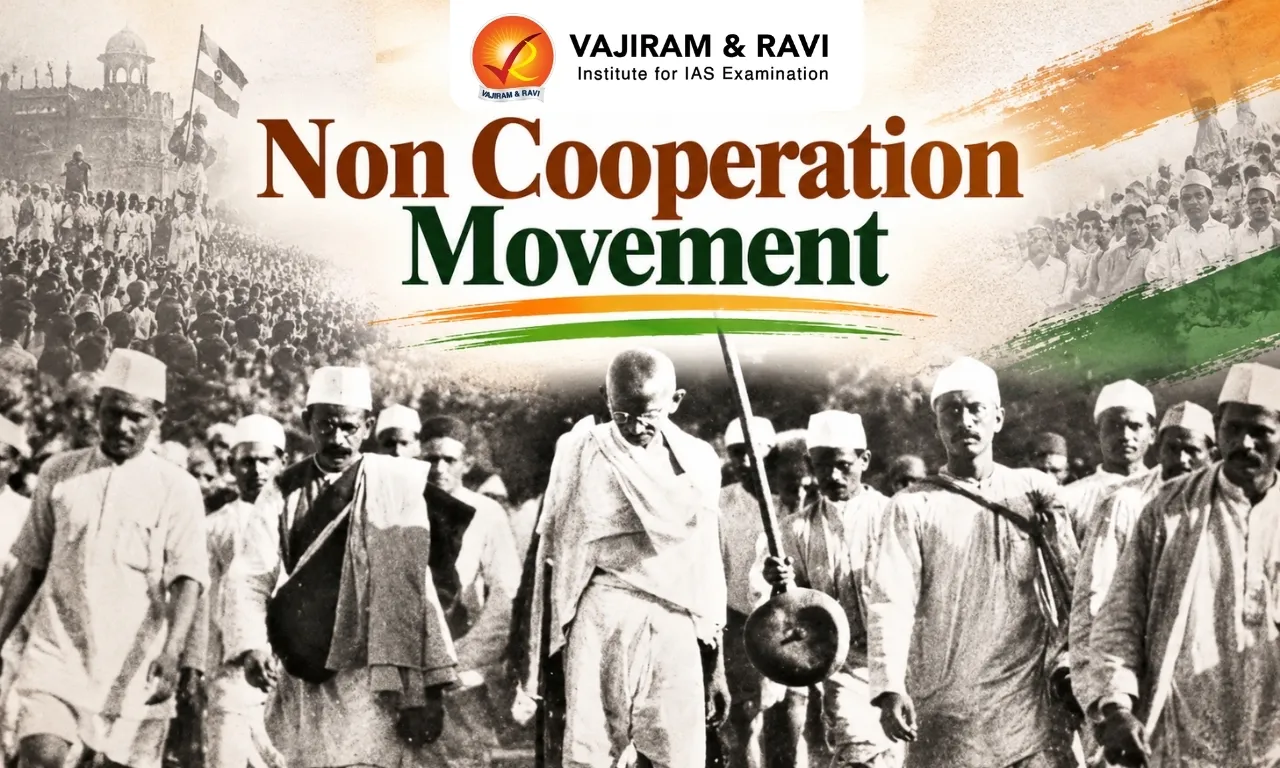
The Non Cooperation Movement was a major nationwide mass movement launched under Mahatma Gandhi’s leadership and the Indian National Congress to challenge British rule through non-violent non-cooperation. It aimed to achieve Swaraj (self-rule) and address grievances arising from British policies, including the Rowlatt Act, the Jallianwala Bagh massacre and the Khilafat issue.
The movement formally began on 1 August 1920. The Indian National Congress approved the programme at its special session in Calcutta in September 1920 and endorsed it at the Nagpur Session in December 1920. It was withdrawn in February 1922 following the Chauri Chaura incident.
Why was the Non Cooperation Movement launched?
The Non Cooperation movement emerged from growing disillusionment with British rule after the First World War and the failure of constitutional methods to secure meaningful political concessions.
- Rowlatt Act, 1919: The Act extended the government’s powers to detain and prosecute people suspected of revolutionary activities without the ordinary safeguards of a trial. It triggered widespread opposition.
- Jallianwala Bagh massacre, 1919: The killing of hundreds of unarmed people by troops under General Reginald Dyer in Amritsar intensified public anger against British rule.
- Khilafat issue: Indian Muslims opposed the treatment of the Ottoman Empire and the position of the Ottoman Caliph after the First World War. Gandhi supported the Khilafat cause to build a broader anti-colonial movement.
- Unfulfilled expectations after the First World War: Indians expected political concessions in return for their support during the war, but British policies failed to meet these expectations.
- Failure of constitutional methods: Gandhi increasingly believed that cooperation with an unjust colonial government helped sustain its authority. He argued that non-violent non-cooperation could challenge that authority.
Role of the Khilafat Movement
The Khilafat Movement sought to protect the position of the Ottoman Caliph and address Muslim concerns about the post-war settlement imposed on Turkey.
- Key leaders: Muhammad Ali and Shaukat Ali, widely known as the Ali Brothers, were prominent leaders of the Khilafat Movement.
- Gandhi’s support: Gandhi supported the Khilafat cause and sought to unite the movement with the broader struggle for Indian self-rule.
- Hindu-Muslim cooperation: The alliance brought many Congress and Khilafat activists together in a common campaign against British rule.
- Political significance: The alliance helped expand the reach of the Non-Cooperation Movement, although Hindu-Muslim unity remained vulnerable to later political and communal tensions.


Launch and Congress Approval
The Non Cooperation Movement developed through a series of important decisions by Gandhi and the Indian National Congress.
- 1 August 1920: Gandhi formally initiated the non-cooperation campaign and returned his Kaiser-i-Hind medal, along with other medals awarded for his services in South Africa.
- Calcutta Special Session, September 1920: The Congress approved Gandhi’s non-cooperation programme to address the Punjab wrongs and the Khilafat issue.
- Nagpur Session, December 1920: The Congress endorsed the programme and reorganised its structure to strengthen mass participation. It also adopted the goal of attaining Swaraj through legitimate and peaceful means.
- Expansion in 1921: The movement spread through public meetings, demonstrations, boycotts and the promotion of Swadeshi.
Programme and Methods of the Non Cooperation Movement
The Non Cooperation Movement aimed to weaken colonial authority by withdrawing Indian cooperation from British institutions and promoting self-reliance.
Boycott Programme
- Surrender of titles and honours: Indians were encouraged to give up titles and honours conferred by the British government. Gandhi returned his Kaiser-i-Hind medal on 1 August 1920.
- Educational institutions: Students were encouraged to leave government schools and colleges, while national educational institutions were promoted.
- Law courts: Lawyers were urged to suspend legal practice in colonial courts, and people were encouraged to explore alternative dispute resolution.
- Legislative councils: The programme called for a boycott of elections to the reformed legislative councils.
- Foreign goods: Foreign cloth and other imported goods were boycotted, and public bonfires of foreign cloth became a visible expression of resistance.
- Government employment and institutions: The programme also called for the gradual withdrawal of cooperation from other colonial institutions, although participation varied.
Constructive Programme
- Khadi and spinning: The use of khadi and the charkha promoted self-reliance and challenged dependence on imported cloth.
- Swadeshi: Indians were encouraged to use locally produced goods and support indigenous industries.
- National education: Institutions such as the Jamia Millia Islamia and Gujarat Vidyapith emerged in the wider national education movement.
- Hindu-Muslim unity: Gandhi promoted cooperation between communities as part of the struggle against colonial rule.
- Removal of untouchability: Social reform was included in Gandhi’s broader constructive programme.
The movement initially focused on non-cooperation and boycott. Gandhi also contemplated a transition towards mass civil disobedience, including a no-tax campaign in Bardoli, but this phase did not proceed after the movement was suspended.
Spread and Mass Participation
The Non Cooperation Movement drew participation from different social groups, although their motivations and methods varied across regions.
- Students and teachers: Many left government educational institutions and joined national schools and colleges.
- Lawyers: Several prominent lawyers gave up legal practice, including C. R. Das, Motilal Nehru and Rajendra Prasad.
- Urban middle classes: Students, professionals, traders and some business groups participated in boycotts and demonstrations.
- Peasants: In several regions, peasants linked the national movement to local demands concerning rent, taxes, landlords and oppressive officials.
- Workers: Some industrial workers participated in strikes and protests, although labour mobilisation was not uniform across the country.
- Women: Women joined picketing, public meetings, the promotion of khadi and other nationalist activities.
- Regional movements: In places such as Awadh, the movement intersected with peasant mobilisation; in the Malabar region, it overlapped with the Moplah uprising, which developed its own agrarian and religious dynamics.
The participation of these groups expanded the social reach of Indian nationalism. However, local grievances sometimes went beyond the objectives and methods defined by Congress leadership.
Government Response and Repression
The British government responded to the Non Cooperation Movement through surveillance, arrests and restrictions on political activities.
- Arrests of leaders: Prominent nationalist and Khilafat leaders were arrested as the campaign intensified.
- Restrictions on public activity: Authorities attempted to limit meetings, processions and political mobilisation.
- Imprisonment of activists: Thousands of volunteers and supporters were arrested during the movement.
- Growing confrontation: By late 1921, the government and nationalist leadership were increasingly at odds, while the movement continued to attract mass participation.
Chauri Chaura Incident and Withdrawal
The Chauri Chaura incident became the immediate reason for Gandhi’s decision to suspend the Non Cooperation Movement.
- Incident, February 1922: On 4 February 1922, a protest in Chauri Chaura in the United Provinces, now Uttar Pradesh, turned violent following a confrontation between demonstrators and police. A crowd set fire to a police station, killing 22 policemen.
- Gandhi’s response: Gandhi believed that the movement had not developed sufficient discipline to sustain mass non-violent action. He opposed continuing a campaign in which violence had occurred.
- Withdrawal, February 1922: The Congress Working Committee met at Bardoli on 11–12 February and accepted Gandhi’s decision to suspend the mass civil disobedience programme and shift emphasis towards constructive work.
- Reaction within Congress: Several leaders were disappointed by the decision, arguing that withdrawing the movement weakened popular momentum and curtailed mass initiative.
The withdrawal reflected Gandhi’s insistence that non-violence was central to the movement, rather than merely a tactical method.
Consequences, Significance and Limitations
The Non Cooperation Movement did not achieve Swaraj, but it changed the character of the Indian national movement.
Non Cooperation Movement Significance and Achievements
- Mass mobilisation: It brought large numbers of ordinary Indians into organised anti-colonial politics.
- Transformation of Congress: The Congress expanded its popular base and strengthened its organisational presence beyond urban political elites.
- Challenge to colonial legitimacy: Boycotts and the surrender of honours challenged the idea that British rule enjoyed Indian consent.
- Promotion of Swadeshi: Khadi and indigenous production became important symbols of economic self-reliance.
- Political awareness: The movement connected national demands with local experiences of colonial authority and economic hardship.
- Preparation for future struggles: Its experience influenced later mass campaigns, including the Civil Disobedience Movement.
Non Cooperation Movement Limitations
- Uneven participation: The extent and nature of participation differed across regions and social groups.
- Different local objectives: Peasants, workers and other groups sometimes pursued demands beyond the Congress programme.
- Dependence on non-violence: Maintaining discipline across a large and diverse movement proved difficult.
- Withdrawal before achieving Swaraj: The suspension disappointed many supporters and exposed differences over the future course of the national movement.
Aftermath of the Non Cooperation Movement
The withdrawal led to a debate over how the nationalist struggle should proceed.
- Gandhi’s arrest: Gandhi was arrested on 10 March 1922, tried for sedition and sentenced to six years’ imprisonment. He was released in 1924.
- Swaraj Party: C. R. Das and Motilal Nehru later established the Swaraj Party in 1923 to contest legislative elections and obstruct colonial governance from within the councils.
- No-Changers: Leaders who supported Gandhi’s approach prioritised khadi, village work, Hindu-Muslim unity and other constructive activities.
- Future nationalist strategies: The debate reflected differing views within the Congress on council entry, constructive work and the methods required to challenge colonial rule.
UPSC Previous Year Questions
Q : Consider the following subjects with regard to Non-Cooperation Programme [2025]
- Boycott of law-courts and foreign cloth
- Observance of strict non-violence
- Retention of titles and honours without using them in public
- Establishment of Panchayats for settling disputes
How many of the above were parts of the Non Cooperation Programme?
a) Only one
b) Only two
c) Only three
d) All the four
Q : Consider the following statements in respect of the Non-Cooperation Movement [2025]
- The Congress declared the attainment of ‘Swaraj’ by all legitimate and peaceful means to be its objective.
- It was to be implemented in stages with civil disobedience and non-payment of taxes for the next stage only if ‘Swaraj’ did not come within a year and the Government resorted to repression.
Which of the statements given above is/are correct?
a) I only
b) II only
c) Both I and II
d) Neither I nor II
Q : Who provided legal defence to the people arrested in the aftermath of Chauri Chaura incident? [2025]
a) C. R. Das
b) Madan Mohan Malaviya and Krishna Kant
c) Dr. Saifuddin Kitchlew and Khwaja Hasan Nizami
d) M. A. Jinnah

 Last updated on Oct, 2026
→ UPSC 2027 Notification will be released on 13 January 2027 at upsconline.nic.in.
→ Check Nobel Prize 2026 Winners List here.
→ Check out the latest UPSC Syllabus here.
→ Download UPSC Calendar 2027 PDF Here.
Non Cooperation Movement FAQs
Q1. When was the Non Cooperation Movement launched?+
Q2. What were the main causes of the Non Cooperation Movement?+
Q3. Why did Gandhi support the Khilafat Movement?+
Q4. Why was the Non-Cooperation Movement withdrawn?+
Q5. What was the significance of the Non-Cooperation Movement?+
Tags: non-cooperation movement